


Vermont Practice Permit Test 7

5 out of 5 (35 votes)
80% Passing score
20 Questions
4 Mistakes allowed
Before you take the Vermont permit test, it helps to know what you are actually being measured on, because it is not just “can you recognize a Stop sign” territory. This VT drivers permit practice test gives you 20 questions drawn from the same general world as the real DMV exam: traffic laws, signs, insurance requirements, safe-driving judgment, and a few licensing details that are easy to ignore until they are suddenly part of the process. You need at least 16 correct answers to pass, so the goal here is not perfection. It is readiness — real readiness, not the kind where you skim the manual once and hope the questions stay friendly. The Vermont permit practice test is not timed, which is good, because rushing through permit material usually creates the illusion of knowing it. Slow down a little. Read the explanations. Let the wrong answers do their job. Each question gives feedback so you can see why an answer works, why another one does not, and where your understanding is still a little soft around the edges. That is the useful part, honestly. A missed question with a clear explanation is doing more for you than a lucky guess ever will. There is also the practical DMV layer, and Vermont has its share of it. The Vermont Driver’s Manual lists the learner permit cost, as of July 1, 2024, as $63 total: $39 for the knowledge test and $24 for the permit. Fees are subject to change, so do not treat that number like it was carved into granite. Applicants should also be ready with the usual documents: proof of identity, date of birth, Social Security number or acceptable SSA documentation, Vermont residency, name-change paperwork if needed, and the required fees. For a learner permit, Vermont requires one residency document; for minors, that proof comes through the parent or guardian. Use this Vermont permit test practice more than once if you need to. That is not overdoing it. It is how you get comfortable with the question style, the legal details, and the little bits of wording that can make a familiar rule feel less familiar for a second. By the time you sit for the real DMV practice test experience — well, the real test, rather — you should feel less like you are guessing your way through Vermont’s rules and more like you have already done the hard, slightly tedious, useful work.
FREE DMV Practice Test App
Study for your Vermont permit test or driver’s license with the NextDoorDriving app. 700+ DMV questions and answers, 100% free!
Download on the App Store

Sample Vermont Permit Test Questions

Question 1

What is the main danger indicated by a LOW SHOULDER warning sign?
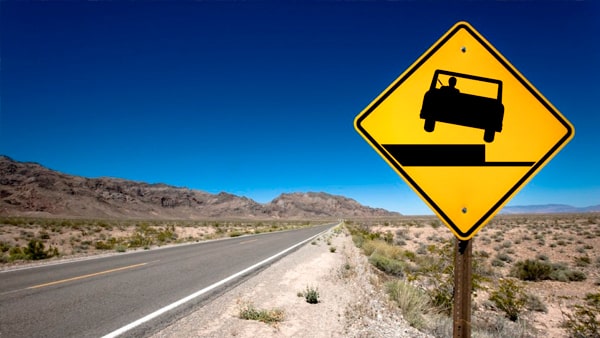
What should you be most concerned about when you see this sign?
  1. A Your headlights may shine at different heights
  2. B Your tires may immediately become flat
  3. C Water on the shoulder will always cause hydroplaning
  4. D You could lose control if your wheels leave the pavement

Correct answer: D – You could lose control if your wheels leave the pavement

A LOW SHOULDER warning indicates that the shoulder is below the level of the roadway. If your wheels leave the pavement, abrupt braking or steering could cause a loss of control. Reduce speed without hard braking, then carefully return to the pavement at a slow speed.

Source: Vermont Driver’s Manual — “Low Shoulders”

Question 2

How should you drive when fog, heavy rain, or snow severely reduces visibility?

  1. A Use low-beam headlights and reduce speed for the conditions
  2. B Maintain your usual speed to avoid being struck from behind
  3. C Switch repeatedly between high and low beams

Correct answer: A – Use low-beam headlights and reduce speed for the conditions

Low-beam headlights improve your vehicle’s visibility without producing the glare that high beams can create in fog. Reduce speed enough to remain able to stop within the distance you can see. Vermont law also requires a reasonable and prudent speed based on actual and potential hazards.

Source: 23 V.S.A. § 1081(a), (d) — Basic rule and maximum limits, Vermont Driver’s Manual — “Reduced Visibility”

Question 3

For how much distance must a turn signal generally remain on before a turn?

  1. A At least 50 feet
  2. B At least 100 feet
  3. C At least 300 feet
  4. D At least 400 feet

Correct answer: B – At least 100 feet

Vermont requires a turn signal to be given continuously for at least the final 100 feet before turning. The signal may be given with an approved vehicle signal or the appropriate hand signal. Signaling does not eliminate the driver’s responsibility to make the turn with reasonable safety.

Source: 23 V.S.A. § 1064(a), (b), (d) — Signals required; general obligation to turn and move safely

Question 4

Which U-turn would be permitted on a divided limited-access highway?

  1. A A turn across the physical median barrier
  2. B A turn near a curve with only 150 feet of visibility
  3. C A turn through an authorized median opening where it is not prohibited and visibility is adequate
  4. D A turn near a hillcrest with only 100 feet of visibility

Correct answer: C – A turn through an authorized median opening where it is not prohibited and visibility is adequate

A U-turn on a limited-access highway may be made only through an opening provided in the dividing curb, separation, or line. A U-turn is prohibited near a curve or hillcrest when the vehicle cannot be seen from both directions for 500 feet. Signs or other traffic-control devices may impose additional restrictions.

Source: 19 V.S.A. § 1711 — Unlawful use of limited access facilities, 23 V.S.A. § 1062 — Turning prohibited

Question 5

Which substances can impair a person’s ability to drive safely?

What kinds of drugs, other than alcohol, can affect your driving ability?
  1. A Cold or allergy medicine that causes drowsiness
  2. B Cannabis
  3. C A prescription medicine that affects alertness
  4. D All of these choices

Correct answer: D – All of these choices

Prescription medicines, over-the-counter products, and cannabis may affect alertness, judgment, coordination, or reaction time. Drivers should read medication warnings and avoid driving when a substance makes safe operation difficult. Vermont prohibits operating a vehicle while under the influence of any drug or a combination of alcohol and drugs.

Source: 23 V.S.A. § 1201(a)(3) — Operating vehicle under the influence of alcohol or other substance; criminal refusal; enhanced penalty for BAC of 0.16 or more, Vermont Driver’s Manual — “Other Drugs”

Question 6

According to the Vermont Driver’s Manual, what should you generally avoid doing at a solid double yellow centerline?

  1. A Making a lawful left turn when the way is clear
  2. B Entering a private driveway when safe
  3. C Passing another vehicle
  4. D Stopping for traffic ahead

Correct answer: C – Passing another vehicle

Double solid yellow lines separate lanes carrying traffic in opposite directions. The Vermont Driver’s Manual recommends that drivers not pass when there is one solid yellow line or two solid yellow lines. Posted no-passing signs and other passing restrictions must also be obeyed.

Source: Vermont Driver’s Manual — “Highway Markings”, 23 V.S.A. § 1036 — No-passing zones