


Vermont DMV Sign Test 4

5 out of 5 (33 votes)
80% Passing score
20 Questions
4 Mistakes allowed
A solid Vermont DMV signs practice test should do more than flash a few sign pictures at you. This one gives you 20 multiple-choice questions focused on road signs, sign shapes, colors, meanings, and the small distinctions that can trip people up when they have not looked at the material in a while. You need 16 correct answers to pass, and because the test is untimed, you can actually study the question in front of you instead of racing through it like the DMV is standing behind you with a stopwatch. It is a practice test, yes, but it works best when you treat it like a quick diagnostic: what do you know cold, what looks familiar-but-not-quite, and what needs another look before test day. That matters in Vermont because road sign knowledge sits inside the larger licensing process, not off in its own little corner. A learner permit is available at age 15, and applicants who are 15, 16, or 17 need parent or guardian permission unless they are emancipated. Once the online permit test is passed and the required fees are paid, a permit holder may drive in Vermont with a qualified, licensed, unimpaired supervising driver seated beside them. That supervisor may be a parent or guardian, a certified driver education instructor, or a licensed unimpaired adult at least 25 years old. And yes, the permit has to be carried while driving; it is a plain rule, but plain rules have a way of becoming important at exactly the wrong moment. For 16- and 17-year-olds, Vermont’s Graduated Driver’s License program adds more structure. Before a Junior Driver’s License, teens must complete an approved driver education course with 30 classroom hours, 6 hours behind the wheel, and 6 hours of observation. They also need 40 additional practice hours, including 10 at night. Adults have a more direct path: a valid learner permit, a road test appointment, a qualified accompanying driver, a legal insured vehicle with valid registration, and a passing road test. No teen driver education course, no 40-hour teen practice log. So, use this Vermont road signs test the practical way. Work through the questions, read the hints, review the explanations after missed answers, and pay attention to the signs you almost got right. Those are usually the ones worth studying twice.
FREE DMV Practice Test App
Study for your Vermont permit test or driver’s license with the NextDoorDriving app. 700+ DMV questions and answers, 100% free!
Download on the App Store

Sample Vermont Permit Test Questions

Question 1

What roadway feature does this T-shaped warning sign indicate?
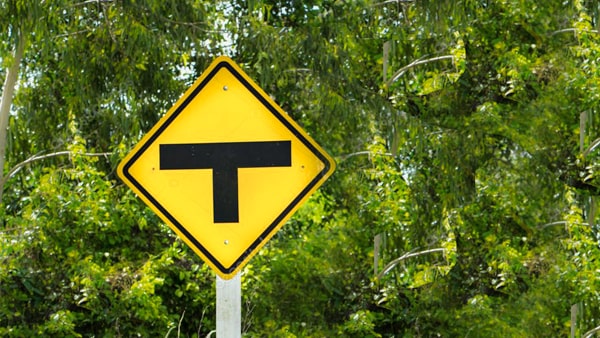
This sign shows one type of:
  1. A A required right turn
  2. B A T-intersection ahead
  3. C A lane shift
  4. D A reverse curve

Correct answer: B – A T-intersection ahead

This is the T-Intersection warning sign. It gives advance notice that the roadway approaches an intersection shaped like a T. Vermont uses the MUTCD as its standard for traffic-control signs, including intersection warning signs that depict the general roadway configuration.

Source: 23 V.S.A. § 1025 – Standards, Manual on Uniform Traffic Control Devices for Streets and Highways, 11th Edition with Revision 1 — § 2C.41, “Intersection Warning Signs (W2-1 through W2-8)”
Question 2

Which centerline marking prohibits passing by traffic in both directions?

  1. A One solid and one broken yellow line
  2. B A single broken yellow line
  3. C Two solid yellow lines
  4. D A single broken white line

Correct answer: C – Two solid yellow lines

Two solid yellow lines form a two-direction no-passing marking. Traffic traveling in either direction may not cross the centerline to pass. Vermont has adopted the MUTCD standards governing the meaning and use of these pavement markings.

Source: 23 V.S.A. § 1025 – Standards, Manual on Uniform Traffic Control Devices for Streets and Highways, 11th Edition with Revision 1 — § 3B.01, “Yellow Center Line Pavement Markings”, Manual on Uniform Traffic Control Devices for Streets and Highways, 11th Edition with Revision 1 — § 3B.03, “No-Passing Zone Pavement Markings”

Question 3

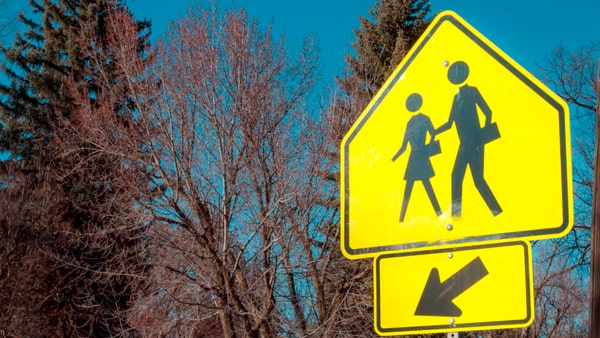
When paired with a diagonal downward arrow plaque, this pentagonal sign marks a:

This road sign means:
  1. A School crossing
  2. B Business district
  3. C Sidewalk-only area
  4. D Location where crossing is prohibited

Correct answer: A – School crossing

A School Crossing assembly consists of the pentagonal School sign and a diagonal downward-pointing arrow plaque. The assembly identifies a crossing adjacent to a school or located on an established school pedestrian route. It is installed at, or as close as possible to, the crossing.

Source: 23 V.S.A. § 1025 – Standards, Manual on Uniform Traffic Control Devices for Streets and Highways, 11th Edition with Revision 1 — § 7B.03, “School Crossing Signs”

Question 4

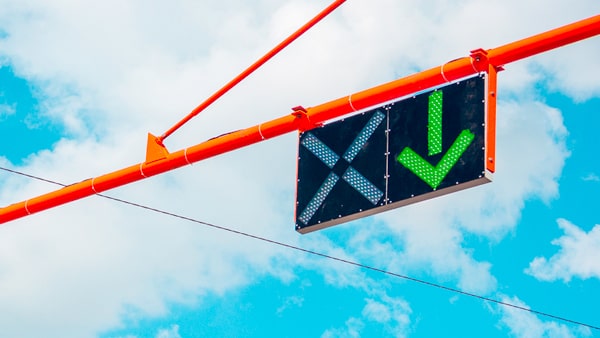
What does a steady downward green arrow above a traffic lane mean?

This green arrow on a lane use control signal means that:
  1. A The lane is open for travel in your direction
  2. B The lane is closed to all traffic
  3. C Traffic in the lane has priority at every intersection
  4. D Drivers must merge into the lane

Correct answer: A – The lane is open for travel in your direction

A downward green arrow on a lane-use control signal means the lane below the arrow is open to vehicle travel in that direction. It does not direct every driver to enter that lane or grant an unrestricted right-of-way. Vermont adopts the MUTCD standards governing these signals.

Source: 23 V.S.A. § 1025 – Standards, Manual on Uniform Traffic Control Devices for Streets and Highways, 11th Edition with Revision 1 — § 4T.02, “Meaning of Lane-Use Control Signal Indications”

Question 5

A yellow diamond warning sign shows two separated roadways joining as the median ends. Which sign is this?

  1. A Lane Ends
  2. B Divided Highway Ends
  3. C Two-Way Traffic
  4. D Turn Left or Right

Correct answer: B – Divided Highway Ends

The Divided Highway Ends sign warns that the physical median or other barrier separating opposing traffic will end ahead. Drivers will transition toward an undivided roadway where opposing traffic is no longer physically separated. The sign is distinct from the Divided Highway sign, which warns that a median begins ahead.

Source: 23 V.S.A. § 1025 – Standards, Manual on Uniform Traffic Control Devices for Streets and Highways, 11th Edition with Revision 1 — § 2C.21, “Divided Highway Ends Sign (W6-2)”

Question 6

On a one-way roadway or ramp, red pavement markers facing you indicate that you are:

  1. A Approaching a congested intersection
  2. B Near a stop sign
  3. C Traveling in a prohibited direction
  4. D Entering an ordinary no-passing zone

Correct answer: C – Traveling in a prohibited direction

Red raised pavement markers may face traffic approaching a one-way roadway, ramp, or lane from a prohibited direction. Seeing them directly ahead is a wrong-way warning. Vermont follows the MUTCD color standard under which these markers delineate travel areas that must not be entered from the direction where red is visible.

Source: 23 V.S.A. § 1025 – Standards, Manual on Uniform Traffic Control Devices for Streets and Highways, 11th Edition with Revision 1 — § 3A.03, “Colors”