Vermont Drivers Ed Practice Test 8

5 out of 5 (34 votes)
80% Passing score
20 Questions
4 Mistakes allowed
Vermont keeps the knowledge test compact, which is helpful, but compact does not mean casual. The official Vermont permit test is an online multiple-choice exam with 20 questions, each with four answer choices, and you need 16 correct answers to pass. That leaves room for only 4 misses. So the small stuff — who goes first at a four-way stop, when a left turn has to wait, what a driver should do when an intersection gets a little crowded and everyone is pretending they are being polite — starts to matter pretty quickly. This Vermont permit practice test is built around those exact kinds of decisions. It uses 20 multiple-choice questions to walk you through intersection rules, right-of-way situations, four-way stop procedures, roundabouts, and other everyday traffic moments that sound simple in the handbook and become less tidy on the road. There is no time limit, which is more useful than it sounds. You can slow down, read the wording properly, and actually work through the scene instead of guessing because one answer “feels DMV-ish,” whatever that means. For teen drivers, passing the Vermont DMV permit test is only the first official step. A learner permit is available at 15, but moving on to a Junior Driver’s License at 16 or 17 takes more than just aging into it. Vermont requires the permit to be held for at least 1 year, with a clean driving record for the 6 months before licensing. Driver education also has real numbers attached: 30 classroom hours, 6 hours behind the wheel, 6 observation hours, and another 40 hours of supervised practice, including 10 hours at night. Night driving, for this purpose, means from 30 minutes after sunset to 30 minutes before sunrise, which is oddly precise but worth knowing. The supervising-driver rule is another one people skim past too quickly. While you have a learner permit, you need a parent or guardian, a driver education instructor, or a licensed unimpaired adult who is at least 25 riding with you. Later, the Junior Driver’s License comes with its own passenger and employment-driving restrictions before the full license stage at 18. Use this Vermont DMV practice test as a rehearsal, not a trivia game. The goal is to recognize the rule inside the situation, answer with confidence, and avoid burning an official attempt when Vermont makes you wait at least one day after a failed knowledge test.
FREE DMV Practice Test App
Study for your Vermont permit test or driver’s license with the NextDoorDriving app. 700+ DMV questions and answers, 100% free!
Download on the App Store

Sample Vermont Permit Test Questions

Question 1

Which action best communicates an intended turn or lane change to other road users?

  1. A Activate the appropriate turn signal before moving
  2. B Wait for others to guess your intended movement
  3. C Use an unrelated lane to attract attention
  4. D Change direction without warning when traffic is light

Correct answer: A – Activate the appropriate turn signal before moving

Vermont law requires a driver to warn of an intended change in direction or a substantial reduction in speed. Turn signals are used to indicate turns, lane changes, and movement from a parked position. Signaling communicates intent, but it does not create the right-of-way; the movement must still be made with reasonable safety.

Source: 23 V.S.A. § 1064(a), (b), (e) – Signals required
Question 2

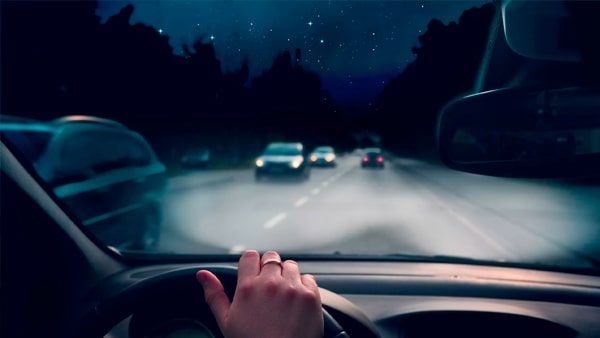
When following another vehicle at night, which headlights should you use?

When approaching another vehicle from the rear at night, you must dim your bright headlights within:
  1. A Parking lights only
  2. B High beams until the driver ahead signals you
  3. C Low beams
  4. D No headlights on a well-lighted road

Correct answer: C – Low beams

Use low-beam headlights when following another vehicle at night. The driver’s manual also directs motorists to dim promptly when meeting or following other traffic to avoid blinding another road user. High beams are intended for open areas with few other vehicles, not for close following.

Source: Vermont Driver’s Manual — Ch. 7, “Use High and Low Headlight Beams Properly.”

Question 3

Lighting or smoking a cigarette while driving is:

Preparing to smoke and smoking while driving:
  1. A Unrelated to driving performance
  2. B A reliable way to remain alert
  3. C A distracting activity
  4. D Safe whenever traffic is light

Correct answer: C – A distracting activity

The driver’s manual specifically identifies smoking as a distraction and advises drivers to avoid it while driving. Distractions can slow a driver’s response to traffic conditions and make hazards harder to recognize. Keep your attention on controlling the vehicle and observing the roadway.

Source: Vermont Driver’s Manual — Ch. 7, “Distracted Driving.”

Question 4

In which situation must you yield to an approaching vehicle from the opposite direction?

  1. A You are already circulating in a roundabout
  2. B You have already cleared the intersection
  3. C You are continuing straight
  4. D You intend to turn left across its path

Correct answer: D – You intend to turn left across its path

Vermont law requires a driver turning left at an intersection or into an alley, private road, or driveway to yield to an opposing vehicle that is already in the intersection or is close enough to be an immediate hazard. Wait until the turn can be completed without crossing dangerously in front of approaching traffic.

Source: 23 V.S.A. § 1047(a) – Vehicle turning left

Question 5

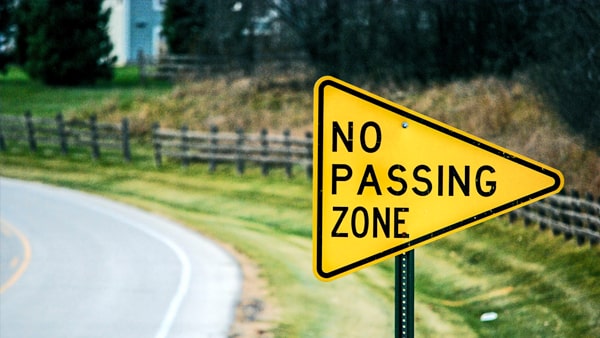
Which roadway restriction is identified by a yellow, pennant-shaped warning sign?

The sign with this shape and color is a _____________ sign.
  1. A A no-passing zone
  2. B A wrong-way roadway
  3. C A railroad crossing
  4. D A required stop

Correct answer: A – A no-passing zone

Vermont drivers can use a sign’s shape and color to help identify its meaning. A yellow pennant-shaped sign warns that a no-passing zone begins. Drivers must obey posted no-passing-zone signs even if they otherwise believe there is enough room to pass.

Source: Vermont Driver’s Manual — Ch. 7, “Road Signs”, 23 V.S.A. § 1036(a)–(b) – No-passing zones

Question 6

On a Vermont road, traffic ahead would leave your vehicle stopped across an intersection or crosswalk. What should you do?

  1. A Enter slowly and wait inside the intersection
  2. B Move close enough to prevent another vehicle from entering
  3. C Wait before entering until there is room to clear the area
  4. D Use your horn to make traffic move

Correct answer: C – Wait before entering until there is room to clear the area

Wait before entering until sufficient space is available beyond the intersection. The driver’s manual instructs motorists not to block a crosswalk while stopped or waiting to turn. State law also generally prohibits stopping within an intersection or on a crosswalk, subject to limited exceptions such as avoiding a traffic conflict or obeying an officer or traffic-control device.

Source: 23 V.S.A. § 1104(a)(1)(C)–(D) – Stopping prohibited, Vermont Driver’s Manual — Ch. 7, “Driver Responsibilities”