


Kentucky Road Signs Test

4.6 out of 5 (907 votes)
80% Passing score
10 Questions
2 Mistakes allowed
Kentucky’s permit test is not just a road sign quiz, even though the signs can absolutely trip people up if they only skim them once and call that studying. The written knowledge test for a Kentucky instruction permit is based on the Kentucky Driver Manual, which is the official source for the standard Class D Operator’s License. That means the test pulls from the full driver’s manual territory: traffic laws, rules of the road, safe driving procedures, highway signs, signals, pavement markings, sharing the road, impaired driving, and the basic equipment and safety habits Kentucky expects new drivers to understand. This KY permit practice test gives you a cleaner way to work through that material before you sit for the real thing. The actual Kentucky written permit test is multiple choice and is commonly reported as having 40 questions. You need an 80% to pass, which works out to 32 correct answers and no more than 8 missed. That little bit of math matters, because a few careless misses on signs, lane markings, or right-of-way rules can eat up your margin faster than you meant them to. Road signs deserve their own attention, even though Kentucky does not appear to publish a separate road-sign-only score in the official sources reviewed. Sign questions are folded into the written knowledge test, along with the rules and procedures questions. So when this Kentucky DMV practice test spends time on sign colors, shapes, regulatory signs, warning signs, guide signs, pavement markings, traffic signals, and lane markings, it is not wandering off topic. It is covering the stuff that tends to show up in small, specific ways. And Kentucky driving gives those details some real range. Rural highways may ask you to recognize warnings for curves, crossings, changing road conditions, and work zones. City driving brings its own clutter: one-way streets, pedestrian crossings, parking restrictions, lane-use signs, signals stacked over busy intersections. Different roads, same basic requirement: you need to recognize what the sign or marking is telling you quickly enough for it to matter. Use this KY driving test practice as a repeatable study tool, not a one-time confidence check. Missing questions here is useful, actually, because it shows you what to review before the testing office does. Kentucky allows applicants who fail the written test to return the next available day to retake it, but passing the first time is the cleaner plan.
FREE DMV Practice Test App
Study for your Kentucky permit test or driver’s license with the NextDoorDriving app. 700+ DMV questions and answers, 100% free!
Download on the App Store

Sample Kentucky Permit Test Questions

Question 1

What does a broken white lane line indicate?
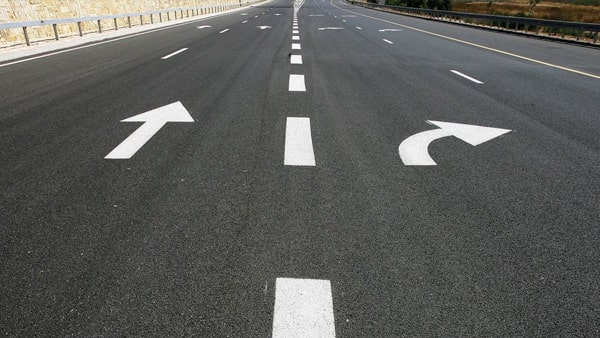
A broken white center line on the roadway means:
  1. A Turns are prohibited
  2. B A reduced-speed area begins
  3. C Passing is prohibited in both directions
  4. D You may change lanes when the movement can be made safely

Correct answer: D – You may change lanes when the movement can be made safely

A broken white line separates lanes of traffic moving in the same direction and permits drivers to cross when changing lanes. Before moving from the lane, the driver must determine that the movement can be made safely. Kentucky law also requires an appropriate signal before moving right or left on the roadway.

Source: KRS 189.340(7)(a) – Overtaking vehicles, bicycles, or electric low-speed scooters -- Traffic lanes -- Following vehicles -- Exemption for commercial motor vehicle platoon trailing vehicle, KRS 189.380(1) – Signals, Manual on Uniform Traffic Control Devices for Streets and Highways, 11th ed. § 3B.06, “White Lane Line Pavement Markings”
Question 2

If you see a curb painted yellow, what should you do before parking there?

  1. A Check signs or wording on the curb for the exact restriction
  2. B Assume parking is allowed only for buses
  3. C Assume the space is reserved for emergency vehicles
  4. D Treat it as an accessible parking space

Correct answer: A – Check signs or wording on the curb for the exact restriction

The Kentucky Driver Manual warns that painted curbs may prohibit or limit parking and directs drivers to check for restrictions. The MUTCD does not establish yellow as a statewide loading-zone color; local agencies may prescribe special curb colors. Read any posted sign or curb wording rather than assuming that a yellow curb automatically permits loading or unloading.

Source: Kentucky Driver Manual — Section Seven, “Parking”, 603 KAR 5:050 §§ 2–3 – Uniform traffic control devices, Manual on Uniform Traffic Control Devices for Streets and Highways, 11th ed. § 3B.18, “Curb Markings for Parking Regulations”

Question 3

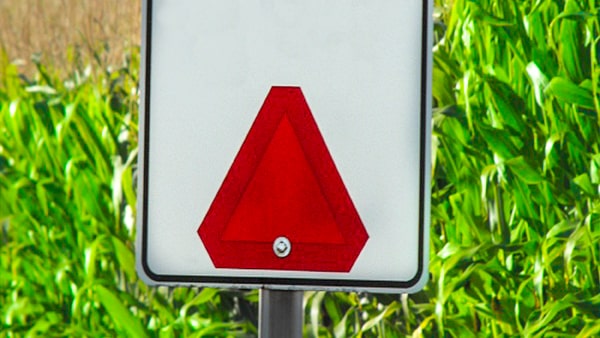
What does a fluorescent orange triangle with a reflective red border on the rear of a vehicle identify?

An orange and red sign of this shape always means:
  1. A A vehicle that must yield at every intersection
  2. B A vehicle carrying hazardous materials
  3. C A slow-moving vehicle
  4. D An emergency-response vehicle

Correct answer: C – A slow-moving vehicle

In Kentucky, this orange-and-red triangle identifies a vehicle traveling at less than 25 mph. It commonly appears on farm equipment, construction equipment, and animal-drawn vehicles. Approach cautiously and verify that passing is safe before attempting to go around the vehicle.

Source: KRS § 189.820 – Slow-moving vehicle emblem or reflective tape required -- Display -- Regulations for mounting emblem or reflective tape, Kentucky Driver Manual — § 10, “Slow-Moving Vehicles”

Question 4

On a two-way road with double solid yellow centerlines, which maneuver may still be permitted?

  1. A Turning left into a private driveway
  2. B Passing a slow motor vehicle
  3. C Using the center as a travel lane
  4. D Driving as though the road were one-way

Correct answer: A – Turning left into a private driveway

Double solid yellow lines indicate that passing is prohibited in both directions. They do not turn the center of the road into an uncrossable barrier for every lawful maneuver. A Kentucky driver may turn left into a driveway but must yield to oncoming traffic that is close enough to create an immediate hazard.

Source: KRS § 189.330(9) – Turning and right-of-way at intersections, Kentucky Driver Manual — § 6, “Pavement Markings—Yellow Lane Markings”

Question 5

At an intersection of two-way streets, what may you generally do after stopping at a steady red light?

  1. A Continue straight if no traffic is visible
  2. B Turn left onto the two-way street
  3. C Turn right after yielding, unless a sign prohibits it
  4. D Enter the intersection and wait there for green

Correct answer: C – Turn right after yielding, unless a sign prohibits it

Kentucky generally permits a right turn after a complete stop at a steady red signal unless an official sign prohibits the turn. Before turning, the driver must yield to pedestrians and other traffic lawfully using the intersection. A red signal does not permit proceeding straight through the intersection.

Source: KRS § 189.338(3)(a)1., (3)(b) – Limitation of colored lights used in traffic-control signals -- Rules for vehicular and pedestrian traffic controlled by traffic-control signals -- Affirmative defense for motorcyclists, Kentucky Driver Manual — § 6, “Traffic Signals”

Question 6

When passing another motor vehicle on a two-way road, which center marking prohibits passing in both directions?

  1. A A broken white line
  2. B Two solid yellow lines
  3. C A broken yellow line
  4. D A solid white line

Correct answer: B – Two solid yellow lines

Two solid yellow centerlines mark a no-passing zone for motor vehicles traveling in either direction. Kentucky requires drivers to obey clearly visible no-passing markings. State law provides a limited exception for passing a bicycle or electric low-speed scooter when the required clearance and safety conditions are satisfied and no other law prohibits crossing the center.

Source: KRS § 189.340(2)(b), (6) – Overtaking vehicles, bicycles, or electric low-speed scooters -- Traffic lanes -- Following vehicles -- Exemption for commercial motor vehicle platoon trailing vehicle, Kentucky Driver Manual — § 6, “Pavement Markings—Yellow Lane Markings”