


Louisiana DMV Practice Test 2

4.9 out of 5 (131 votes)
80% Passing score
20 Questions
4 Mistakes allowed
The Louisiana DMV written test is not trying to be charming, which is fine, because nobody goes to the OMV looking for charm. The Class E learner’s permit knowledge test is pulled from the Louisiana Class D & E Driver’s Guide, so the questions can wander through traffic laws, road signs, signals, pavement markings, safe driving habits, alcohol rules, emergencies, road sharing, vehicle requirements, and all the little driver-responsibility details that are easy to read once and immediately misplace in your brain. The official Class E knowledge test has 40 multiple-choice questions, and you need 80% to pass. That means 32 correct answers, with only 8 misses available before the day gets a lot more irritating than it needed to be. This Louisiana DMV practice test gives you a cleaner way to rehearse the material before you’re dealing with the real thing. It keeps the focus where it belongs: right-of-way, seat belts, signs and signals, safe driving choices, and Louisiana-specific rules that may not sound dramatic but absolutely show up when points are on the line. For teen drivers, the process usually starts with the Temporary Instructional Permit, better known as the TIP. And yes, that comes before the knowledge test, behind-the-wheel driver education, or the road skills test, because Louisiana likes a proper order of operations. A learner’s permit may be issued at age 15 after the required steps are handled, including the vision screening and knowledge test. Drivers who are 15 or 16 also move through the Graduated Licensing Program, so the permit stage is not just a cute little warm-up. It counts. Adults get a slightly different version of the maze. First-time applicants age 18 or older generally need either a 38-hour driver education course or a 6-hour pre-licensing course plus 8 hours behind the wheel, followed by the vision, knowledge, and road skills tests before a full Class E license is issued. Use this Louisiana DMV practice permit test as a place to make mistakes before those mistakes come with fluorescent lighting and an official score. It is not a replacement for approved driver education, and it is not pretending to be. But as a DMV learners permit practice test, it is a solid way to find the rules you know, the ones you almost know, and the ones you were absolutely about to guess on with dangerous confidence.
FREE DMV Practice Test App
Study for your Louisiana permit test or driver’s license with the NextDoorDriving app. 700+ DMV questions and answers, 100% free!
Download on the App Store

Sample Louisiana Permit Test Questions

Question 1

What effect does drinking coffee have on a person’s blood alcohol concentration?

  1. A It lowers the concentration
  2. B It neutralizes the alcohol
  3. C It does not reduce the concentration
  4. D It immediately increases the concentration

Correct answer: C – It does not reduce the concentration

Coffee does not lower blood alcohol concentration or make an impaired person sober. Exercise and cold showers are also ineffective for this purpose. Alcohol must be metabolized and eliminated by the body, and that process takes time.

Source: Louisiana Class D & E Driver’s Guide — Ch. 9, “Alcohol”
Question 2

At which driving speeds should safety belts be used?

  1. A Only above 40 mph
  2. B Only at low speeds
  3. C Only during city driving
  4. D At all speeds

Correct answer: D – At all speeds

Safety belts should be worn at every speed. Fatalities involving unbelted occupants have occurred in very low-speed crashes, and properly worn belts help prevent occupants from being thrown around or ejected. A short trip or low speed does not eliminate the need for restraint.

Source: Louisiana Class D & E Driver’s Guide — “Safety Belts Save Lives”

Question 3

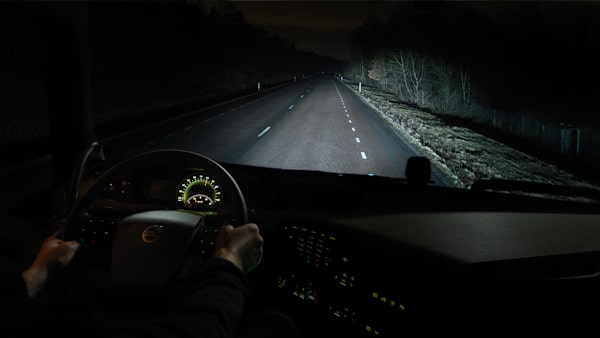
How should you control your speed on a dimly lit road at night?

  1. A Keep the instrument panel at maximum brightness
  2. B Look directly at approaching headlights
  3. C Drive slowly enough to stop within the distance illuminated ahead
  4. D Use high beams at all times

Correct answer: C – Drive slowly enough to stop within the distance illuminated ahead

Headlights limit how far you can see at night. Adjust your speed so you can stop within the portion of roadway illuminated ahead. High beams are not appropriate when approaching or closely following another vehicle, and looking directly into oncoming headlights can cause temporary blindness from glare.

Source: Louisiana Class D & E Driver’s Guide — “Night Driving”

Question 4

Which visual habit is unsafe while driving?

  1. A Sweeping the roadway with your eyes moving
  2. B Keeping your eyes fixed only on the pavement directly ahead
  3. C Looking at objects both near and far
  4. D Scanning to the left and right as you travel

Correct answer: B – Keeping your eyes fixed only on the pavement directly ahead

Fixing your gaze only on the roadway immediately ahead can cause you to miss hazards developing elsewhere. Keep your eyes moving and scan near and far as well as to both sides. A broad visual search gives you more time to identify changing traffic conditions and choose a safe response.

Source: Louisiana Class D & E Driver’s Guide — “SIPDE Process”

Question 5

At night, which hazard may require special attention because it can appear only as a dark shape near the roadway?

At night, it is hardest to see:
  1. A Reflective traffic signs
  2. B Pedestrians and other unlighted road users
  3. C Vehicles displaying working lights
  4. D Illuminated streetlights

Correct answer: B – Pedestrians and other unlighted road users

Headlights provide a much shorter range of visibility than daylight. Drivers should look well ahead for dark shapes and scan the roadway’s edges for hazards entering from the sides. Reducing speed provides more time to detect and respond to pedestrians or other unlighted road users.

Source: Louisiana Class D & E Driver’s Guide — “At Night”

Question 6

When may a driver cross double solid yellow centerlines?

  1. A To pass slower traffic traveling in the same direction
  2. B Only during daylight hours
  3. C Whenever no vehicle is immediately visible
  4. D To make a lawful turn when the movement can be made safely

Correct answer: D – To make a lawful turn when the movement can be made safely

The Louisiana guide states that double solid yellow centerlines may not be crossed to pass another vehicle. They may be crossed to make a turn. Before crossing the centerlines, the driver must determine that the turning movement can be made with reasonable safety.

Source: La. R.S. 32:104(A) – Turning movements and required signals, Louisiana Class D & E Driver’s Guide — Ch. 3, “Lane Markings—Center Lines”