Louisiana Road Signs Test 2

5 out of 5 (41 votes)
80% Passing score
20 Questions
4 Mistakes allowed
Louisiana road signs deserve a little more attention than most people give them, especially when a license renewal, permit step, or OMV visit is coming up and suddenly those familiar shapes and colors need to be answered in multiple-choice form. This Louisiana road signs practice test gives you a clean way to refresh what you already know, tighten up what you almost know, and catch the signs you have been mentally driving past for years without naming them. The test includes 20 multiple-choice questions, and you will need 16 correct answers to pass. It covers the usual suspects—stop, yield, speed, school zone, merging traffic—but it also gets into the warning signs, red prohibitive signs, and green guide signs that matter more than people admit. The point is not to make road signs feel complicated. They are not, mostly. The point is to make recognition quick, because on the road, you do not get much time to admire the sign and think it over like a museum label. Louisiana’s Class E testing process has a few moving parts, and this is where people sometimes get tripped up for reasons that have nothing to do with actual driving. Knowledge tests are usually taken on a computer in OMV offices, and proper identification is required each time you test. Some testing may also be handled through driver education providers, OMV locations, or approved third-party testers, depending on what you are doing. For the road skills test, Louisiana requires a score of at least 80 out of 100, with points deducted for missed maneuvers. Your vehicle also has to be licensed, inspected, insured, and safe to operate, with proof of insurance ready before the test begins. Basic stuff, yes, but basic stuff has a way of becoming very important at the counter. Louisiana also offers Class E knowledge testing through the automated K2D system in multiple languages, including English, Spanish, French, Arabic, Vietnamese, Korean, Portuguese, Italian, German, Farsi, and Cantonese. Oral exams may be available through the automated system, and interpreters may be permitted for certain non-CDL knowledge tests. Before applying for a Temporary Instructional Permit, first-time license, or REAL ID, bring original or certified documents. Photocopies are not accepted. Expect proof of identity, Louisiana residency, Social Security verification, and, for REAL ID, two separate proofs of residence. So yes, study the signs—but get your paperwork straight too.

FREE DMV Practice Test App
Study for your Louisiana permit test or driver’s license with the NextDoorDriving app. 700+ DMV questions and answers, 100% free!
Download on the App Store

Sample Louisiana Permit Test Questions

Question 1

Your light turns green while crossing traffic is still in the intersection. What should you do?

  1. A. Wait for the intersection to clear before entering
  2. B. Drive around the other vehicles if space appears available
  3. C. Enter and wait behind the crossing vehicles
  4. D. Sound the horn and proceed

Correct answer: A. – Wait for the intersection to clear before entering

A driver facing green must yield to vehicles and pedestrians lawfully within the intersection or adjacent crosswalk. The Louisiana guide instructs a stopped driver to allow crossing traffic to clear before proceeding when the light changes to green. Do not enter merely because your signal has changed.

Source: La. R.S. § 32:232(1)(a) – Traffic-control signals, Louisiana Class D & E Driver’s Guide — Ch. 3, “Traffic Signals”

Question 2

A curb painted yellow generally identifies:

  1. A. A loading zone or another parking restriction
  2. B. Parking reserved for buses only
  3. C. A fire zone reserved for emergency vehicles
  4. D. Accessible parking only

Correct answer: A. – A loading zone or another parking restriction

The Louisiana driver’s guide states that a yellow curb indicates a loading zone or some other restriction. The paint alone does not establish that unlimited parking is permitted. Drivers should follow any signs that specify who may stop there, the permitted purpose, or the applicable time limit.

Source: Louisiana Class D & E Driver’s Guide — Ch. 5, “Parking”

Question 3

You have stopped at a painted stop line, but your view of cross traffic is blocked. Before entering, what must you do?

  1. A. Wait five seconds and proceed
  2. B. Sound the horn and enter
  3. C. Listen for traffic without checking visually
  4. D. Check for traffic and pedestrians, yield, and enter only when safe

Correct answer: D. – Check for traffic and pedestrians, yield, and enter only when safe

The stop line marks the required place for the initial stop. After stopping, Louisiana law requires the driver to yield to vehicles already in the intersection or approaching closely enough to be an immediate hazard. Check carefully for traffic and pedestrians and do not enter until the required right-of-way can be given.

Source: La. R.S. § 32:123(B) – Stop signs and yield signs; penalties for violations, Louisiana Class D & E Driver’s Guide — Ch. 3, “Lane Markings”

Question 4

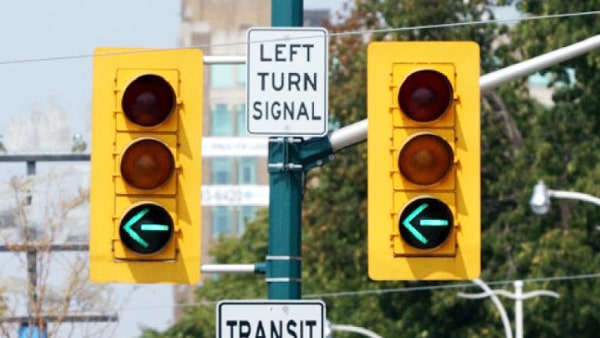
At an intersection, an illuminated green arrow pointing left permits you to:

On the intersection, if you see a green arrow pointing to the left, you can:
  1. A. Travel in any direction
  2. B. Make a cautious left turn after required yielding
  3. C. Turn left or continue straight regardless of other indications
  4. D. Turn only after all opposing signal heads become visible

Correct answer: B. – Make a cautious left turn after required yielding

A green arrow permits a driver to enter the intersection cautiously for the movement indicated by the arrow. Before turning, the driver must yield to pedestrians lawfully in an adjacent crosswalk and to other traffic lawfully using the intersection. The arrow does not permit unrelated movements unless another signal indication authorizes them.

Source: La. R.S. § 32:232(1)(b) – Traffic-control signals

Question 5

What should you do when a steady yellow arrow appears in a dedicated left-turn lane?

  1. A. Stop immediately regardless of your position
  2. B. Accelerate to enter the intersection before the signal changes
  3. C. Prepare to stop and obey the next signal indication
  4. D. Begin turning because all other roadway users must yield

Correct answer: C. – Prepare to stop and obey the next signal indication

A steady yellow arrow warns that the green arrow is ending. Prepare to stop and yield to oncoming traffic or pedestrians as required. Do not accelerate merely to enter before the next signal appears, and continue to follow the indication displayed for your lane.

Source: Louisiana Class D & E Driver’s Guide — Ch. 3, “Traffic Signals”

Question 6

A steady red signal displayed with a green arrow means you may:

  1. A. Proceed straight only
  2. B. Proceed only in the green arrow’s direction after required yielding
  3. C. Make no movement until the circular signal turns green
  4. D. Proceed in any direction if the intersection appears open

Correct answer: B. – Proceed only in the green arrow’s direction after required yielding

When a green arrow appears with another signal indication, a driver may cautiously make the movement shown by the arrow. The red signal continues to prohibit movements not otherwise permitted. The driver must still yield to lawful pedestrians and traffic within the intersection.

Source: La. R.S. § 32:232(1)(b), (3)(a)–(b) – Traffic-control signals