


Louisiana DMV Sign Test 4

5 out of 5 (43 votes)
80% Passing score
20 Questions
4 Mistakes allowed
Louisiana gives you 40 questions on the Class E knowledge test, and you need 32 correct to pass, which is the sort of math that sounds harmless until you realize eight misses is the whole cushion. This Louisiana road signs test keeps the focus on the part people love to “already know,” like signs, colors, shapes, symbols, all the little roadside instructions that seem obvious until they do not.   The practice test has 20 multiple-choice questions, built to give you a cleaner, less sweaty version of the real DMV sign test experience. Red signs are not gently suggesting things; they mean stop, yield, wrong way, do not enter, and other commands Louisiana would very much like you to obey. Green signs guide you along. Yellow signs warn you before the road does something irritating, dangerous, or both. And the shapes matter too, because the test may not always hand you a sign in the most generous, friendly wording possible. For new drivers, this is one slice of a bigger licensing process. A Temporary Instructional Permit can start at 14, while a learner’s permit starts at 15. If you’re under 18, Louisiana expects a 38-hour driver education course: 30 hours in class and 8 hours behind the wheel. Then comes the 180-day learner’s permit holding period, plus 50 supervised driving hours, including 15 at night. So, no, road signs are not the entire story. They are just one of the parts you can actually practice right now without gathering identity documents, checking whether you need two residence documents for REAL ID, or wondering why photocopies still do not count. They do not. Of course they do not. This Louisiana driving practice test gives you instant feedback after each answer, with explanations that do more than pat you on the head and move along. Miss a question, and you can see what went wrong while the mistake is still fresh. Finish the test, review your answers, and use it again before the real Louisiana permit practice test, license renewal, or DMV knowledge test. It is a practical way to clean up weak spots before they become expensive, inconvenient little surprises.
FREE DMV Practice Test App
Study for your Louisiana permit test or driver’s license with the NextDoorDriving app. 700+ DMV questions and answers, 100% free!
Download on the App Store

Sample Louisiana Permit Test Questions

Question 1

A black-and-white regulatory sign shows an arrow directing traffic to the right of an island or obstruction. Which instruction does it give?

  1. A. Divided Highway Ends
  2. B. Keep Right
  3. C. Sharp Left Turn
  4. D. Lane Ends

Correct answer: B. – Keep Right

The Keep Right sign directs vehicles to pass on the right-hand side of the indicated roadway feature or obstruction. It is commonly used near the approach end of a median, island, or similar divider. It is a regulatory instruction rather than a general warning about a curve or lane ending.

Source: Manual on Uniform Traffic Control Devices, 2009 ed., Revs. 1–3 — § 2B.32, “Keep Right and Keep Left Signs (R4-7, R4-8)”

Question 2

What color pavement lines separate traffic lanes moving in the same direction?

  1. A. Yellow
  2. B. White
  3. C. Red
  4. D. Black

Correct answer: B. – White

White lines separate lanes carrying traffic in the same direction. Dashed white lines may be crossed when it is safe, while a single solid white line indicates that changing lanes is hazardous and should be done only with great care. Crossing double solid white lines is prohibited.

Source: Class D & E Driver’s Guide — Ch. 3, “Lane Markings”

Question 3

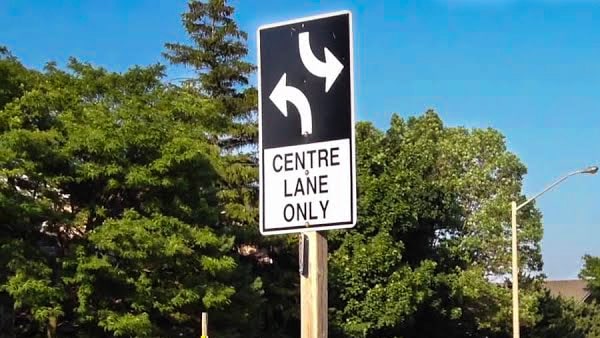
Which is a proper use of a two-way center left-turn lane?

From the center lane, what maneuvers can you perform?
  1. A. Preparing for or completing a left turn
  2. B. Passing a slower vehicle
  3. C. Traveling continuously between intersections
  4. D. Parking while waiting for traffic to clear

Correct answer: A. – Preparing for or completing a left turn

Louisiana defines a two-way left-turn lane as a center lane used by vehicles making left turns in either direction. The law permits no more than 200 feet of travel in that lane for specified left-turn or U-turn maneuvers. It is not a passing lane or a general through-traffic lane.

Source: La. R.S. 32:83(A)(3), (B) – Driving on highways with two-way left-turn lanes and dedicated left-turn lanes, Class D & E Driver’s Guide — Ch. 6, “Shared Center Left Turn Lane”

Question 4

What does an orange diamond sign showing a worker with a shovel indicate?

This sign means that:
  1. A. A volunteer group is collecting litter
  2. B. Workers are performing maintenance on or near the roadway ahead
  3. C. A children's play area is ahead
  4. D. A pedestrian crossing is ahead

Correct answer: B. – Workers are performing maintenance on or near the roadway ahead

The Workers Ahead sign warns that maintenance personnel are working on or near the roadway. Drivers should reduce speed and adjust their lane position away from the workers when directed and safe to do so. Orange is the basic color used for construction and maintenance warning devices.

Source: Class D & E Driver’s Guide — Ch. 3, “Construction and Maintenance Signs”

Question 5

Which category of traffic sign normally uses a diamond shape?

  1. A. Warning signs for approaching conditions or hazards
  2. B. Interstate route markers
  3. C. School crossing signs
  4. D. Speed limit signs

Correct answer: A. – Warning signs for approaching conditions or hazards

Diamond-shaped signs warn of approaching roadway conditions or hazards. Yellow diamonds are used for general warnings, while orange diamonds identify warnings in construction areas. Interstate markers, school signs, and speed limit signs use different shapes.

Source: Class D & E Driver’s Guide — Ch. 3, “Traffic Signs”

Question 6

After stopping at a steady red signal where both streets carry two-way traffic, which movement is generally permitted?

  1. A. Proceeding straight when the intersection appears clear
  2. B. Turning left after yielding to oncoming traffic
  3. C. Turning right unless a sign prohibits it, after yielding
  4. D. Making any movement if no vehicles are visible

Correct answer: C. – Turning right unless a sign prohibits it, after yielding

Louisiana generally permits a cautious right turn after a complete stop at a steady red signal unless a sign prohibits the turn. Before turning, the driver must yield to pedestrians lawfully within the adjacent crosswalk and to other traffic lawfully using the intersection. A left turn on red is limited to a one-way street entering another one-way street.

Source: La. R.S. 32:232(3)(a), (c) – Traffic-control signals