


Nebraska DMV Practice Test 2

5 out of 5 (38 votes)
80% Passing score
20 Questions
4 Mistakes allowed
Nebraska’s written test is based on the Nebraska Driver’s Manual, which sounds simple enough until you start sorting through permits, age rules, waivers, documents, vision checks, and all the little details that somehow matter at the DMV window. The real Nebraska knowledge test has 25 questions, and you need 20 correct answers to pass. That means an 80% score, with only 5 missed questions allowed. So a Nebraska DMV practice test is not just a warm-up. It is a pretty useful reality check. This free Nebraska DMV practice test helps you see how well you understand the material before you take the official DMV permit test. It covers the usual high-value topics: road signs, traffic signals, right-of-way rules, safe driving habits, pavement markings, and Nebraska licensing requirements. In other words, the things that look obvious when you read them slowly but get a little less obvious when they show up as multiple-choice questions. For teen drivers, the licensing path starts earlier than many people expect. A School Learner’s Permit, or LPE, may be issued at age 14 and is valid for 6 months. A School Permit can come at 14 years and 2 months. A Learner’s Permit, or LPD, starts at age 15 and is valid for 1 year. The Provisional Operator’s Permit, or POP, becomes available at 16, but not just because you had a birthday. Nebraska also looks at permit-holding time, driving record, and training. For a POP, applicants generally need to hold an LPE, SCP, or LPD for 6 months and have fewer than 3 points in the previous 6 months. They also need either a DMV-approved driver safety course or 50 hours of supervised driving, including 10 hours between sunset and sunrise. Once issued, the POP allows unsupervised driving from 6 a.m. to midnight, with tighter overnight limits. For the first 6 months, POP drivers may have no more than 1 non-immediate-family passenger under 19. Before testing or licensing, Nebraska also requires proof of identity, lawful status, Social Security number or exemption, 2 Nebraska address documents, and name-change documents when applicable. A vision screening is required too. Use this Nebraska learners permit practice test before the DMV gets to ask the questions first.
FREE DMV Practice Test App
Study for your Nebraska permit test or driver’s license with the NextDoorDriving app. 700+ DMV questions and answers, 100% free!
Download on the App Store

Sample Nebraska Permit Test Questions

Question 1

Under Nebraska law, when may you drive around, through, or under a railroad crossing gate that is closed or moving?

  1. A When no train is visible
  2. B When the gate is almost fully raised
  3. C When another vehicle has crossed safely
  4. D Never

Correct answer: D – Never

A driver may not go through, around, or under a railroad gate or barrier while it is closed or being opened or closed. A lowered gate is also one of the conditions requiring a stop between 15 and 50 feet from the nearest rail. Proceed only after the restriction has cleared and crossing can be completed safely.

Source: Neb. Rev. Stat. § 60-6,170(1)(b), (2) – Obedience to signal indicating approach of train or on-track equipment; prohibited acts
Question 2

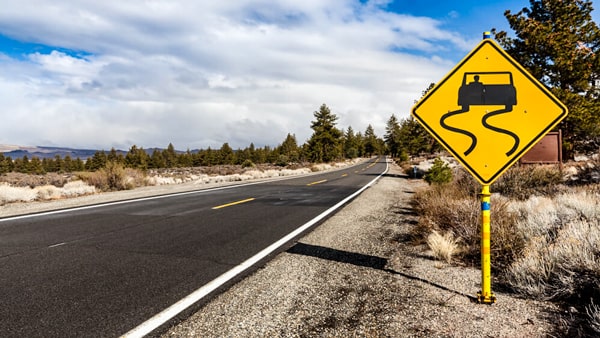
Which driving technique is safest when the roadway is slippery?

When roads are slippery, you should:
  1. A Look a shorter distance ahead
  2. B Stop on hills to test tire traction
  3. C Make speed and direction changes gradually
  4. D Use cruise control to maintain a constant speed

Correct answer: C – Make speed and direction changes gradually

Slippery pavement reduces the traction available for accelerating, braking, and turning. Reduce speed and make changes in speed or direction gradually. Increase your following distance and avoid cruise control when snow, ice, or other adverse conditions make the roadway slick.

Source: Neb. Rev. Stat. § 60-6,185 – Basic rule; speed, Nebraska Driver’s Manual — § 5C-5, “Snow and Ice”

Question 3

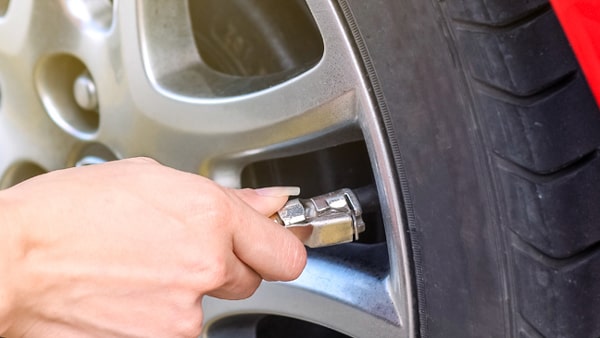
Improper tire pressure can contribute to which of the following?

If your tires are not inflated to the pressure recommended by the manufacturer, it may cause:
  1. A A greater risk of a heat-related blowout when tires are underinflated
  2. B Reduced traction when tires are overinflated
  3. C An increased risk of hydroplaning when tire pressure is low
  4. D All of the above

Correct answer: D – All of the above

Underinflation increases tire flexing and heat buildup, raising the chance of a blowout. Low pressure can also increase the likelihood of hydroplaning, while overinflation may reduce traction because less tread contacts the road. Use the pressure listed on the vehicle label or in the owner’s manual, not the maximum pressure printed on the tire sidewall.

Source: Nebraska Driver’s Manual — § 2N, “Tire Pressure/Tread Depth”, Nebraska Commercial Driver’s License Manual — § 2.6.2, “Hydroplaning”; § 11.5.2, “Tires”

Question 4

You face a green arrow displayed with a circular red light. What movement may you make?

  1. A Proceed only straight ahead
  2. B Proceed cautiously only in the direction allowed by the green arrow
  3. C Make any movement after stopping
  4. D Remain stopped regardless of the arrow

Correct answer: B – Proceed cautiously only in the direction allowed by the green arrow

In Nebraska, traffic facing a green arrow may cautiously enter the intersection to make the movement indicated by that arrow. The circular red signal continues to prohibit movements not authorized by the arrow. Drivers must yield to pedestrians lawfully in an adjacent crosswalk and to other traffic lawfully using the intersection.

Source: Neb. Rev. Stat. § 60-6,123(1)(b) – Traffic control signals; meaning; turns on red signal, when; signal not in service; effect

Question 5

In Nebraska, where is ordinary parking prohibited?

  1. A At a location where an official sign prohibits parking
  2. B Within 1,000 feet of a police station
  3. C Near any school while children are present
  4. D Along a curb with the wheels parallel to the roadway

Correct answer: A – At a location where an official sign prohibits parking

A vehicle may not be parked at a place where an official sign prohibits parking. The statutory parking restriction permits a temporary stop only while the driver is actually loading or unloading merchandise or passengers. Other signs may impose stricter restrictions against stopping or standing as well.

Source: Neb. Rev. Stat. § 60-6,166(1)(a)(ix), (b)(vi), (c)(ii) – Stopping, standing, or parking prohibited; exceptions

Question 6

What should you do when approaching a flashing yellow traffic signal?

  1. A Maintain speed without checking the intersection
  2. B Come to a complete stop before proceeding
  3. C Be alert and proceed with caution
  4. D Wait for the signal to display green

Correct answer: C – Be alert and proceed with caution

A flashing yellow signal tells drivers to be alert and proceed cautiously. It is commonly used to draw attention to a sign, intersection, or other location requiring extra care. Unlike a flashing red signal, it does not automatically require a complete stop.

Source: Nebraska Driver’s Manual — § 3A-1, “Color and Types,” “Flashing Yellow Light”