Nebraska Drivers Ed Practice Test 8

5 out of 5 (34 votes)
80% Passing score
20 Questions
4 Mistakes allowed
A good Nebraska permit practice test should feel a little like a rehearsal, not a guessing game dressed up as studying. This Nebraska learners permit practice test gives you 20 multiple-choice questions built around the material Nebraska drivers are expected to know before they get anywhere near the real road test: right-of-way, four-way stops, road signs, traffic signals, pavement markings, speed limits, parking rules, railroad crossings, and the small-but-important driving rules people tend to blur together when they only skim the manual. The real Nebraska knowledge test is based on the Nebraska Driver’s Manual, which covers Class O licenses, learner permits, school permits, and provisional operator permits. The actual Class O or learner permit knowledge test is commonly reported as 25 questions, with 20 correct answers needed to pass. That is an 80% score, which sounds manageable, sure, but it also means you do not have much room to wander off mentally or talk yourself into a wrong answer because the wording “basically seems right.” Five misses, and that cushion is gone. This Nebraska drivers ed practice test helps with that in a direct, practical way. After each question, you get immediate feedback, including an explanation of why the answer is correct. That is where the useful studying happens. Not in memorizing a DMV test cheat sheet, not in trying to outsmart the exam, and definitely not in collecting half-true shortcuts from the internet. The explanations slow the rule down just enough so it makes sense — who goes first at an intersection, what to do around a school bus, how to share the road with motorcycles, pedestrians, bicyclists, large trucks, and Nebraska’s snow-removal equipment, which, yes, deserves its own attention. A knowledge test may be required if you are applying for your first Nebraska license, cannot show a valid out-of-state license, or have a Nebraska license that has been expired for more than one year. So the smart move is fairly plain: use this free drivers ed practice test, read the Nebraska Driver’s Manual, and add road sign charts, flashcards, or an online drivers education course if your weak spots start showing. That way the DMV visit can be as painless as possible.

FREE DMV Practice Test App
Study for your Nebraska permit test or driver’s license with the NextDoorDriving app. 700+ DMV questions and answers, 100% free!
Download on the App Store

Sample Nebraska Permit Test Questions

Question 1

After passing another vehicle, when should you return to the right lane?

  1. A When the front of the passed vehicle is visible in your rearview mirror
  2. B As soon as you activate your turn signal
  3. C Immediately after moving ahead of its driver
  4. D When the other driver flashes the headlights

Correct answer: A – When the front of the passed vehicle is visible in your rearview mirror

The passing driver must not return to the right side of the roadway until safely clear of the overtaken vehicle. Seeing the front of that vehicle or its headlights in your rearview mirror is the manual's recommended clearance check. Signal and verify that the right lane is clear before moving back.

Source: Neb. Rev. Stat. § 60-6,133(1) – Overtaking and passing rules; vehicles proceeding in same direction, Nebraska Driver's Manual — § 4D-2, “How To Pass”

Question 2

Under Nebraska law, which lane should you use to turn left from one one-way street onto another?

  1. A The extreme left-hand lane available for traffic
  2. B Any lane if the intersection appears clear
  3. C The lane nearest the right-hand curb
  4. D Whichever lane has the fewest vehicles

Correct answer: A – The extreme left-hand lane available for traffic

A driver intending to turn left must approach in the extreme left-hand lane lawfully available. The turn should leave the intersection in the extreme left-hand lane available on the roadway being entered, as nearly as practicable. Follow any signs or pavement markings that direct a different turning path.

Source: Neb. Rev. Stat. § 60-6,159(2), (3) – Required position and method of turning; right-hand and left-hand turns; traffic control devices

Question 3

In Nebraska, what should you do when approaching a blind pedestrian using a white cane or guide dog?

When driving near a blind pedestrian who is carrying a white cane or using a guide dog, you should:
  1. A Stop until the pedestrian is safely clear of your path
  2. B Take the right-of-way if you arrived first
  3. C Continue at the same speed
  4. D Sound the horn and pass quickly

Correct answer: A – Stop until the pedestrian is safely clear of your path

Drivers approaching a pedestrian who is blind and using a predominantly white or metallic cane or a service animal must take all necessary precautions to avoid injury. The driver manual directs motorists to stop until the person is well away from the roadway or path of travel. Do not proceed merely because your vehicle arrived first.

Source: Neb. Rev. Stat. § 20-128 – Pedestrian using cane or service animal; driver of vehicle; duties; violation; damages, Nebraska Driver's Manual — § 4B-11, “Right-of-Way to Visually Impaired”

Question 4

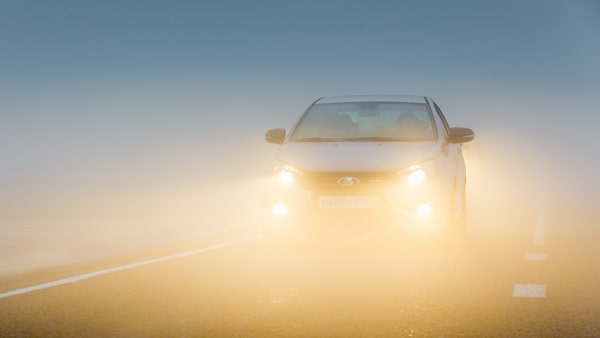
Which headlights should you use when driving in dense fog?

When it is very foggy, you should slow down and turn on your:
  1. A Low-beam headlights
  2. B High-beam headlights
  3. C Emergency flashers instead of headlights
  4. D Parking lights only

Correct answer: A – Low-beam headlights

Use low-beam headlights in fog and reduce your speed. Proceed with extreme caution because visibility and the distance available for responding to hazards are reduced. High beams are not the recommended setting for fog, and parking lights alone do not provide proper roadway illumination.

Source: Nebraska Driver's Manual — § 5C-3, “Fog”, Nebraska Driver's Manual — § 5B, “Driving at Night”

Question 5

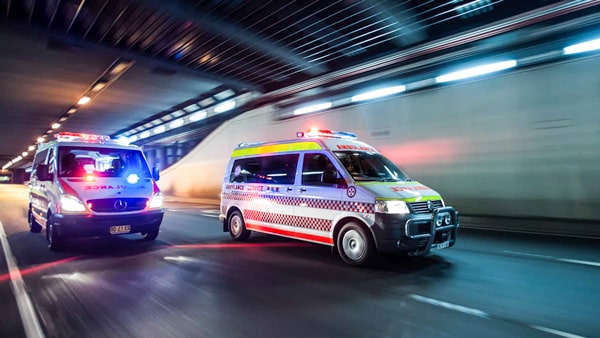
On a Nebraska two-way road, an emergency vehicle approaches with its siren or warning lights activated. You must:

When you hear the sirens or see the red emergency lights of a closely approaching emergency vehicle, you must:
  1. A Accelerate to remain ahead of it
  2. B Continue slowly in your lane
  3. C Pull near the right edge, clear of the intersection, and stop
  4. D Stop immediately inside the intersection

Correct answer: C – Pull near the right edge, clear of the intersection, and stop

Upon the immediate approach of an authorized emergency vehicle using proper audible or visual signals, yield the right-of-way. Move parallel and as close as possible to the right-hand edge or curb, stop clear of any intersection, and remain there until the emergency vehicle passes. A peace officer may direct you to act differently.

Source: Neb. Rev. Stat. § 60-6,151(1) – Operation of vehicles upon the approach of emergency vehicles

Question 6

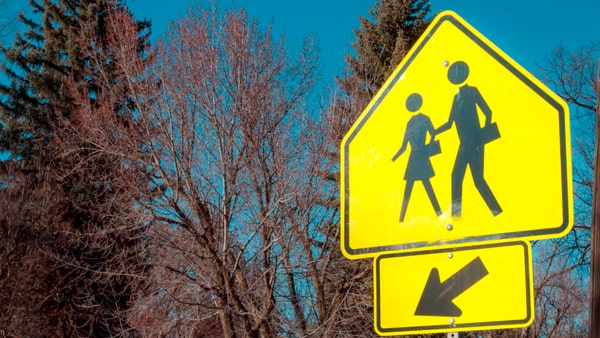
A pentagon-shaped sign showing schoolchildren warns of:

This road sign means:
  1. A A school area or school crossing
  2. B A nearby business district
  3. C A pedestrian-only sidewalk
  4. D A location where crossing is prohibited

Correct answer: A – A school area or school crossing

The five-sided sign shape identifies a school area or school crossing. A school advance crossing sign warns that a crosswalk used by schoolchildren is ahead, while a school crossing sign marks the crossing location. Watch for children and obey directions from school crossing guards.

Source: Nebraska Driver's Manual — § 3B-2, “Sign Shapes”, Nebraska Driver's Manual — § 3B-4, “Warning Signs”