New Hampshire DMV Practice Test

4.7 out of 5 (267 votes)
80% Passing score
20 Questions
4 Mistakes allowed
New Hampshire does one thing that catches plenty of new drivers off guard: it does not issue a standard learner’s permit for non-commercial first-time drivers. So, yes, you may still be practicing under the state’s supervised-driving rules before you ever sit for the license process itself, but the knowledge test becomes a real checkpoint. Not a decorative one. Not something to wander into after skimming signs for fifteen minutes and hoping the rest feels familiar. This NH DMV permit practice test is meant to give you a cleaner, calmer run at the material before the official test day. It covers the same broad territory you are expected to know from the New Hampshire Driver’s Manual: traffic laws, right-of-way, road signs, signals, pavement markings, safe driving practices, impaired driving rules, sharing the road, and the basic responsibilities that come with operating a vehicle. Some of it feels obvious until it gets buried in DMV wording, and some of it is just detail-heavy because, well, driving rules are detail-heavy. The official New Hampshire DMV knowledge test is taken in person on a computer-based touch-screen system. It has 40 multiple-choice questions, and you need 32 correct answers to pass. That is 80%, with room to miss up to 8 questions. There is also a time limit, and the system can automatically end the test if you run out of time or miss too many questions. So the goal here is not just to “see some questions.” It is to build enough recognition, enough rule memory, and enough patience with the wording that you are not figuring everything out for the first time at the DMV. This DMV knowledge test practice gives instant feedback as you go, which is where a lot of the actual learning happens. A wrong answer without an explanation is just a little insult on a screen; a wrong answer with a clear explanation is usable. You can see why the correct answer works, why the tempting answer does not, and which topics keep tripping you up. At the end, the performance summary pulls those misses together so you know what deserves another look before scheduling the real thing. New Hampshire licensing also includes a vision screening and, after the knowledge test, a road test appointment. For the vision test, applicants generally need to read the 20/40 line with both eyes, with glasses or contacts allowed if needed. And if the official knowledge test goes badly, you may have to wait at least 10 days before requesting a retest appointment. Better to find the rough spots here, quietly, before the touch screen starts keeping score.
FREE DMV Practice Test App
Study for your New Hampshire permit test or driver’s license with the NextDoorDriving app. 700+ DMV questions and answers, 100% free!
Download on the App Store

Sample New Hampshire Permit Test Questions

Question 1

Which statement about driving on a slippery roadway is correct?

  1. A. Wet pavement improves tire grip at lower speeds
  2. B. Normal dry-road stopping distance remains adequate
  3. C. Reduced traction makes stopping and turning more difficult
  4. D. Hydroplaning affects only large trucks

Correct answer: C. – Reduced traction makes stopping and turning more difficult

Tires do not grip a slippery roadway as well as they grip dry pavement. A vehicle will require more distance to stop and may be harder to turn without skidding. Reduce speed at the first sign of rain, snow, sleet, ice, or pooled water, and make steering and braking movements smoothly.

Source: New Hampshire Driver’s Manual — § 5, “Adjusting to Roadway Conditions”
Question 2

Why should you look well ahead and beyond the vehicle directly in front of you?

  1. A. To eliminate the need to check mirrors
  2. B. Because your eyes should remain fixed on one distant point
  3. C. To recognize potential hazards early

Correct answer: C. – To recognize potential hazards early

Looking well ahead helps identify traffic changes and other potential dangers before they become immediate problems. Drivers should look beyond the vehicle directly ahead while continuing to search the sides and check mirrors. Keeping the eyes moving provides a broader view and more time to change speed or position safely.

Source: New Hampshire Driver’s Manual — § 8, “Visual Search”

Question 3

During the first six months after licensing, which passenger situation is restricted for a New Hampshire driver under age 18?

  1. A. Driving with one passenger who is age 30
  2. B. Driving with passengers who are all family members
  3. C. Driving with more than one nonfamily passenger under 25 without a licensed responsible adult age 25 or older
  4. D. Driving with one nonfamily passenger under age 25

Correct answer: C. – Driving with more than one nonfamily passenger under 25 without a licensed responsible adult age 25 or older

During the first six months, a driver under 18 may not carry more than one passenger under 25 who is not a family member unless accompanied by a licensed responsible adult who is at least 25. A first violation may bring a fine of up to $100 and a suspension of up to 30 days. Subsequent violations may bring up to a $200 fine and a 90-day suspension.

Source: RSA 263:14, II(c), (d), (f) – Original and Youth Operators' Licenses

Question 4

When parking on a level, two-way New Hampshire roadway with an adjacent curb, how should the vehicle be positioned?

When you park on a level road next to a curb:
  1. A. With the right-hand wheels parallel and close to the right curb
  2. B. With the front wheels turned sharply toward the curb
  3. C. Without setting the parking brake if the transmission is in park
  4. D. With the left-hand wheels against the left curb

Correct answer: A. – With the right-hand wheels parallel and close to the right curb

The right-hand wheels must be parallel to the right-hand curb on a two-way roadway, and the driver’s manual directs drivers to park as close to the curb as possible. If the vehicle will be unattended, the driver must effectively set the brake in addition to completing the other required securing steps. Turning the front wheels toward the curb is specifically required when parked on a grade.

Source: RSA 265:71, I – Additional Parking Regulations, RSA 265:72, I – Unattended Vehicle, New Hampshire Driver’s Manual — § 6, “Parking”

Question 5

On a New Hampshire divided highway, when may a driver cross an intervening space or physical divider?

  1. A. Whenever opposing traffic is absent
  2. B. At an established opening, crossover, or intersection
  3. C. Whenever making a left turn into private property
  4. D. To pass a vehicle traveling below the speed limit

Correct answer: B. – At an established opening, crossover, or intersection

A vehicle generally may not be driven over, across, or within the space, barrier, or dividing section separating the roadways of a divided highway. Crossing is allowed through an established opening, crossover, or intersection, unless public authority specifically permits another movement. Treat the divider as a barrier rather than as a passing or turning lane.

Source: RSA 265:26, I – Driving on Divided Ways

Question 6

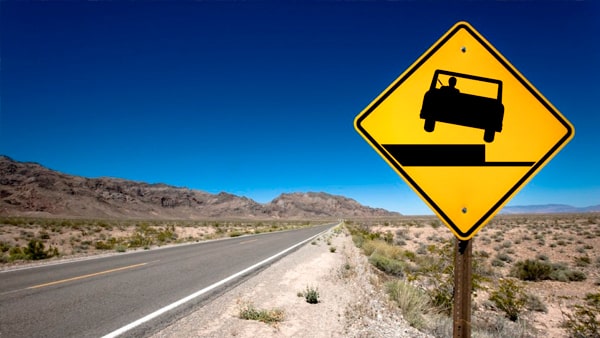
A yellow warning sign showing a vehicle’s right wheels dropping onto a lower shoulder warns primarily of:

What should you be most concerned about when you see this sign?
  1. A. Headlight misalignment caused by a crowned road
  2. B. A tire-repair area on the shoulder
  3. C. Standing water limited to the shoulder
  4. D. A possible loss of control if the vehicle leaves the pavement

Correct answer: D. – A possible loss of control if the vehicle leaves the pavement

The symbol warns that the shoulder is lower than the adjoining travel lane. If a vehicle’s wheels leave the pavement at that location, the difference in surface level can make vehicle control more difficult. Reduce speed as appropriate and maintain a steady position within the travel lane while passing the hazard.

Source: New Hampshire Driver’s Manual — § 6, “Warning Signs”