


New Hampshire DMV Practice 3

5 out of 5 (61 votes)
80% Passing score
20 Questions
4 Mistakes allowed
The NH DMV written test is not just a road sign pop quiz with a few obvious shapes tossed in for decoration. It is taken in person at the DMV, on a touch-screen monitor, and it is timed, which means the room has exactly the kind of quiet pressure nobody asked for. Miss too many questions or run out of time, and the test can end automatically. So yes, practicing ahead of time is the sensible move, even if it feels a little dramatic to study rectangles. This New Hampshire road signs test gives you 20 multiple-choice questions focused on sign shapes, meanings, and the clues drivers are supposed to pick up fast. A stop sign is octagonal. A yield sign is triangular. Rectangular signs usually deal with directions, traffic rules, or important road information that seems boring until you need it immediately. To pass this DMV practice test, you need at least 16 correct answers, or 80%, which is a decent measuring stick before you walk into the real NH DMV written test and discover how specific the state can be about things you thought you already knew. The point here is not to memorize a pile of random sign trivia and call it a day. It is to get comfortable with the way the questions are asked: read carefully, compare the answer choices, eliminate the nonsense, then choose the one that actually fits. That matters for the New Hampshire road signs permit test, but it also helps with the broader NH driving test practice process. Road sign recognition is part memory, part pattern recognition, and part not letting one weirdly phrased question knock you sideways. A few test-day details are worth keeping in the back of your mind. New Hampshire DMV testing is appointment-based, and applicants also need to pass a vision screening. Corrective lenses are allowed, but if you use them to pass, you are expected to wear them while driving. The knowledge test is offered in English, Spanish, French, Arabic, Mandarin, Portuguese, Farsi, and American Sign Language, with other interpreter options available at the Concord DMV. First-time applicants need proof of identity and residency, REAL ID applicants need the extra federal documentation, and drivers under 18 have additional paperwork, including driver education and parent or guardian authorization. This NH road sign test is not a cheat sheet, and honestly, that is a good thing. It is lawful, focused NH driving test practice built to make the real DMV screen feel less unfamiliar and a lot less frustrating.
FREE DMV Practice Test App
Study for your New Hampshire permit test or driver’s license with the NextDoorDriving app. 700+ DMV questions and answers, 100% free!
Download on the App Store

Sample New Hampshire Permit Test Questions

Question 1

Which sign warns that vehicles will be traveling in both directions ahead?

  1. A Lane-ends-ahead.jpg
  2. B Divided-highway-ends.jpg
  3. C Two-way-traffic-ahead.jpg
  4. D Turn-left-or-right.jpg

Correct answer: C – Two-way-traffic-ahead.jpg

The Two-Way Traffic sign warns that opposing vehicles use the roadway ahead. New Hampshire traffic-control standards provide for this sign where a divided or one-way roadway changes to a two-lane, two-way roadway. It may also appear along a two-way road as a reminder that traffic approaches from both directions.

Source: N.H. Admin. R. Tra 502.04(a)(3) – Highway Project Design Criteria, Manual on Uniform Traffic Control Devices, 2009 ed., Revs. 1–3 — § 2C.44, “Two-Way Traffic Sign (W6-3)”
Question 2

Under New Hampshire law, which is an allowed reason to cross an unbroken yellow centerline?

  1. A To overtake a slower motor vehicle
  2. B Only during daylight hours
  3. C Whenever no approaching traffic is visible
  4. D To enter or leave a side road or adjacent property

Correct answer: D – To enter or leave a side road or adjacent property

An unbroken center or barrier line generally may not be crossed from the driver's lane. RSA 265:22 permits crossing when necessary for access to or from a side road or property adjoining the highway. The law also lists limited exceptions for emergencies and certain other situations, but it does not generally allow crossing to pass another motor vehicle.

Source: RSA 265:22, I(a)–(e) – Highway Markings

Question 3

Which pictured sign requires traffic to pass to the right of an obstruction or island?

  1. A Divided-highway-ends.jpg
  2. B Keep-right.jpg
  3. C Sharp-left-turn.jpg
  4. D Lane-ends-ahead.jpg

Correct answer: B – Keep-right.jpg

The Keep Right sign directs vehicles to pass on the right-hand side of the indicated roadway feature or obstruction. It is commonly used near the approach end of a median, island, or similar divider. It is a regulatory instruction rather than a general warning about a curve or lane ending.

Source: N.H. Admin. R. Tra 502.04(a)(3) – Highway Project Design Criteria, Manual on Uniform Traffic Control Devices, 2009 ed., Revs. 1–3 — § 2B.32, “Keep Right and Keep Left Signs (R4-7, R4-8)”

Question 4

What color lines separate traffic lanes moving in the same direction?

  1. A Yellow
  2. B White
  3. C Red
  4. D Black

Correct answer: B – White

White lines divide lanes carrying traffic in the same direction. The New Hampshire manual explains that broken white lines may be crossed when it is safe, while solid white lines prohibit changing lanes or passing. Yellow lines generally separate traffic moving in opposite directions.

Source: New Hampshire Driver’s Manual — § 6, “Pavement Markings”

Question 5

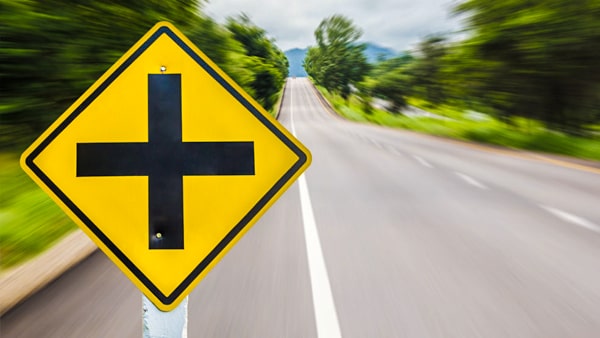
The pictured cross-shaped warning sign announces which roadway condition?

This sign shows one type of:
  1. A A crossroad intersection ahead
  2. B A series of roadway curves
  3. C A required right turn
  4. D A shift in the travel lane

Correct answer: A – A crossroad intersection ahead

A Cross Road warning sign indicates that another road intersects the driver's roadway ahead. Drivers should watch for vehicles that may enter, cross, or turn at the intersection. The sign warns of the intersection's configuration; it does not establish which driver has the right-of-way.

Source: N.H. Admin. R. Tra 502.04(a)(3) – Highway Project Design Criteria, Manual on Uniform Traffic Control Devices, 2009 ed., Revs. 1–3 — § 2C.46, “Intersection Warning Signs (W2-1 through W2-8)”

Question 6

In New Hampshire, which purpose is not an allowed exception for crossing a double solid yellow centerline?

  1. A Turning left into an adjacent driveway
  2. B Leaving property beside the highway
  3. C Passing a slower motor vehicle
  4. D Responding to an emergency

Correct answer: C – Passing a slower motor vehicle

An unbroken line in the driver's lane generally prohibits crossing for a routine pass of another motor vehicle. RSA 265:22 permits limited crossings for emergencies and for access to or from side roads or property adjoining the highway. It also contains narrow exceptions involving certain vulnerable road users and other specified circumstances.

Source: RSA 265:22, I(a)–(e) – Highway Markings