


New Hampshire DMV Practice 3

4.8 out of 5 (151 votes)
80% Passing score
20 Questions
4 Mistakes allowed
New Hampshire gives you plenty to remember before you ever get near the licensing counter, and some of it is the kind of detail that sounds simple once you know it, then suddenly matters a lot when it appears on the actual NH DMV written test. This third NH DMV practice test gives you a focused way to work through those details without turning the whole process into a memorization slog. The official New Hampshire knowledge test is computer-based and taken on a touch screen. It has 40 questions, and you need 32 correct answers to pass, which is 80%. That also means you can miss only 8. Miss too many, or run out of time, and the state requires a retake wait of at least 10 days. So, yes, this smaller 20-question DMV permit practice test is not the whole official exam, obviously, but it is built around the same passing standard: 16 correct answers, 80%, enough pressure to be useful without making every wrong answer feel like an event. You will see questions tied to New Hampshire driving laws, safe driving practices, and the local rules that are easy to nod along with until the exact wording shows up. NH’s hands-free law prohibits handheld device use while operating a vehicle. The Move Over law requires drivers, when safe, to shift lanes for emergency vehicles stopped along the roadside. Those are not just handbook decorations; they are the kind of rules the New Hampshire DMV permit test expects you to understand clearly, in plain terms. Teen drivers have their own set of requirements, and they are worth keeping straight. Supervised learning may begin at 15½, but the minimum license application age is 16. Drivers under 18 need approved driver education: 30 classroom hours, 10 hours behind the wheel with a certified instructor, 6 observation hours, and 40 additional supervised driving hours, including 10 at night. A Youth Operator License also comes with restrictions, including a 1:00 a.m. to 4:00 a.m. nighttime limit for drivers under 18 and, for the first 6 months, no more than one non-family passenger under 25 unless a licensed responsible adult at least 25 is along for the ride. Use this NH DMV test online as many times as needed. Review the answers, notice the details you keep missing, and get comfortable with the less flashy paperwork-and-requirements side too — the DSMV 450 application, proof of identity and residency, REAL ID Social Security documentation, vision screening, and the 20/40 acuity standard. It is practice, yes, but good practice should make the real appointment feel less like a guessing game.
FREE DMV Practice Test App
Study for your New Hampshire permit test or driver’s license with the NextDoorDriving app. 700+ DMV questions and answers, 100% free!
Download on the App Store

Sample New Hampshire Permit Test Questions

Question 1

Traffic beyond an intersection is stopped, and entering would leave your vehicle blocking the roadway. What should you do?

  1. A Enter if you have the right-of-way
  2. B Wait outside the intersection until there is enough room to clear it
  3. C Enter if cross traffic can drive around you
  4. D Enter if no vehicle is immediately behind you

Correct answer: B – Wait outside the intersection until there is enough room to clear it

New Hampshire prohibits stopping or parking in a manner that impedes or makes the roadway dangerous for others, except in specified circumstances such as avoiding a collision, obeying an authorized official, or experiencing a mechanical breakdown. If traffic prevents you from clearing an intersection, wait before entering. Your right-of-way does not permit you to stop where your vehicle would obstruct traffic.

Source: RSA 265:37-b, I – Avoidance of Lane Blockage
Question 2

Which statement about safety belts is correct?

  1. A They are useful only at highway speeds
  2. B Being thrown from a vehicle generally improves survival chances
  3. C They usually prevent escape from a vehicle after a crash
  4. D They greatly reduce the chance of injury or death in a crash

Correct answer: D – They greatly reduce the chance of injury or death in a crash

The official manual states that safety-belt use greatly decreases the chance of injury or death and helps prevent occupants from being thrown from the vehicle. Air bags supplement safety belts rather than replace them. New Hampshire requires passengers under 18 and drivers under 18 to be properly belted, subject to listed exceptions. Violations carry a $50 fine for a first offense and $100 for a later offense.

Source: RSA 265:107-a, I, I-a, III – Child Passenger Restraints Required, New Hampshire Driver’s Manual — § 4, “Using Safety Belts”

Question 3

If you plan to drink alcohol at a social event, which transportation plan best follows safe-driving guidance?

  1. A Drink coffee before driving home
  2. B Arrange for a person who will not drink alcohol to drive
  3. C Take a cold shower before driving
  4. D Stop drinking 30 minutes before leaving

Correct answer: B – Arrange for a person who will not drink alcohol to drive

The official manual advises against driving after consuming alcohol because impairment begins with the first drink. Coffee, cold showers, food, exercise, and fresh air do not counter alcohol’s effects. Riding with someone who has consumed no alcohol keeps the person who drank from operating the vehicle.

Source: New Hampshire Driver’s Manual — § 3, “Dangerous Driving”

Question 4

How should a driver respond to a flashing yellow traffic signal?

  1. A Merge into the nearest traffic lane
  2. B Slow down and proceed cautiously
  3. C Treat it only as a pedestrian warning
  4. D Come to a full stop before continuing

Correct answer: B – Slow down and proceed cautiously

In New Hampshire, a flashing yellow signal permits a driver to proceed through the intersection or past the signal only with caution. The driver’s manual instructs motorists to slow down and be prepared to stop for traffic entering the intersection. The flashing-signal statute does not apply at railroad grade crossings, which are governed by separate rules.

Source: RSA 265:12, I(b), II – Flashing Signals, New Hampshire Driver’s Manual — § 6, “Traffic Signals”

Question 5

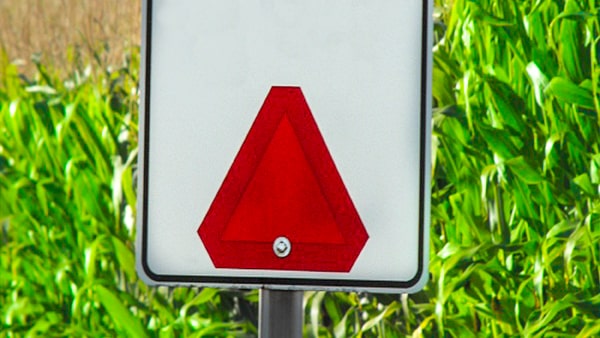
A fluorescent orange-and-red triangle displayed on the rear of a vehicle identifies a:

An orange and red sign of this shape always means:
  1. A Vehicle that must yield at every intersection
  2. B Vehicle that automatically has the right-of-way
  3. C Slow-moving vehicle
  4. D Vehicle responding to an emergency

Correct answer: C – Slow-moving vehicle

The orange-and-red triangle is a slow-moving vehicle emblem. The official manual explains that it may appear on animal-drawn vehicles, farm equipment, and construction equipment traveling at low speeds. Drivers should approach cautiously and verify that passing is safe. New Hampshire law requires tractors and animal-drawn vehicles operated on a way to display an approved emblem on the rear.

Source: RSA 266:46-a – Slow Moving Vehicle Emblems, New Hampshire Driver’s Manual — § 11, “Slow Moving Vehicles”

Question 6

An oncoming driver has not dimmed the vehicle’s high beams at night. Where should you direct your gaze?

  1. A At the other vehicle while flashing your high beams
  2. B Toward the right edge or fog line of the roadway
  3. C Straight into the oncoming headlights
  4. D Toward the left edge of the roadway

Correct answer: B – Toward the right edge or fog line of the roadway

Looking directly into high-beam headlights can cause glare and momentarily interfere with vision. The official manual recommends looking toward the right side of the road, such as the fog line or roadway edge, while continuing to track the road. Drivers should also dim their own high beams for approaching traffic.

Source: New Hampshire Driver’s Manual — § 5, “Night Driving”