New Hampshire DMV Practice 9

4.9 out of 5 (63 votes)
80% Passing score
20 Questions
4 Mistakes allowed
New Hampshire does licensing its own way, and that matters before you start treating the written test like a quick formality. For one thing, applicants under 18 do not get a learner permit here. They can begin supervised driving at 15½, but they must be at least 16 to apply for a driver license, and by then they are expected to have completed a New Hampshire-approved Driver Education Program, 40 extra hours of supervised driving, parent or guardian permission, and the required under-18 paperwork. It is a lot, yes. It is also the structure the state uses, so it is better to know it before appointment day instead of discovering it while holding the wrong folder of documents. This NH DMV practice test is aimed at the knowledge-test piece of that process, especially the rules around school buses, school zones, and pedestrians. Those are not throwaway topics. A stopped school bus, flashing lights, a narrow road, icy pavement, impatient traffic behind you—suddenly the “obvious” answer needs to be the legally correct one, not just the answer that feels polite or cautious. The practice written driving test gives you 20 questions, and you need 16 correct answers to pass, which is a clean way to measure whether you are actually ready for the New Hampshire DMV written test. First-time applicants need an appointment for the Driver License Knowledge Test and must bring a completed Driver License Application, proof of identity, proof of residency, and any other documents required for their license type. They also need to pass the vision, knowledge, and road tests. Adults 18 and older may apply for a New Hampshire Operator License without the under-18 driver education course or 40-hour driving log, though testing still applies unless a transfer or exemption covers it. And transfers have their own small print. New residents generally have 60 days after establishing residency to get a New Hampshire driver license. A valid out-of-state license usually means only a vision test, but if that license has been expired for more than one year, the vision, knowledge, and road tests return to the agenda. Use this 2026 New Hampshire written driving test practice as a focused rehearsal, not a magic shortcut. It helps you get comfortable with school bus rules and real NH driving conditions, from snowy northern roads to Manchester, Nashua, and Seacoast traffic, before the official test starts asking for precision.
FREE DMV Practice Test App
Study for your New Hampshire permit test or driver’s license with the NextDoorDriving app. 700+ DMV questions and answers, 100% free!
Download on the App Store

Sample New Hampshire Permit Test Questions

Question 1

When one yellow centerline is solid and the other is broken, when may you cross the lines to pass?

You may cross a double line to pass another vehicle if the line on your side is:
  1. A When the solid line is on your side
  2. B Whenever no vehicle is immediately behind you
  3. C When the broken line is on your side and the pass is otherwise lawful and safe
  4. D Only when both lines are solid

Correct answer: C – When the broken line is on your side and the pass is otherwise lawful and safe

A driver generally may not cross an unbroken centerline located on the driver’s side. A broken yellow line permits passing from that side when visibility, traffic, signs, and other passing rules allow it. In New Hampshire, unlawfully crossing an unbroken highway marking carries a $100 fine.

Source: RSA 265:22, I, II – Highway Markings, New Hampshire Driver’s Manual — “Traffic Signs, Signals and Road Markings,” “Pavement Markings”
Question 2

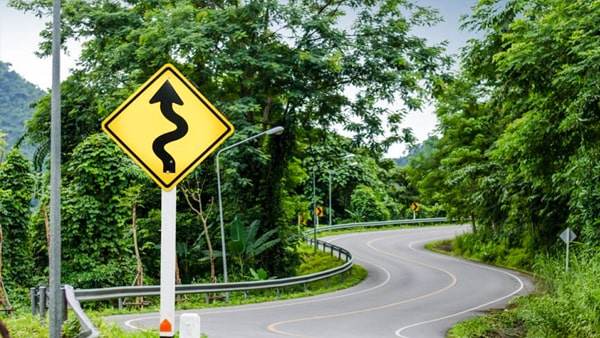
A yellow diamond sign displaying a winding arrow warns that:

This sign tells you that:
  1. A Turns are prohibited ahead
  2. B The roadway becomes narrower
  3. C A series of curves is ahead
  4. D The pavement is slippery only when wet

Correct answer: C – A series of curves is ahead

This warning sign indicates a curving or winding section of road ahead. Warning signs alert drivers to conditions that may require reduced speed or other preparation. Slow to an appropriate speed before entering the curves rather than braking sharply after a curve has begun.

Source: New Hampshire Driver’s Manual — “Traffic Signs, Signals and Road Markings,” “Examples of Warning Signs”, New Hampshire Driver’s Manual — “Adjusting to Roadway Conditions,” “Curves”

Question 3

Another vehicle has started passing you on the left. What should you do?

The car behind you begins to pass you. You should:
  1. A Increase speed to shorten the passing maneuver
  2. B Move left to prevent the vehicle from returning too soon
  3. C Stay in your lane and do not increase your speed
  4. D Stop immediately in your travel lane

Correct answer: C – Stay in your lane and do not increase your speed

New Hampshire law requires the overtaken driver to give way to the right when properly signaled and prohibits increasing speed until completely passed. The driver’s manual also directs drivers being passed to remain in their lane and maintain a constant speed. The passing driver remains responsible for passing at a safe distance and returning only when safely clear.

Source: RSA 265:18, I, II – Overtaking a Vehicle on the Left, New Hampshire Driver’s Manual — “Passing,” “When Being Passed”

Question 4

At 30 mph or less, what clearance is presumed reasonable when passing a bicyclist in New Hampshire?

When passing a bicyclist, you should:
  1. A At least 1 foot
  2. B At least 3 feet
  3. C Exactly half of a traffic lane
  4. D No minimum clearance if the horn is sounded

Correct answer: B – At least 3 feet

A driver must exercise due care and leave a reasonable and prudent distance when approaching a bicyclist. At 30 mph or less, at least 3 feet is presumed reasonable and prudent. One additional foot of clearance is required for every 10 mph above 30 mph.

Source: RSA 265:143-a – Drivers to Exercise Due Care When Approaching Bicycle

Question 5

Which visual-search habit best helps prevent sudden, last-minute maneuvers?

  1. A Watch only the vehicle directly ahead
  2. B Keep your attention fixed on the centerline
  3. C Look well ahead, beyond nearby vehicles, while continuing to scan
  4. D Check the road ahead only before changing lanes

Correct answer: C – Look well ahead, beyond nearby vehicles, while continuing to scan

Drivers should continually search ahead, to the sides, and behind their vehicle. Looking down the road and beyond vehicles directly ahead provides earlier notice of hazards and changing traffic. Keeping the eyes moving also prevents a fixed stare from hiding important information elsewhere around the vehicle.

Source: New Hampshire Driver’s Manual — § 8, “Visual Search”

Question 6

If your vehicle begins hydroplaning, what should you do?

  1. A Maintain speed until the tires regain contact
  2. B Apply the brakes firmly
  3. C Ease off the accelerator and avoid braking while the vehicle slows
  4. D Accelerate to push through the water

Correct answer: C – Ease off the accelerator and avoid braking while the vehicle slows

Hydroplaning occurs when tires ride on water and lose contact with the roadway. Ease off the accelerator and allow the vehicle to slow while the wheels turn freely; do not use the brakes to slow a hydroplaning vehicle. Reducing speed on wet roads and maintaining proper tire tread and inflation help prevent hydroplaning.

Source: New Hampshire Commercial Driver’s License Manual — § 2.6.2, “Speed and Road Surface”, New Hampshire Driver’s Manual — “Adjusting to Roadway Conditions,” “Hydroplaning”