


North Carolina DMV Permit Practice Test 6

4.9 out of 5 (579 votes)
80% Passing score
20 Questions
4 Mistakes allowed
Getting ready for the NC DMV permit test is one of those chores that starts out sounding harmless, almost cute, and then suddenly you are reading about road signs, supervised driving hours, school attendance rules, and whether you remembered to bring proof of your Social Security number. Fun little errand. Very normal. This North Carolina DMV permit practice test gives you 20 questions to work through before you walk into an NCDMV office and discover, in public, that “I sort of know what a turn signal is” may not be enough. It focuses on the stuff new drivers actually get tested on: traffic laws, safe driving, road signs, turn signals, and those small rule details that feel obvious until they are sitting in front of you as a multiple-choice question with two answers that both look annoyingly possible. The real North Carolina permit exam is taken in person, not online, and the written knowledge test has 25 multiple-choice questions. You need 20 correct answers to pass, which is 80%. There is also a road signs test, where you identify signs by color and shape and explain what they mean. You can miss no more than three on that part. Adult applicants also need to pass a vision test, because apparently the state wants to know you can both understand the rules and see the things you are about to drive toward. Bring your documents, too. Not “probably in my glove box somewhere” documents, actual documents: proof of identity and date of birth, proof of Social Security number, one proof of North Carolina residency, and the $25.50 permit fee. If you fail, you must wait 7 calendar days before retaking it, which is not forever, but it is long enough to be irritating. Teen drivers get a few extra hoops, naturally. If you are under 18, North Carolina’s Graduated Driver Licensing program starts at age 15 with the Level 1 Limited Learner Permit. You will need driver education, a Driver’s Education Certificate, a parent or guardian, and a Driving Eligibility Certificate from your school. That DEC is only valid for 30 days, and ten consecutive unexcused absences can trigger a 12-month license revocation. Yes, school attendance can mess with your driving plans. Sneaky little detail. So no, this NC DMV practice test is not a magic cheat sheet. It is better than that, honestly. It helps you get familiar with the DMV written test format, the permit test topics, and the North Carolina-specific rules before you are standing at the counter trying to look calm.
FREE DMV Practice Test App
Study for your North Carolina permit test or driver’s license with the NextDoorDriving app. 700+ DMV questions and answers, 100% free!
Download on the App Store

Sample North Carolina Permit Test Questions

Question 1

When turning right from one two-way street onto another, where should you complete the turn?

  1. A In the left lane
  2. B In the lane farthest from the right edge
  3. C As close as practicable to the right curb or roadway edge
  4. D In whichever lane has the least traffic

Correct answer: C – As close as practicable to the right curb or roadway edge

North Carolina requires both the approach and the right turn to be made as close as practicable to the right-hand curb or roadway edge. This normally places the vehicle in the rightmost available lane after the turn. Signs, markers, or other traffic-control devices may direct a different turning path at a particular intersection.

Source: G.S. 20-153(a), (c) – Turning at Intersections, North Carolina Driver Handbook — Ch. 4, “Turning”

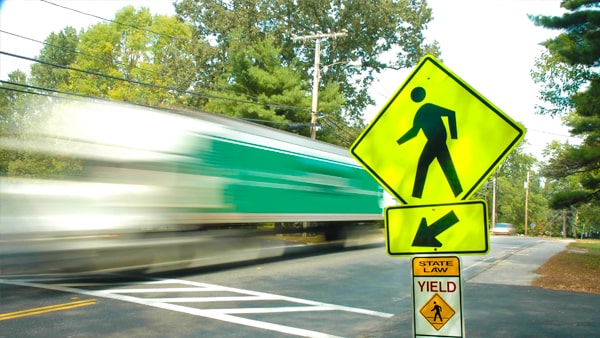
Question 2

Orange traffic signs and flags warn drivers about:

  1. A Permanent road closures only
  2. B Work zones, workers, or temporary roadway conditions
  3. C Ordinary speed-limit zones
  4. D High-occupancy vehicle lanes

Correct answer: B – Work zones, workers, or temporary roadway conditions

Orange signs identify highway construction, maintenance, or utility work zones. Their messages may warn about workers, flaggers, equipment, lane shifts, or other temporary conditions. Stay alert and be prepared to follow the instructions conveyed by signs, channelizing devices, and authorized flaggers.

Source: North Carolina Driver Handbook — Ch. 4, “Work Zones”

Question 3

At an uncontrolled crossing, a pedestrian who is blind extends a white cane or is accompanied by a guide dog. What must approaching drivers do?

  1. A Yield only if the crossing is at a street corner
  2. B Stop and remain stopped until the pedestrian completes the crossing
  3. C Proceed because the pedestrian must wait for traffic
  4. D Stop only if another pedestrian is assisting

Correct answer: B – Stop and remain stopped until the pedestrian completes the crossing

At an uncontrolled crossing in North Carolina, vehicles must come to a full stop when a blind or partially blind pedestrian gives the specified white-cane or guide-dog signal. Vehicles must remain stationary until the pedestrian completes the crossing. Failure to yield as required by this statute is a Class 2 misdemeanor.

Source: G.S. 20-175.2 – Right-of-Way at Crossings, Intersections and Traffic-Control Signal Points; White Cane or Guide Dog to Serve as Signal for the Blind

Question 4

Worn tire tread can:

Worn or bald tires:
  1. A Reduce traction and stopping ability
  2. B Increase the chance of hydroplaning
  3. C Make a tire legally unsafe when tread falls below the required depth
  4. D Cause all of these problems

Correct answer: D – Cause all of these problems

Worn tread reduces a tire’s grip and increases the chance of hydroplaning on wet pavement. North Carolina considers a passenger-vehicle tire unsafe when it has less than 2/32 inch of tread at two or more locations around its circumference in two adjacent major grooves. Tires with exposed cord, visible separation, or chunking are also unsafe.

Source: G.S. 20-122.1(a) – Motor Vehicles to Be Equipped with Safe Tires, North Carolina Driver Handbook — Ch. 4, “Tires”; “Hydroplaning”

Question 5

At an unsignalized marked midblock crosswalk, a driver must:

If a pedestrian is in a crosswalk in the middle of a block:
  1. A Yield to a pedestrian crossing within the crosswalk
  2. B Proceed because the pedestrian must always yield at midblock
  3. C Yield only when the pedestrian is a child
  4. D Sound the horn and continue through the crosswalk

Correct answer: A – Yield to a pedestrian crossing within the crosswalk

At an unsignalized marked crosswalk in North Carolina, a driver must yield to a pedestrian crossing the roadway, slowing or stopping if necessary. This differs from a person crossing at a midblock location outside a marked crosswalk, who generally must yield to roadway traffic. Drivers must still exercise due care to avoid every pedestrian.

Source: G.S. 20-173(a) – Pedestrians’ Right-of-Way at Crosswalks, G.S. 20-174(a), (e) – Crossing at Other Than Crosswalks; Walking Along Highway

Question 6

A vehicle without a qualifying disability credential:

  1. A May use a reserved space for less than five minutes
  2. B May stand in the space with its hazard lights on
  3. C May use the space when no other driver is waiting
  4. D May not park or be left standing in the reserved space

Correct answer: D – May not park or be left standing in the reserved space

North Carolina law prohibits parking or leaving a vehicle standing in a properly designated disability space without an authorized plate or placard. The same restriction applies to a clearly marked access aisle. A violation is an infraction carrying a penalty of at least $100 and no more than $250.

Source: G.S. 20-37.6(d)–(f) – Parking Privileges for Handicapped Drivers and Passengers