


North Carolina DMV Sign Test 4

4.8 out of 5 (1132 votes)
80% Passing score
20 Questions
4 Mistakes allowed
Getting ready for the NC DMV road signs test is one of those things that feels like it should be easy. You’ve seen stop signs. You know what yellow means, mostly. You have successfully existed near traffic before. And then the practice test asks about some oddly specific sign shape or a pavement marking you swear you’ve seen a thousand times but never, not once, properly thought about. So, yes — a little brushing up is probably a good idea. This North Carolina road signs permit test gives you 20 multiple-choice questions built around the signs and traffic control clues drivers actually need to understand, not just vaguely recognize while cruising past them at a questionable level of confidence. You’ll run into the familiar crowd: stop signs, yield signs, speed limit signs, lane merge warnings, hospital signs, route markers, and those helpful guide signs that quietly save you from taking the wrong exit and pretending it was intentional. The test also gets into the categories behind the signs, which sounds dry, and honestly, it kind of is — but it matters. Regulatory signs tell you what you’re required to do. Warning signs give you a heads-up before the road does something rude. Informational and guide signs help you find places, services, directions, and other useful things that are very nice to know before you’ve already passed them. Pavement markings and traffic signals belong in that same traffic-control universe too, so they’re not just decoration slapped onto asphalt for fun. Color matters as well. Red is the bossy one: stop, yield, do not enter. Yellow is the nervous friend warning you that something may be coming up. Green usually points you where you’re allowed to go. These basics are standardized across the country, which means North Carolina drivers are expected to know not only what a sign is, but what they’re supposed to do when it appears. This NC DMV signs practice test keeps things focused without turning into a full-blown lecture from someone holding a clipboard. If you get stuck, hints can give you a nudge, and missed answers come with explanations so the information has a better chance of sticking. You’ll need 16 correct answers out of 20 to pass, which is very doable — assuming the signs stop looking like abstract art at the worst possible moment.
FREE DMV Practice Test App
Study for your North Carolina permit test or driver’s license with the NextDoorDriving app. 700+ DMV questions and answers, 100% free!
Download on the App Store

Sample North Carolina Permit Test Questions

Question 1

A left-curve warning sign posted above a yellow “25 MPH” plaque means:
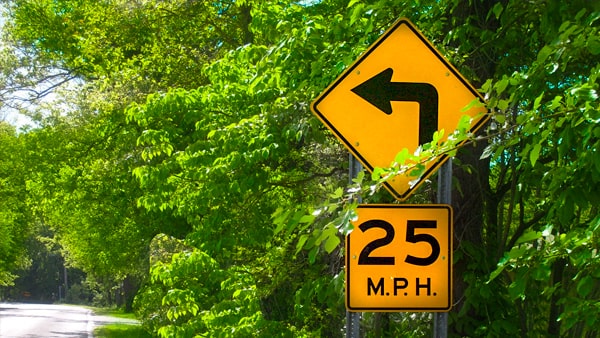
This sign means:
  1. A Curve left and maintain at least 25 mph
  2. B Curve right and maintain at least 25 mph
  3. C Curve right with an advisory speed of 25 mph
  4. D Curve left with an advisory speed of 25 mph

Correct answer: D – Curve left with an advisory speed of 25 mph

The upper sign warns that the roadway curves left, while the plaque provides a 25-mph advisory speed for that condition. It is not a minimum speed. Drivers must still travel at a reasonable and prudent speed, and weather, visibility, traffic, or pavement conditions may require a speed below the advisory value.

Source: G.S. 20-141(a), (c) – Speed Restrictions, North Carolina Driver Handbook — Ch. 5, “Warning Signs”; Ch. 4, “Rounding a Curve”
Question 2

Before entering an intersection on a solid green arrow, you must:

  1. A Check only the rearview mirror
  2. B Wait several seconds after the arrow appears
  3. C Enter cautiously and respect pedestrians or vehicles still entitled to use the intersection
  4. D Yield to vehicles but disregard pedestrians

Correct answer: C – Enter cautiously and respect pedestrians or vehicles still entitled to use the intersection

A solid green arrow permits a protected movement in the direction shown, but the driver must enter cautiously. In North Carolina, movement on a green indication remains subject to the rights of pedestrians and other vehicles provided by law. Follow the arrow and make sure the permitted path can be completed safely.

Source: G.S. 20-158(b)(2a) – Vehicle Control Signs and Signals, North Carolina Driver Handbook — Ch. 5, “Traffic Signals”

Question 3

What does a solid green arrow controlling a dedicated turn lane permit?

  1. A A turn in either direction
  2. B A protected movement in the arrow’s direction, entered cautiously
  3. C Straight travel through the intersection from the turn lane
  4. D A turn without observing the intersection

Correct answer: B – A protected movement in the arrow’s direction, entered cautiously

A solid green arrow indicates a protected movement in the direction shown. A driver may cautiously enter the intersection and complete that movement. The arrow does not authorize travel in another direction or eliminate the driver’s responsibility to observe the intersection before proceeding.

Source: North Carolina Driver Handbook — Ch. 5, “Traffic Signals”

Question 4

A steady yellow arrow appears while you are approaching a left turn. What should you do?

  1. A Stop immediately even if you cannot stop safely
  2. B Accelerate before the arrow changes
  3. C Prepare to stop and obey the signal that appears next
  4. D Treat it as a flashing yellow arrow

Correct answer: C – Prepare to stop and obey the signal that appears next

A steady yellow arrow warns that the related protected green phase is ending or that a red indication is about to appear. North Carolina’s handbook directs drivers facing a solid yellow arrow to prepare to stop. Do not accelerate in an attempt to enter the intersection before the signal changes.

Source: G.S. 20-158(b)(2a) – Vehicle Control Signs and Signals, North Carolina Driver Handbook — Ch. 5, “Traffic Signals”

Question 5

A red-and-white DO NOT ENTER sign means:

This red and white sign means:
  1. A Enter only after yielding to other traffic
  2. B The roadway is closed to traffic in every direction
  3. C U-turns are prohibited, but entry is allowed
  4. D Traffic may not enter from your direction

Correct answer: D – Traffic may not enter from your direction

DO NOT ENTER is a regulatory sign prohibiting traffic from entering a roadway or ramp from that approach. It is commonly used to prevent entry into the opposing direction of a one-way or divided roadway. Choose another lawful route rather than passing the sign.

Source: North Carolina Driver Handbook — Ch. 5, “Regulatory Signs”

Question 6

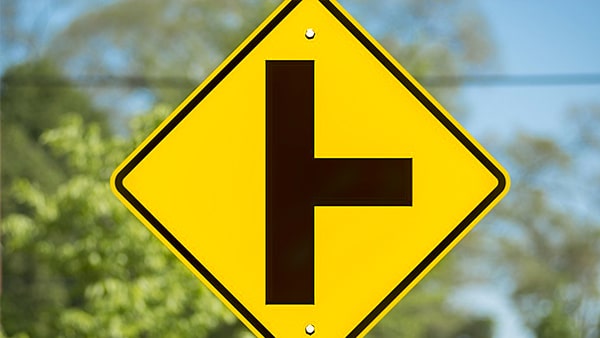
A yellow diamond sign showing a short road joining from the right warns of:

This sign means:
  1. A A required right turn
  2. B A side road entering from the right
  3. C A straight-ahead-only lane
  4. D A prohibited right turn

Correct answer: B – A side road entering from the right

The side-road warning sign tells you that another roadway joins the highway from the direction shown by the symbol. Watch for vehicles entering or leaving near the junction. Unlike a regulatory turn sign, it does not require you to turn or prohibit a movement.

Source: North Carolina Driver Handbook — Ch. 5, “Warning Signs”