


North Carolina Road Signs Test 2

4.8 out of 5 (496 votes)
80% Passing score
20 Questions
4 Mistakes allowed
If you’re getting ready for a North Carolina driver’s license renewal, this is probably the part where road signs suddenly start feeling more important than they have any right to feel. Funny how that happens. You see them every day, barely think about them, and then the DMV gets involved and suddenly a yellow diamond or an oddly specific highway marker feels like it has personally challenged you. This NC road sign practice test gives you 20 multiple-choice questions built around the signs North Carolina drivers are expected to know — not just the obvious “please stop before causing chaos” ones, but the shapes, colors, and meanings that show up on the actual road signs test. The real test expects applicants to identify signs by color and shape and explain what they mean, which sounds very reasonable until two signs start looking suspiciously similar. And yes, that is usually when the second-guessing begins. The North Carolina permit exam includes more than just road signs, too. There is a written knowledge test with 25 multiple-choice questions covering traffic laws and safe driving, and you need 20 correct answers to pass. That is an 80% passing score, for anyone who enjoys DMV math. There is no time limit, thankfully, so you can read the questions like a calm and responsible adult instead of a person trying to defuse a tiny bureaucratic bomb. The separate road signs test is a little less forgiving: applicants may miss no more than 3 questions. That is where this North Carolina DMV practice test earns its keep. You can take it more than once, miss a few, grumble quietly, review the explanations, and then take it again with slightly less grumbling. The questions are meant to help you recognize signs faster and understand what they are actually telling you, whether you are driving through Charlotte, Raleigh, Asheville, Wilmington, or one of those stretches of road where the scenery is lovely but the signage still expects you to be paying attention. Work through this NC road sign recognition test a few times and you should feel less rusty, less surprised, and generally less at the mercy of whatever sign-shaped nonsense the DMV decides to put in front of you.
FREE DMV Practice Test App
Study for your North Carolina permit test or driver’s license with the NextDoorDriving app. 700+ DMV questions and answers, 100% free!
Download on the App Store

Sample North Carolina Permit Test Questions

Question 1

What is the standard top-to-bottom order of a vertical traffic signal?

From top to bottom, the following is the proper order for traffic lights:
  1. A Red, yellow, green
  2. B Red, green, yellow
  3. C Green, red, yellow
  4. D Green, yellow, red

Correct answer: A – Red, yellow, green

A standard vertical traffic signal displays red at the top, yellow in the middle, and green at the bottom. North Carolina law specifically requires the red light on a vertically arranged signal face to appear above the yellow and green lights. On a horizontal signal, red appears to their left.

Source: G.S. 20-158(a)(3) – Vehicle control signs and signals, North Carolina Driver Handbook — Ch. 5, “Traffic Signals”
Question 2

Your signal turns green. Before entering the intersection, what must you verify?

  1. A You can proceed cautiously without conflicting with traffic or pedestrians
  2. B Every cross-traffic vehicle stopped before your light changed
  3. C Pedestrians will remain on the curb until you pass
  4. D You can accelerate immediately through the intersection

Correct answer: A – You can proceed cautiously without conflicting with traffic or pedestrians

A green signal is permission to proceed cautiously, not an unconditional command to enter. North Carolina law makes green-signal movement subject to the rights of pedestrians and other vehicles. Check the intersection and avoid entering when another road user is still in your path or otherwise has the right-of-way.

Source: G.S. 20-158(b)(2a) – Vehicle control signs and signals, North Carolina Driver Handbook — Ch. 4, “Interchanges, Intersections, Roads, Streets and Highways”

Question 3

You may not cross which centerline to pass another car in either direction?

  1. A A solid yellow line beside a broken yellow line
  2. B A single broken yellow line
  3. C Two solid yellow lines
  4. D A single broken white line

Correct answer: C – Two solid yellow lines

In North Carolina, continuous double solid yellow centerlines may not be crossed to pass another car in either direction. State law prohibits passing where official markings indicate that passing should not be attempted. A limited statutory exception can apply when passing a bicycle or moped under specified conditions, but it does not authorize passing another car.

Source: G.S. 20-150(e)(1)–(5) – Limitations on privilege of overtaking and passing, North Carolina Driver Handbook — Ch. 5, “Pavement Markings”

Question 4

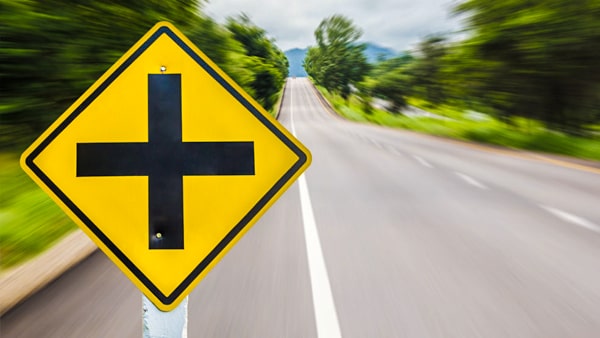
A yellow diamond sign displaying a black cross warns of:

This sign shows one type of:
  1. A A crossroad intersection ahead
  2. B A series of roadway curves
  3. C A mandatory right turn
  4. D A lane shift

Correct answer: A – A crossroad intersection ahead

This is the Cross Road warning sign. It indicates that another roadway crosses the one on which you are traveling. Watch for cross traffic and for any signs or signals controlling the upcoming intersection.

Source: North Carolina Driver Handbook — Ch. 5, “Warning Signs”

Question 5

You plan to turn left on green, but approaching traffic is close enough to create a hazard. What must you do?

  1. A Continue to the next intersection
  2. B Wait with your vehicle blocking the crosswalk
  3. C Yield and wait until the turn can be made safely
  4. D Turn first because your signal is green

Correct answer: C – Yield and wait until the turn can be made safely

North Carolina law requires a driver turning left to yield to an oncoming vehicle that is already in the intersection or close enough to constitute an immediate hazard. A green signal does not give the left-turning driver priority over such traffic. Wait until the required yield has been made and the turn can be completed safely.

Source: G.S. 20-155(b) – Right-of-way, North Carolina Driver Handbook — Ch. 4, “Interchanges, Intersections, Roads, Streets and Highways”

Question 6

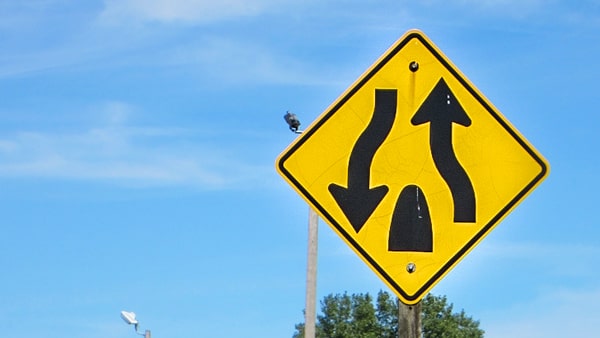
A yellow warning sign showing the center divider coming to an end means:

This sign means:
  1. A A turn is required at the next intersection
  2. B The divided highway ends ahead
  3. C A one-way roadway begins ahead
  4. D The roadway is closed ahead

Correct answer: B – The divided highway ends ahead

The Divided Highway Ends sign warns that the median separating opposing traffic will end ahead. After the transition, traffic traveling in opposite directions will share an undivided roadway. Stay on the correct side of the centerline as you pass through the change.

Source: North Carolina Driver Handbook — Ch. 5, “Warning Signs”