North Carolina DMV Practice Test 3

4.9 out of 5 (1215 votes)
80% Passing score
20 Questions
4 Mistakes allowed
Studying for the North Carolina DMV permit test is one of those things that sounds simple until you realize NC has its own little maze of rules, certificates, time limits, passenger limits, and yes, the occasional “wait, school attendance affects my license?” moment. So this NC permit practice test is here to make that whole process feel a little less like decoding paperwork under bad fluorescent lighting. This DMV practice test gives you 20 questions, with 16 correct answers needed to pass, which is a pretty tidy way to see how ready you are before the real DMV test starts breathing down your neck. The questions cover the usual suspects — traffic laws, road signs, safe driving habits, the knowledge test, the signs test, and North Carolina-specific licensing rules — but the useful bit is what happens after you answer. You get immediate feedback with explanations, so instead of just being told “wrong,” which is rude but efficient, you find out why the correct answer actually makes sense. For teen drivers, the NC Graduated Driver Licensing program deserves some attention, because it is not exactly a one-and-done situation. Level 1, the Limited Learner Permit, starts at age 15 and requires driver education. You can drive only from 5 AM to 9 PM, and a supervising licensed driver with at least 5 years of driving experience has to sit beside you. Cozy. After holding Level 1 for at least 9 months, logging 60 supervised driving hours, including 10 at night, and passing a road test at age 16, you can move toward Level 2. That Limited Provisional License allows unsupervised driving from 5 AM to 9 PM, with 1 passenger under age 21. Then, after 6 clean months, Level 3 removes the time-of-day restrictions. Cell phone use, meanwhile, is banned at all three GDL levels, so maybe leave the “just checking something real quick” routine alone. There is also the Driving Eligibility Certificate, or DEC, for drivers under 18. It comes from your school, proves satisfactory attendance, lasts only 30 days, and has to be renewed. Ten consecutive unexcused absences can trigger a 12-month license revocation, which is a wildly serious consequence for skipping class, but here we are. Adult applicants get a more direct route: no driver education requirement, just the knowledge test, signs test, and vision test at an NCDMV office. At 18, eligible drivers can upgrade to a regular Class C license online. Use this North Carolina practice permit test as a low-stakes way to catch the rules you know, the rules you sort of know, and the rules you absolutely thought were made up.

FREE DMV Practice Test App
Study for your North Carolina permit test or driver’s license with the NextDoorDriving app. 700+ DMV questions and answers, 100% free!
Download on the App Store

Sample North Carolina Permit Test Questions

Question 1

On a controlled-access highway, where may a driver make a U-turn if the maneuver is otherwise safe and permitted?

  1. A Across any paved median area
  2. B Within 150 feet of a hill or curve
  3. C Through an opening provided for turning
  4. D Within 100 feet of a hill or curve

Correct answer: C – Through an opening provided for turning

On a North Carolina controlled-access highway, a driver may not cross the dividing curb, separation or line to make a U-turn except through an opening provided for that purpose. The driver must also verify that the movement can be completed safely. Signs or other traffic-control devices may still prohibit the turn at a particular opening.

Source: N.C. Gen. Stat. § 20-140.3(1), (2) – Unlawful use of National System of Interstate and Defense Highways and other controlled-access highways, N.C. Gen. Stat. § 20-154(a) – Signals on starting, stopping or turning

Question 2

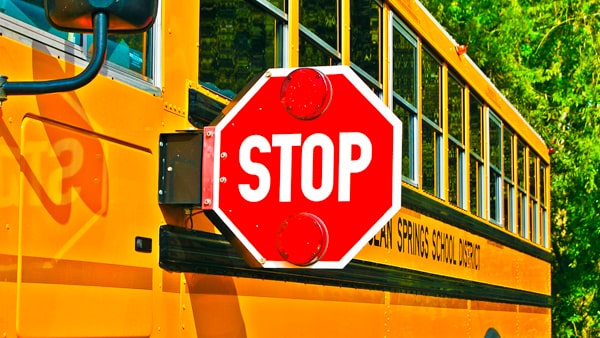
A school bus is stopped with its red lights flashing and stop arm extended. Which driver is not required to stop?

The only time you do not have to stop for a school bus whose red lights are flashing and Stop arm is extended is when you:
  1. A A driver who does not see children near the bus
  2. B A driver following directly behind the bus
  3. C A driver approaching from the opposite direction across a qualifying divided roadway
  4. D A driver who believes passing on the left is safe

Correct answer: C – A driver approaching from the opposite direction across a qualifying divided roadway

Traffic approaching a stopped school bus generally must stop and remain stopped until the stop signal is withdrawn, the red lights are off and the bus begins moving. The opposite-direction exception applies when the roadway is separated by a physical barrier or intervening space. It also includes a center left-turn lane when the roadway has at least four lanes. An undivided four-lane road does not qualify for the exception.

Source: N.C. Gen. Stat. § 20-217(a), (c) – Motor vehicles to stop for properly marked and designated school buses in certain instances; evidence of identity of driver, North Carolina Driver Handbook — Ch. 4, “School Buses”

Question 3

When following a motorcycle, what lane space must you allow the rider?

If you are driving behind a motorcycle, you must:
  1. A The full width of the lane
  2. B Only the left half of the lane
  3. C Only the right half of the lane
  4. D Enough room to pass within the same lane

Correct answer: A – The full width of the lane

North Carolina law entitles a motorcycle to full use of a lane. A motorist may not operate in a way that deprives the motorcycle of that space. Although two motorcycles may ride abreast in one lane, a car may not share the lane with a motorcycle or pass it within the same lane.

Source: N.C. Gen. Stat. § 20-146.1(a), (b) – Operation of motorcycles

Question 4

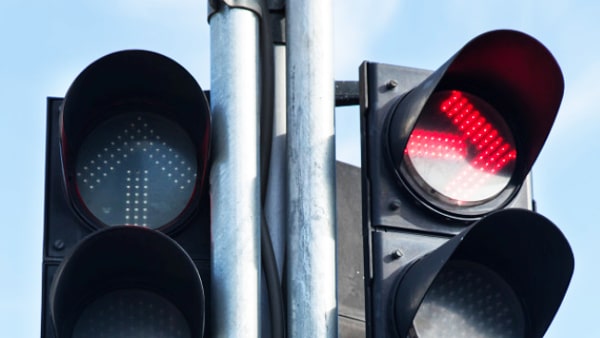
What must you do when facing a steady red right-turn arrow?

A red arrow pointing to the right on a traffic light means you may:
  1. A Turn after stopping and yielding
  2. B Remain stopped until a signal permits the turn
  3. C Slow down and turn if traffic is clear
  4. D Turn when vehicles behind you begin moving

Correct answer: B – Remain stopped until a signal permits the turn

A solid red arrow requires turning traffic to stop, and no turn is permitted while that arrow is displayed. This differs from a steady red circular signal, which generally permits a right turn after a complete stop unless a sign prohibits it. Wait until another signal authorizes your movement.

Source: North Carolina Driver Handbook — Ch. 5, “Traffic Signals”

Question 5

On a road posted at 35 mph, how far before a turn must you signal continuously?

  1. A For at least the last 100 feet
  2. B For at least the last 25 feet
  3. C Only while making the turn
  4. D Only after beginning to slow

Correct answer: A – For at least the last 100 feet

In North Carolina, a turn signal must be maintained continuously for at least the last 100 feet before turning on a road posted below 45 mph. Where the speed limit is 45 mph or higher, the required distance increases to 200 feet. An advance signal warns other road users that you intend to slow and turn.

Source: N.C. Gen. Stat. § 20-154(a), (b) – Signals on starting, stopping or turning, North Carolina Driver Handbook — Ch. 4, “Flashing Turn Signals”

Question 6

You are several lanes left of an approaching right-side freeway exit. How should you move toward the exit lane?

  1. A Cross every lane in one continuous movement
  2. B Accelerate past all surrounding traffic
  3. C Brake before moving across each lane line
  4. D Make separate lane changes, checking before each move

Correct answer: D – Make separate lane changes, checking before each move

Before changing lanes, check the side and rearview mirrors, look over your shoulder for traffic in the blind spot, and signal in advance. Complete a controlled move into the adjacent lane, then repeat the checks before moving again. Crossing several lanes at once does not allow the same careful verification for each lane.

Source: North Carolina Driver Handbook — Ch. 4, “Changing Lanes”, North Carolina Driver Handbook — Ch. 4, “City Driving”