


Oregon DMV Practice Test 3

4.8 out of 5 (386 votes)
80% Passing score
20 Questions
4 Mistakes allowed
By the time you are looking at a third Oregon DMV practice permit test, you are probably past the “what is a Stop sign” stage. It is learning how Oregon phrases its rules, how small details change an answer, and how safely driving in theory has to connect to what you would actually do in traffic, with other cars around you and someone behind you getting impatient for no useful reason. This Oregon DMV practice test gives you 20 questions covering the material Class C applicants are expected to know: Oregon traffic laws, road signs, right-of-way rules, signals, lane use, safe driving habits, and the distracted-driving rules around mobile devices. You need 16 correct answers to pass, which makes this practice DMV permit test a straightforward check on whether your study is holding together or just floating around in pieces. The official Oregon DMV permit test questions are not released to the public, so this Oregon DMV learners permit practice test is not pretending to be a leaked copy of the real exam. Better to be honest about that. What it does is mirror the feel of the real thing: multiple-choice questions, rule-based wording, practical driving situations, and topics drawn from the Oregon Driver Manual. You can retake it as often as you need, and the repeat attempts are where the value usually shows up. The first try tells you what you think you know. The next ones show you what you actually read closely. Oregon lets applicants take the Class C knowledge test online or at a DMV office. Online testing requires a desktop or laptop with a keyboard, mouse, and functioning webcam; phones, tablets, and other touchscreen devices are not allowed. Applicants under 18 need a proctor over age 21. At a DMV office, the test is taken on a touchscreen computer with audio available, and the testing rules are firm: no manual, notes, phones, or smart devices. Cheating means failure and a 90-day wait before retesting. There are a few licensing details worth keeping in mind, too. Oregon requires a vision screening for an original driving privilege, and if you need glasses or contacts to meet the standard, your permit or license may require corrective lenses. You will also need proper proof of identity, Oregon residency, and Social Security information when applying. Use this Oregon DMV practice permit test with the Oregon Driver Manual, road sign review, and whatever driver education resources you trust. It is not a shortcut. It is a rehearsal with the rough edges left in, which is usually the useful kind.
FREE DMV Practice Test App
Study for your Oregon permit test or driver’s license with the NextDoorDriving app. 700+ DMV questions and answers, 100% free!
Download on the App Store

Sample Oregon Permit Test Questions

Question 1

Under Oregon turning rules, where should you finish a left turn from a two-way road onto a one-way road?

  1. A. In the far-right lane
  2. B. Across the center of the roadway
  3. C. In the nearest lawful left lane
  4. D. In whichever lane has the least traffic

Correct answer: C. – In the nearest lawful left lane

Approach the left turn from the extreme left-hand lane lawfully available in your direction of travel. When entering the one-way road, finish the turn in its nearest lawful left lane. Do not swing across another lane or change lanes while completing the turn.

Source: ORS § 811.340(1) – Improperly executed left turn; penalty, 2026–2027 Oregon Driver Manual — Turns and Intersections, “Left or Right Turn: Two-Way Road to One-Way Road”

Question 2

At an Oregon four-way stop, which approach follows the driver manual’s guidance?

  1. A. Always wave every other driver through first
  2. B. Allow the driver who stopped first to go first; when in doubt, yield to the driver on your right
  3. C. Let the largest vehicle proceed first

Correct answer: B. – Allow the driver who stopped first to go first; when in doubt, yield to the driver on your right

At an intersection with stop signs in all four directions, the manual states that the driver who stops first commonly goes first. When the order is uncertain, yield to the driver on your right. Automatically waving every other driver through is not the right-of-way sequence described in the manual.

Source: 2026–2027 Oregon Driver Manual — Turns and Intersections, “Intersections”

Question 3

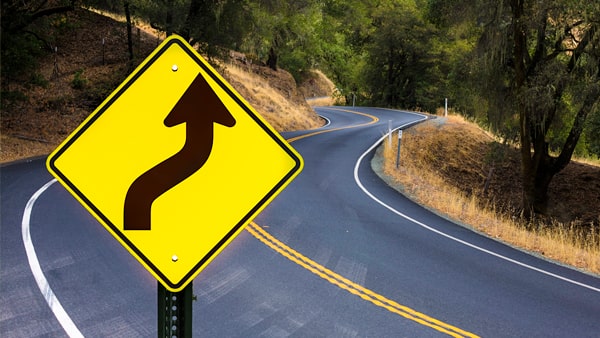
A yellow warning sign showing a right curve followed by a left curve means:

This sign means:
  1. A. A single sharp right turn is ahead
  2. B. Reversing curves begin with a curve to the right
  3. C. Reversing curves begin with a curve to the left
  4. D. The paved roadway ends ahead

Correct answer: B. – Reversing curves begin with a curve to the right

The reversing-curves warning sign indicates that the road ahead first curves to the right and then to the left. It warns of a change in roadway alignment rather than a pavement ending or a single turn. Reduce speed as needed before entering the curves and remain within your lane.

Source: 2026–2027 Oregon Driver Manual — Signs and Traffic Signals, “Reversing Curves”

Question 4

May you cross a centerline to pass when the line on your side is solid yellow?

  1. A. Yes, whenever the other vehicle is below the speed limit
  2. B. No, a solid yellow line on your side prohibits passing
  3. C. Yes, whenever no oncoming vehicle is visible
  4. D. Only between sunset and sunrise

Correct answer: B. – No, a solid yellow line on your side prohibits passing

A solid yellow centerline on your side marks a no-passing restriction. Double solid yellow lines prohibit passing in both directions. The manual distinguishes passing from a lawful left turn: after yielding to oncoming traffic, a driver may cross double solid yellow lines to enter or leave a roadway where the turn is otherwise permitted.

Source: ORS § 811.420 – Passing in no passing zone; exceptions; penalty, 2026–2027 Oregon Driver Manual — Lane Travel, “Yellow Markings”

Question 5

In Oregon, when may you continue past a school bus displaying flashing red safety lights without stopping?

The only time you do not have to stop for a school bus whose red lights are flashing and Stop arm is extended is when you:
  1. A. When no children are visible
  2. B. When you are traveling behind the bus
  3. C. When the bus is stopped on a different roadway separated by an unpaved median or barrier
  4. D. When there is enough room to pass on the left

Correct answer: C. – When the bus is stopped on a different roadway separated by an unpaved median or barrier

Drivers meeting or overtaking a bus displaying red safety lights must stop before reaching it and remain stopped until the lights are no longer operating. The requirement does not apply when the bus is on a different roadway. An unpaved median or physical barrier creates separate roadways, but a painted median or turn lane does not. Failure to stop is a Class A traffic violation.

Source: ORS § 811.155 – Failure to stop for bus safety lights; exemptions; penalty, 2026–2027 Oregon Driver Manual — Sharing the Road, “School Buses”

Question 6

Under Oregon law, how must a child younger than two years old be secured in a motor vehicle?

  1. A. In a properly installed rear-facing child safety system
  2. B. With an adult safety belt regardless of the child’s size
  3. C. Without a restraint when an adult is holding the child
  4. D. With no restraint when the vehicle is traveling slowly

Correct answer: A. – In a properly installed rear-facing child safety system

A child younger than two must be properly secured in a rear-facing child safety system. Other child-restraint requirements depend on weight, height, and age; for example, many children over 40 pounds and no taller than four feet nine inches require a system that properly positions the safety belt. Failure to comply is a Class D traffic violation.

Source: ORS § 811.210(1)(a)(D), (2)–(4) – Failure to properly use safety belts; penalty