


Oregon DMV Sign Test 3

5 out of 5 (134 votes)
80% Passing score
20 Questions
4 Mistakes allowed
Road signs deserve more attention than most Oregon permit test prep gives them. The DMV expects you to know what a sign means quickly, from its shape as much as its wording, because that is how signs work when you are actually driving. A Stop sign’s octagon is supposed to register immediately. A yield sign’s triangle is a warning to ease off, look carefully, and let traffic sort itself out before you roll forward like you own the intersection. This Oregon DMV signs practice test gives you 20 questions focused on road sign shapes, meanings, and recognition. It is meant to sharpen the part of your test prep that often feels simple until you start mixing similar signs together, which is where people lose points they probably should not lose. The immediate feedback helps there. When you miss a question, you get an explanation instead of a bare wrong answer, so the mistake actually teaches you something useful. Small mercy, but a real one. The full Oregon Class C Knowledge Test is broader than road signs, of course. It has 35 questions, and you need 28 correct to pass, which means an 80% score and no more than 7 missed answers. The knowledge test costs $7 each time. Online testing has its own limits: 2 attempts in 24 hours, and 4 online attempts for that test type before you have to take it at a DMV office. Also, Oregon does not shrug off cheating. A cheating violation can block you from retesting for 90 days, which is a long way to go just to avoid studying road signs and lane rules. For younger drivers, the licensing process has a few extra steps. You can apply for a Provisional Instruction Permit at 15, with a parent or legal guardian signature if you are under 18. Before applying for a provisional license, you need to hold that permit for 6 months. Oregon also requires supervised driving practice: 50 hours if you complete an ODOT-approved driver education course, or 100 hours if you do not. The supervising driver has to be at least 21 and licensed for at least 3 years. Bring the paperwork side into your planning, too, because this is where a prepared person can still have a deeply irritating morning. Oregon requires proof of identity, date of birth, full legal name, Oregon residence address, and a Social Security number or certification of no SSN. REAL ID requires stricter original documents and 2 proofs of current residence, and it costs an extra $30. The instruction permit is $30, a Class C license is $58, and the DMV Class C drive test is $45. Study the Oregon Driver’s Handbook, use this Oregon DMV road signs test, and give the signs enough practice that they stop feeling like guesses.
FREE DMV Practice Test App
Study for your Oregon permit test or driver’s license with the NextDoorDriving app. 700+ DMV questions and answers, 100% free!
Download on the App Store

Sample Oregon Permit Test Questions

Question 1

In Oregon, if an official curbside traffic control device prohibits stopping, you must:

  1. A. Not stop, stand, or park there unless an exemption applies
  2. B. Park there only while making a commercial delivery
  3. C. Park there only with a disabled parking permit

Correct answer: A. – Not stop, stand, or park there unless an exemption applies

State law prohibits stopping a vehicle at any place where a traffic control device prohibits stopping, subject to specified exemptions. Parking for deliveries or persons with disabilities is not automatically permitted in such a location. Always follow the posted sign or official marking that applies to the curbside area.

Source: ORS 811.550(14) – Places where stopping, standing and parking prohibited, ORS 811.560 – Exemptions from prohibitions on stopping, standing or parking, Oregon Driver Manual — Parking and Stopping, “No Parking”

Question 2

A yellow diamond sign with a short line joining the main road from the right indicates:

This sign means:
  1. A. All traffic must turn right
  2. B. A side road enters from the right
  3. C. All traffic must continue straight
  4. D. Right turns are prohibited

Correct answer: B. – A side road enters from the right

A Side Road warning sign shows that an intersecting roadway joins from the side depicted by the symbol. Drivers may encounter traffic turning or entering at that intersection. Because it is a warning sign, it does not require a turn or prohibit a movement.

Source: OAR 734-020-0005 – Traffic Control Devices, Manual on Uniform Traffic Control Devices, 11th ed., § 2C.41 – Intersection Warning Signs, Oregon Driver Manual — Signs and Traffic Signals, “Side Road”

Question 3

Under Oregon law, what may you do when facing a steady green arrow?

  1. A. Enter the intersection for any movement after yielding
  2. B. Cautiously make the movement shown by the arrow
  3. C. Turn without checking whether the path is clear
  4. D. Wait until a circular green signal appears

Correct answer: B. – Cautiously make the movement shown by the arrow

A steady green arrow permits you to cautiously enter the intersection only for the movement indicated by the arrow or another movement allowed by a signal shown at the same time. The driver manual describes this as having the right of way. The arrow does not authorize an unchecked entry or a movement in another direction.

Source: ORS 811.260(2) – Appropriate driver responses to traffic control devices, Oregon Driver Manual — Signs and Traffic Signals, “Green Arrow”

Question 4

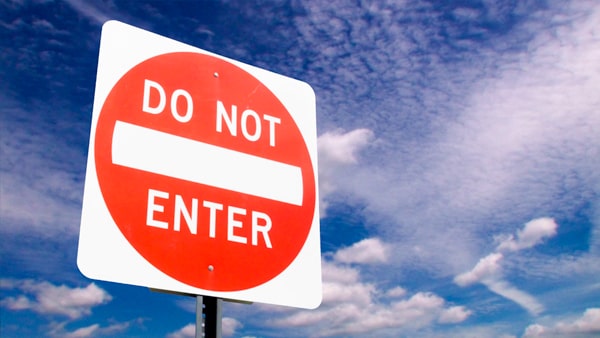
A DO NOT ENTER sign is intended to prevent drivers from:

This sign is used to prevent:
  1. A. Entering a parking area that has no open spaces
  2. B. Driving into an active construction zone
  3. C. Turning onto a street that ends ahead
  4. D. Entering a road or ramp from a prohibited direction

Correct answer: D. – Entering a road or ramp from a prohibited direction

A DO NOT ENTER sign warns that you must not enter the road or freeway from that direction. It is placed where entering could put a driver on the wrong side of the roadway. It does not indicate a full parking lot, construction closure, or dead-end street.

Source: Oregon Driver Manual — Signs and Traffic Signals, “Do Not Enter—Square”

Question 5

Which sign is an example of a rectangular regulatory sign?

  1. A. School crossing
  2. B. Railroad advance warning
  3. C. Stop
  4. D. Speed limit

Correct answer: D. – Speed limit

Most regulatory signs are rectangular, with black words or symbols on a white background. A speed limit sign is a regulatory sign that displays the maximum permitted speed. School crossing, railroad advance, and stop signs use distinctive shapes other than a vertical rectangle.

Source: Oregon Driver Manual — Signs and Traffic Signals, “Regulatory Signs—Other” and “Speed Limit”

Question 6

What does a steady circular green traffic signal allow you to do?

  1. A. Slow and prepare to stop before entering
  2. B. Stop before proceeding in every case
  3. C. Proceed if your path through the intersection is clear
  4. D. Continue straight, but never turn right

Correct answer: C. – Proceed if your path through the intersection is clear

In Oregon, a green signal allows straight travel and right or left turns unless a sign prohibits a movement. You must yield to vehicles already within the intersection. When turning, the driver manual also directs drivers to yield to pedestrians and, for a left turn, to oncoming traffic.

Source: ORS 811.260(1) – Appropriate driver responses to traffic control devices, Oregon Driver Manual — Signs and Traffic Signals, “Steady Green”