Hawaii DMV Sign Test 3

5 out of 5 (32 votes)
80% Passing score
20 Questions
4 Mistakes allowed
A road sign is basically Hawaii’s way of giving you a quick instruction without slowing down traffic to explain itself. Shape, color, symbol, lane markings...all of it is there to be read fast, and the Class 3 written knowledge test expects you to do that, too. A Stop sign is easy. A warning sign on a curve, a lane marking near an intersection, or a regulatory sign you only half-remember from the handbook? That is where people start guessing, and guessing is a pretty weak study plan. This Hawaii DMV practice test puts that signs-and-signals material under a brighter light, where it belongs. Road signs are not tested in some neat little road-sign-only bubble on the official exam. They are folded into the Class 3 written knowledge test, along with traffic laws, pavement markings, signals, right-of-way rules, safe driving practices, alcohol and drug laws, and the rest of the material from the Hawaii Driver’s Manual. So, yes, you should know the octagon, the triangle, the rectangle, all of that. But you also need to understand what those signs are telling you to do when the road is busy and there is not much time to politely think it over. This Hawaii road sign test includes 20 multiple-choice questions covering regulatory signs, warning signs, guide signs, traffic signals, pavement markings, lane markings, and the safe responses that go with them. You need 16 correct answers to pass this practice test. The question pool changes from attempt to attempt, which helps keep the practice useful instead of turning it into a little memorization trick you can beat once and forget five minutes later. For the real Hawaii learner permit exam, use the official numbers. The Class 3 written knowledge test is a 30-question multiple-choice exam, and you need 24 correct answers to pass. That is 80%, with no more than 6 missed questions. The Hawaii Driver’s Manual is the official study source, and this Hawaii permit practice test should work alongside it, not instead of it. A practice test can tighten your recall, absolutely, but the manual is where the state lays out the full set of rules, including the bits that are easy to skim past and then regret later. Hawaii also offers the learner permit test online through KnowTo Drive Online for applicants who are at least 15 years and 6 months old. The online version is available in English and Spanish, has a one-hour time limit, and must be taken on a desktop or laptop with a webcam, keyboard, mouse or mouse-pad controlled cursor, and internet connection. No phones, no tablets, no touchscreen devices. A little fussy, maybe, but that is the setup. If you pass online, you still have to visit a county driver licensing center, bring the required documents, and complete the permit process within 30 days. Use this DMV signs test as a focused way to clean up the part of studying that tends to blur together: shapes, colors, markings, signals, and what a safe driver is expected to do next. It is not the official DMV written test, and it is not pretending to be. It is a practical rehearsal for reading the road before the road starts reading like a pop quiz.

FREE DMV Practice Test App
Study for your Hawaii permit test or driver’s license with the NextDoorDriving app. 700+ DMV questions and answers, 100% free!
Download on the App Store

Sample Hawaii Permit Test Questions

Question 1

The white edgeline on your right angles inward toward your lane. What does this indicate?

  1. A An intersection is immediately ahead
  2. B A work zone begins at the line
  3. C Traffic must turn left
  4. D The roadway becomes narrower ahead

Correct answer: D – The roadway becomes narrower ahead

A white edgeline serves as a safety guide marking the right edge of the roadway. When that boundary angles inward, the available roadway width is decreasing. Recognize the narrowing early and remain within the traveled portion of the road.

Source: Hawaii Driver’s Manual — Ch. VI, “Pavement Markings—Edgelines”

Question 2

After stopping and before entering an intersection, where should you check for conflicting traffic?

  1. A Ahead and to the left
  2. B Only to the left and right
  3. C To the left, to the right, and ahead
  4. D Ahead and to the right

Correct answer: C – To the left, to the right, and ahead

Before moving into an intersection, scan left and right for cross traffic and look ahead for vehicles, pedestrians, or bicyclists that may conflict with your path. Hawaii’s right-of-way guidance requires drivers to account for traffic on the protected roadway and road users already within the intersection. Proceed only when the required yielding has been completed.

Source: Hawaii Driver’s Manual — Ch. V, “The Rules of Right-of-Way”

Question 3

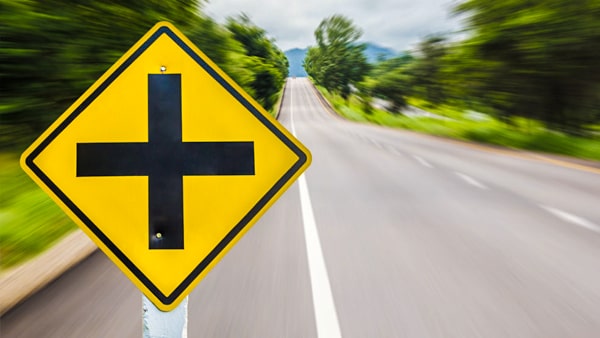
What roadway condition does the pictured warning sign identify?

This sign means:
  1. A A church entrance
  2. B A first-aid station
  3. C A crossroad ahead
  4. D A railroad crossing

Correct answer: C – A crossroad ahead

The crossroad warning sign indicates that another roadway intersects the road ahead. It is a warning sign rather than a regulatory or guide sign. Watch for vehicles, bicyclists, pedestrians, and any traffic controls at the approaching intersection.

Source: Hawaii Driver’s Manual — Ch. VI, “Warning Signs”, Hawaii Driver’s Manual — Appendix, “Questions with Illustrations”

Question 4

A yellow diamond warning sign shows one vertical arrow pointing up and another pointing down. Which sign is this?

  1. A Lane Ends
  2. B Divided Highway Ends
  3. C Two-Way Traffic
  4. D Turn Left or Right

Correct answer: C – Two-Way Traffic

The two-way-traffic sign warns that vehicles ahead travel in opposite directions on the same roadway. It may appear where a divided or one-way section changes to two-way operation. Remain on the right side of the roadway and be prepared for oncoming traffic.

Source: Hawaii Driver’s Manual — Ch. V, “Driving on Right Side of Roadway”, Hawaii Driver’s Manual — Appendix, “Questions with Illustrations”

Question 5

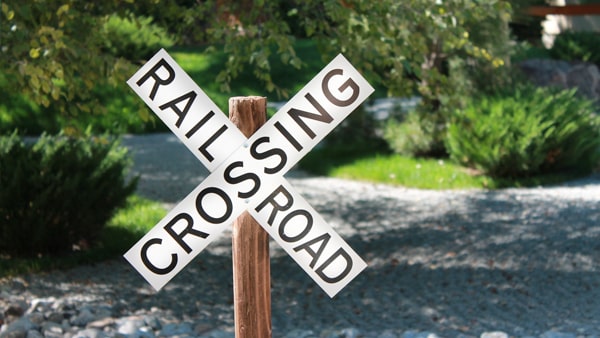
What location is identified by the pictured crossbuck sign?

This road sign means:
  1. A An intersection where you stop only for approaching traffic
  2. B A three-way highway intersection
  3. C A crossroad intersection
  4. D A railroad grade crossing

Correct answer: D – A railroad grade crossing

A crossbuck identifies a railroad grade crossing. Watch and listen for trains and obey gates, lights, or a flagperson. Hawaii law requires a stop between 15 and 50 feet from the nearest rail when a warning device signals an approaching train or when a train is plainly visible and dangerously close.

Source: HRS § 291C-91(a) – Obedience to signal indicating approach of train, Hawaii Driver’s Manual — Appendix, “Questions with Illustrations”

Question 6

How should you respond to a flashing yellow traffic signal?

  1. A Continue at the same speed while watching for traffic
  2. B Come to a complete stop before proceeding
  3. C Proceed through the intersection with caution
  4. D Wait for the signal to display green

Correct answer: C – Proceed through the intersection with caution

A flashing yellow signal is a caution signal. You may proceed through the intersection or past the signal, but only with caution. Unlike a flashing red signal, it does not automatically require a complete stop.

Source: HRS § 291C-34(a)(2) – Flashing signals