North Dakota Permit Practice Test 3

4.8 out of 5 (236 votes)
80% Passing score
20 Questions
4 Mistakes allowed
Preparing for the official ND permit test is partly about knowing the rules of the road and partly about knowing how North Dakota handles the licensing process around the test. That second part matters more than people expect. The written exam is the piece everyone talks about, sure, but the vision screening, documents, appointment rules, testing fees, and retake limits are all part of getting from “I studied” to actually holding a learner permit. Our free North Dakota permit practice test is built around the knowledge-test material you need to know before test day. Each practice test has 20 questions, with 16 correct answers needed to pass, so it gives you a clean way to measure whether you’re ready or just sort of familiar with the manual. The questions cover road signs, right-of-way rules, speed and safety laws, mobile device restrictions, rural driving, bad-weather decisions, and the kinds of everyday driving situations that make sense in North Dakota — not just in Fargo or Bismarck, but also on open highways, smaller-town streets, and long stretches where conditions can change without much warning. The practice test also helps you study with the real licensing process in mind. North Dakota permit and license applicants must pass a vision screening, and if corrective lenses or another restriction is needed, that can be added to the permit or license. In some cases, an applicant who does not pass the office screening may need a Certificate of Vision Examination completed by a physician or optometrist. It is one of those details that feels separate from the written test until, well, suddenly it is not separate at all. You can take the official knowledge test in person at a North Dakota Driver License office by appointment, or online through KnowToDrive. Passing online still means visiting a driver license office afterward to receive the physical permit. For in-office testing, bring proper identification and don’t bring extra items into the testing area; phones, purses, backpacks, paper, pens, notebooks, and electronic devices are not allowed. Leaving before the test is complete counts against you, which is a harsh little rule, but there it is. Before applying, make sure your documents are in order: proof of identity, date of birth, legal presence, Social Security number, and North Dakota residency. Two residence-address documents are generally required, and applicants under 18 need parent or guardian approval and sponsorship. The written test costs $5 per attempt, the online test costs $10, the learner permit costs $15, and only one knowledge-test attempt is allowed per day. Use this ND permit practice test to build real familiarity with the rules, not a shaky memory of practice answers. That is the better way to walk into the official test — prepared, steady, and not trying to sort out the basics while the clock is already running.

FREE DMV Practice Test App
Study for your North Dakota permit test or driver’s license with the NextDoorDriving app. 700+ DMV questions and answers, 100% free!
Download on the App Store

Sample North Dakota Permit Test Questions

Question 1

Under North Dakota law, which crosswalk may require a driver to yield when traffic signals are absent or not operating?

  1. A Only a crosswalk controlled by a signal
  2. B Either a marked crosswalk or an unmarked crosswalk at an intersection
  3. C Only a crosswalk outlined with painted lines
  4. D Only a school crosswalk

Correct answer: B – Either a marked crosswalk or an unmarked crosswalk at an intersection

When signals are absent or not working, a driver must yield when a pedestrian in a crosswalk is on the driver’s half of the roadway or is approaching that half closely enough to be in danger. The law recognizes both marked crosswalks and unmarked crosswalks at intersections. Pedestrians may not suddenly enter the path of a dangerously close vehicle.

Source: N.D.C.C. § 39-10-28(1), (2), (4) – Pedestrian's Right of Way in Crosswalk, North Dakota Noncommercial Driver License Manual — “Right of Way”

Question 2

What does a green arrow displayed with a red traffic light allow you to do?

  1. A Stop and wait for a circular green light
  2. B Proceed straight through the intersection
  3. C Cautiously make the movement shown by the arrow after yielding as required
  4. D Travel in any direction if the intersection appears open

Correct answer: C – Cautiously make the movement shown by the arrow after yielding as required

A green arrow permits you to cautiously enter the intersection for the movement shown by the arrow, even when a red indication is displayed at the same time. You must still yield to pedestrians lawfully in an adjacent crosswalk and to traffic lawfully using the intersection. Other movements remain controlled by the red light.

Source: N.D.C.C. § 39-10-05(1)(b) – Traffic-Control Signal Legend, North Dakota Noncommercial Driver License Manual — “Traffic Signals”

Question 3

Why should you maintain a safe space behind the vehicle ahead?

What is the benefit of a "space cushion" around your vehicle?
  1. A It prevents other vehicles from entering your lane
  2. B It is necessary only while driving in cities
  3. C It gives you more time to stop if traffic ahead slows suddenly
  4. D It allows you to watch the vehicle ahead more closely

Correct answer: C – It gives you more time to stop if traffic ahead slows suddenly

Following too closely leaves insufficient time to stop during an emergency. The manual recommends using the three-second rule to measure a basic following cushion under ordinary conditions. A longer interval may be necessary on slippery roads, when following a motorcycle or large vehicle, or when towing a trailer.

Source: N.D.C.C. § 39-10-18(1) – Following Too Closely, North Dakota Noncommercial Driver License Manual — “Following and Stopping Distances”

Question 4

What must you do before moving into another lane to pass a vehicle?

Before passing another vehicle you should:
  1. A Flash your high beams continuously
  2. B Activate your hazard warning lights
  3. C Verify the lane is clear and signal the lane change
  4. D Sound your horn until the other driver slows

Correct answer: C – Verify the lane is clear and signal the lane change

North Dakota requires a lane change to be made with reasonable safety and with an appropriate signal. Check mirrors and the blind spot to verify that the passing lane is clear, then signal before moving over. The passing driver remains responsible for completing the lane change safely.

Source: N.D.C.C. § 39-10-17(1) – Driving on Roadways Laned for Traffic, N.D.C.C. § 39-10-38(1), (2) – Turning Movements and Required Signals, North Dakota Noncommercial Driver License Manual — “Lane Changes”

Question 5

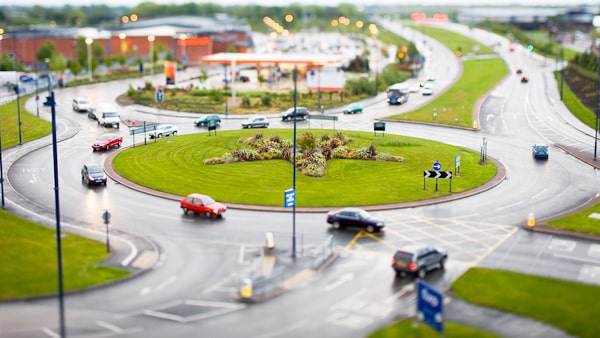
At a North Dakota roundabout, which vehicle normally has priority?

You have the right-of-way when you are:
  1. A A vehicle approaching the entrance
  2. B A vehicle backing from a driveway
  3. C A vehicle leaving a parking space
  4. D A vehicle already circulating in the roundabout

Correct answer: D – A vehicle already circulating in the roundabout

Drivers approaching a roundabout must reduce speed and yield to vehicles already circulating within it. They must also yield to pedestrians and bicyclists before entering. Once inside, drivers should remain in their selected lane and follow the roadway around the center island in the designated direction.

Source: North Dakota Noncommercial Driver License Manual — “Roundabouts”

Question 6

How should you approach a passive railroad crossing that has no lights or gates?

  1. A Always stop, even when the tracks are visibly clear
  2. B Slow down, look and listen, and be ready to stop
  3. C Continue normally because every train crossing has signals
  4. D Speed up to minimize your time on the tracks

Correct answer: B – Slow down, look and listen, and be ready to stop

A passive railroad crossing has no active traffic-control device, so the driver must search for trains and determine whether there is enough clear space to cross safely. Slow down, look, listen, and prepare to stop. A stop is required when a train is plainly visible in hazardous proximity or another listed warning indicates its immediate approach.

Source: N.D.C.C. § 39-10-41(1) – Obedience to Signal Indicating Approach of Train or Other On-Track Equipment, North Dakota Noncommercial Driver License Manual — “Types of Crossings”