


North Dakota Road Signs Test

4.6 out of 5 (157 votes)
80% Passing score
10 Questions
2 Mistakes allowed
This North Dakota road signs practice test keeps its attention where it should be: on the signs, signals, colors, shapes, and pavement markings that show up on the ND Class D knowledge test. The official exam covers the full Rules of the Road material — traffic laws, safe driving, impaired-driving rules, emergencies, sharing the road, vehicle control, and the North Dakota details that are easy to skim past — but road signs are not some separate little add-on. They are part of the same knowledge test, and missed sign questions count against the same score. So, yes, this practice test is focused. Deliberately focused. You get 20 multiple-choice questions built around the road sign material new drivers are expected to know: regulatory signs, warning signs, guide signs, railroad crossings, work zones, school and pedestrian signs, traffic signals, and pavement markings. Some questions lean on shape or color. Others ask you to recognize what a sign means in context, which is usually where people find out they knew the sign “sort of,” but not cleanly enough to trust the answer. The practice permit test is untimed, which is more useful than it sounds. There is no reward here for rushing through a sign you half-recognize from the highway. Take the time, make the choice, and then read the explanation. After each answer, you get immediate feedback that explains why the correct answer works and why the other options do not. That small bit of correction — the part people sometimes skip, for reasons known only to them and maybe their browser history — is where the learning actually sticks. For context, the North Dakota Class D knowledge test is commonly reported as 25 multiple-choice questions, with 20 correct answers needed to pass. Applicants also need to pass a vision screening before a learner permit is issued, and the knowledge test may be taken at a Driver License office or online through KnowToDrive. The signs are only one slice of the bigger licensing process, but they are a slice worth getting right. Use this ND DMV road signs practice test as a serious warm-up before the real permit test. Not dramatic. Just practical. The more familiar these signs become here, the less mental noise they create later — on the exam, and eventually on actual North Dakota roads where the sign is not waiting around for you to remember what it meant.
FREE DMV Practice Test App
Study for your North Dakota permit test or driver’s license with the NextDoorDriving app. 700+ DMV questions and answers, 100% free!
Download on the App Store

Sample North Dakota Permit Test Questions

Question 1

What does a rectangular red-and-white WRONG WAY sign tell you?
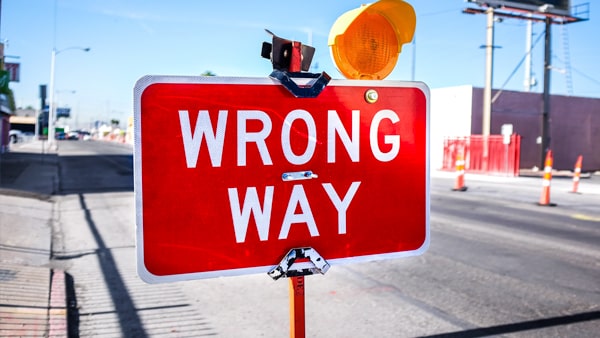
This red and white sign means:
  1. A You may enter the roadway if no traffic is approaching
  2. B The roadway is closed to traffic in every direction
  3. C U-turns are prohibited at this location
  4. D You are traveling against the permitted direction of traffic

Correct answer: D – You are traveling against the permitted direction of traffic

A WRONG WAY sign tells a driver that the vehicle is proceeding in the wrong direction on a street, freeway, or ramp. A DO NOT ENTER sign instead prohibits entry into a restricted section of roadway. WRONG WAY does not mean that the entire road is closed or that only U-turns are prohibited.

Source: North Dakota Noncommercial Driver License Manual — “Signs, Signals, and Road Markings,” “Regulatory Signs”

Question 2

On a two-way road, what does a yellow centerline separate?

  1. A Traffic moving in opposite directions
  2. B Lanes moving in the same direction
  3. C Traffic from a nearby railroad crossing
  4. D Only center turn lanes and turnout lanes

Correct answer: A – Traffic moving in opposite directions

Yellow centerlines identify the boundary between opposing traffic on a two-way roadway. Broken yellow lines may be crossed for a lawful pass or left turn, while solid yellow lines restrict passing. The color identifies the traffic directions being separated; the line pattern controls when crossing is permitted.

Source: North Dakota Noncommercial Driver License Manual — “Signs, Signals, and Road Markings,” “Pavement Markings”

Question 3

When may you cross a solid yellow centerline?

  1. A To pass a slower vehicle traveling in your direction
  2. B Only during daylight hours
  3. C Whenever no approaching vehicle is visible
  4. D As part of a lawful left turn where permitted

Correct answer: D – As part of a lawful left turn where permitted

A solid yellow centerline prohibits using the opposing lane to pass. The driver manual permits crossing a solid yellow line only as part of a left-turn maneuver. State law also preserves qualifying left-turn exceptions to restrictions created by marked no-passing zones.

Source: N.D.C.C. § 39-10-15(3) – No-passing zones, North Dakota Noncommercial Driver License Manual — “Signs, Signals, and Road Markings,” “Pavement Markings”

Question 4

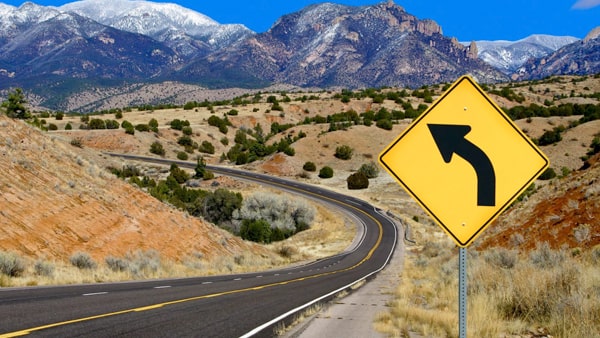
A yellow diamond sign with a black arrow curving to the left warns of:

This sign is used to warn drivers about:
  1. A An intersection ahead
  2. B A highway work zone
  3. C A left curve in the roadway
  4. D A change in the number of lanes

Correct answer: C – A left curve in the roadway

A left-curve warning sign indicates that the roadway bends to the left ahead. Curve and turn signs provide advance notice so drivers have time to reduce speed before entering the change in alignment. An advisory-speed plaque may also be placed beneath the warning sign.

Source: North Dakota Noncommercial Driver License Manual — “Signs, Signals, and Road Markings,” “Warning Signs”

Question 5

What must you do when facing a red, eight-sided STOP sign?

This sign means:
  1. A Slow down and stop only if another vehicle is approaching
  2. B Stop completely, then proceed after yielding when required
  3. C Roll through slowly if the intersection appears clear
  4. D Stop only for traffic on the intersecting roadway

Correct answer: B – Stop completely, then proceed after yielding when required

North Dakota requires a complete stop at a STOP sign, not a rolling stop. Stop at the marked location or, if none is present, at the nearest point where approaching traffic can be seen before entering. After stopping, yield to vehicles that are in the intersection or close enough to present an immediate hazard.

Source: N.D.C.C. § 39-10-24(2) – Stop signs and yield signs, North Dakota Noncommercial Driver License Manual — “Signs, Signals, and Road Markings,” “Regulatory Signs”

Question 6

After stopping and before entering an intersection, where should you look?

  1. A Straight ahead and left
  2. B Left and right only
  3. C Left, straight ahead, and right
  4. D Straight ahead and right

Correct answer: C – Left, straight ahead, and right

The North Dakota driver manual directs a driver proceeding from a stop to look left, then straight ahead, and then right before moving. This scan checks cross traffic as well as the intended path through the intersection. The driver must also yield to traffic presenting an immediate hazard.

Source: N.D.C.C. § 39-10-24(2) – Stop signs and yield signs, North Dakota Noncommercial Driver License Manual — “Parent/Guardian Driver Coaching Tips,” “Do These Each Time You Practice”