


Utah Road Signs Test

4.8 out of 5 (147 votes)
80% Passing score
10 Questions
2 Mistakes allowed
Utah’s learner permit test asks more than whether you can spot a Stop sign, so it helps to study it that way from the beginning. Road signs matter, of course. They show up in the official knowledge test, they show up in real driving, and they have a way of blending together when you have only skimmed them once. But for a first-time learner permit applicant, Utah’s written knowledge test is a 50-question, closed-book exam given through the Driver License Division, and it pulls from the Utah Driver Handbook across a wider spread of material: traffic laws, signs and signals, safe driving practices, impaired driving, driver responsibility, and the rules that keep traffic from turning into guesswork. This Utah DMV practice test gives you a cleaner way to work through that material without pretending the road sign portion exists in a vacuum. Utah does not use a separate road-sign-only test for standard Class D learner permit applicants; signs are folded into the main knowledge exam. So the practice here keeps sign recognition prominent—shapes, colors, symbols, regulatory signs, warning signs, the ones that look familiar until the answer choices get a little too close together—but it also keeps the larger permit test in view. That matters more than people usually think. A sign question is not always just a sign question. Sometimes it is really asking whether you understand who has the right-of-way, how quickly you should react to a road condition, or what a driver is supposed to do before the obvious answer becomes unsafe. And, fine, that sounds a little over-explained, but it is exactly where a lot of missed questions come from. To pass the Utah learner permit knowledge test, you should be ready for 50 questions and plan around an 80% passing score, which means 40 correct answers. Applicants may test twice in one day, and after three failures, another fee is required. There is also more to the licensing process than the written exam itself: the eye test, required documents, permit fee, and age-based rules all matter. Teen applicants have driver education and supervised practice requirements, including 40 practice hours with 10 after sunset. Adults 19 and older have different options depending on whether they complete driver education. Use this Utah permit practice test as a real study tool, not just a quick warm-up. Missed answers are useful when they point you back to the exact parts of the handbook you have not fully absorbed yet.
FREE DMV Practice Test App
Study for your Utah permit test or driver’s license with the NextDoorDriving app. 700+ DMV questions and answers, 100% free!
Download on the App Store

Sample Utah Permit Test Questions

Question 1

The yellow diamond warning sign with a black cross symbol means:
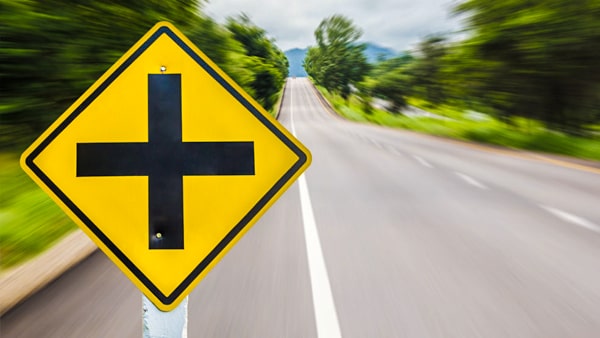
This sign means:
  1. A A church is nearby
  2. B A first-aid facility is ahead
  3. C Another road crosses ahead
  4. D A railroad crossing is ahead

Correct answer: C – Another road crosses ahead

This is a crossroad intersection warning sign. It alerts drivers that another roadway crosses the route ahead and that turning or entering traffic may be present. It is different from the round railroad advance-warning sign and from service signs identifying medical facilities.

Source: Utah Code § 41-6a-301 — Standards and specifications for uniform system of traffic-control devices and school crossing guards., Manual on Uniform Traffic Control Devices for Streets and Highways, 11th ed. — § 2C.41, “Intersection Warning Signs”
Question 2

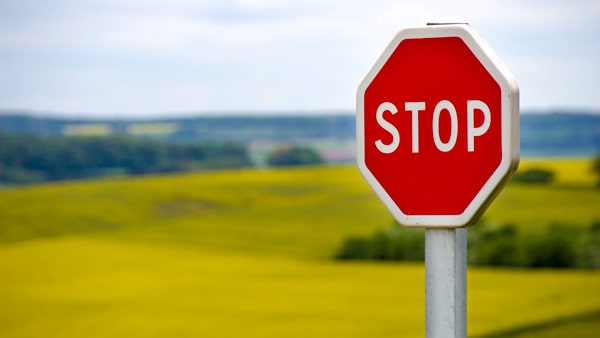
What is required when you approach a red octagonal STOP sign?

This sign means:
  1. A Slow and stop only when other vehicles approach
  2. B Come to a complete stop, yield as required, and proceed when safe
  3. C Continue cautiously if the intersection appears empty
  4. D Stop only for traffic traveling on the intersecting road

Correct answer: B – Come to a complete stop, yield as required, and proceed when safe

Utah requires a complete stop at the marked stop line. If there is no line, stop before the near crosswalk or at the nearest point with a view of approaching traffic. After stopping, yield to pedestrians and to vehicles in or approaching the intersection closely enough to present an immediate hazard.

Source: Utah Code § 41-6a-902(2) — Right-of-way -- Stop or yield signals -- Yield -- Collisions at intersections or junctions of roadways -- Evidence.

Question 3

What color combination is normally used on a freeway guide sign showing the distance to an exit?

  1. A Black lettering on yellow
  2. B White lettering on black
  3. C White lettering on red
  4. D White lettering on green

Correct answer: D – White lettering on green

Standard freeway and expressway guide signs use white letters, symbols, arrows, and borders on a green background. These signs provide route, destination, interchange, and exit information. Other colors are reserved for particular purposes, such as blue for traveler services and brown for recreational or cultural destinations.

Source: Manual on Uniform Traffic Control Devices for Streets and Highways, 11th ed. — § 2E.05, “Color of Guide Signs”

Question 4

While you are waiting to turn left, a steady yellow arrow appears. What does it tell you?

  1. A Accelerate to enter before the signal changes
  2. B The turn is prohibited under every circumstance
  3. C The permitted movement is ending; obey the next signal indication
  4. D You have unconditional right-of-way over oncoming traffic

Correct answer: C – The permitted movement is ending; obey the next signal indication

Under Utah law, a steady yellow arrow warns that the movement allowed by the related green signal is being terminated. Watch for and obey the signal indication that follows. The yellow arrow does not provide an unconditional right-of-way or direct a driver to accelerate into the intersection.

Source: Utah Code § 41-6a-305(3)(a) — Traffic-control signal -- At intersections -- At place other than intersection -- Color of light signal -- Inoperative traffic-control signals -- Affirmative defense.

Question 5

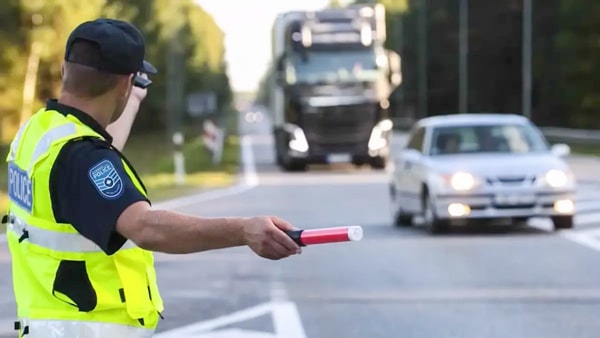
A police officer directs you through an intersection while your signal is red. What should you do?

A traffic light is red, but a police officer is telling you to go ahead anyway. What should you do?
  1. A Remain stopped until the light turns green
  2. B Change lanes and wait for another signal cycle
  3. C Follow the officer’s lawful direction
  4. D Wait for the officer to walk to your vehicle

Correct answer: C – Follow the officer’s lawful direction

Utah law requires compliance with the lawful orders or directions of a peace officer. The general duty to obey traffic-control devices expressly recognizes directions given by peace officers and other authorized personnel. Follow the officer’s signal carefully even when it differs from the displayed traffic light.

Source: Utah Code § 41-6a-209(1) — Obedience to peace officer or other traffic controllers -- Speeding in construction zones., Utah Code § 41-6a-304(1) — Obeying devices -- Effect of improper position, illegibility, or absence -- Presumption of lawful placement and compliance with chapter.

Question 6

Which color is used for lines separating traffic traveling in opposite directions?

  1. A White
  2. B Red
  3. C Black
  4. D Yellow

Correct answer: D – Yellow

Yellow lane markings identify separation between opposing directions of travel on a two-way roadway. They may be broken or solid depending on whether passing is permitted. White markings generally separate traffic lanes moving in the same direction.

Source: Utah Driver Handbook — § 9, “Pavement Markings”