


West Virginia Road Signs Test

4.6 out of 5 (126 votes)
80% Passing score
10 Questions
2 Mistakes allowed
West Virginia road signs are not just decoration along a pretty drive through the hills. They are doing real work, especially on roads where the curve comes sooner than expected, the shoulder disappears for a stretch, or a railroad crossing sign shows up in a place where you would rather not be guessing. This WV DMV practice test is built around that exact kind of knowledge: the signs, signals, pavement markings, and traffic-control details that show up in the West Virginia Driver’s Licensing Handbook and, yes, can show up on the official permit test. The real West Virginia knowledge test is broader than road signs alone. It covers traffic laws, rules of the road, safe driving practices, basic driver responsibilities, pavement markings, traffic signals, and alcohol-related driving laws. The official exam has at least 25 questions, and you need 19 correct answers to pass. That is a 76% score, which sounds comfortable until you miss a couple of questions because you knew the “general idea” but not the actual rule. That distinction matters more than people like to admit. This West Virginia road signs practice test narrows the focus to 20 questions on the sign and traffic-control material drivers tend to see every day but not always study closely. You will work through sign shapes, colors, symbols, warning signs, regulatory signs, guide signs, railroad crossing signs, lane-use signals, traffic lights, and pavement markings. To pass this practice test, you need 16 correct answers out of 20. It is not meant to be a throwaway warm-up. It is a compact check on whether you can recognize what a sign means quickly, without turning it into a long internal debate while traffic is moving behind you. Use it if you are preparing for a Level 1 GDL Instruction Permit, applying for an adult Class E instruction permit, or transferring into West Virginia and trying to clean up the details before dealing with the DMV. Teen applicants have their own extra steps, including parent or guardian consent and the School Driver Eligibility Certificate. Adults follow the regular Class E permit process. Different paperwork, different timelines — same expectation once the test begins: know the signs, know the markings, and understand the rules well enough that the wording does not trip you up.
FREE DMV Practice Test App
Study for your West Virginia permit test or driver’s license with the NextDoorDriving app. 700+ DMV questions and answers, 100% free!
Download on the App Store

Sample West Virginia Permit Test Questions

Question 1

On a divided highway, red faces of raised pavement markers appear toward your vehicle. What does this indicate?

  1. A A busy intersection is ahead
  2. B A stop sign is nearby
  3. C You are traveling opposite the intended direction
  4. D You are entering a passing restriction

Correct answer: C – You are traveling opposite the intended direction

West Virginia highway standards specify white-and-red pavement markers in certain divided-highway applications. The white lens faces traffic traveling in the correct direction, while the opposite face is red. Seeing the red faces indicates that the markers are being viewed from the reverse direction, signaling a wrong-way condition.

Source: West Virginia Division of Highways Standard Detail TEM-4 — Raised Pavement Markers, Types P-2 and R-4
Question 2

What does a double solid yellow centerline indicate?

  1. A Drivers may cross it to pass slow traffic
  2. B Passing is prohibited in both directions
  3. C A center left-turn lane begins
  4. D Traffic on both sides moves in the same direction

Correct answer: B – Passing is prohibited in both directions

Yellow centerlines separate traffic moving in opposite directions. A solid yellow line on a driver’s side of the centerline prohibits that driver from passing. When both centerlines are solid, traffic in neither direction may cross the centerline to overtake another vehicle; a center left-turn lane uses a different combination of solid and broken yellow lines.

Source: West Virginia Driver’s Licensing Handbook — Ch. V, “Pavement Markings”

Question 3

A green arrow authorizes a turn. What must the driver still do before moving?

  1. A Check only the rearview mirror
  2. B Wait five seconds after the arrow appears
  3. C Yield to pedestrians and other lawful traffic still in the intersection
  4. D Yield to motor vehicles but not pedestrians

Correct answer: C – Yield to pedestrians and other lawful traffic still in the intersection

Under West Virginia law, a driver facing a green arrow with a red signal may cautiously enter only to make the movement shown by the arrow. The driver must yield to pedestrians lawfully within a crosswalk and to other traffic lawfully using the intersection. The arrow does not authorize movement in another direction.

Source: W. Va. Code § 17C-3-5(d)(1) — Traffic-control signal legend.

Question 4

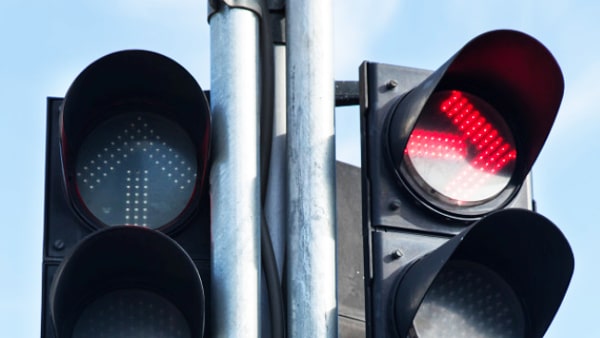
A steady red arrow points to the right. What does it require?

A red arrow pointing to the right on a traffic light means you may:
  1. A Turn right after making a complete stop
  2. B Remain stopped for the right-turn movement while the arrow is red
  3. C Turn right after slowing and checking traffic
  4. D Turn right when vehicles behind you are waiting

Correct answer: B – Remain stopped for the right-turn movement while the arrow is red

A steady red arrow requires a complete stop before the intersection, stop line, or crosswalk for the movement shown. The driver must remain stopped for that movement as long as the arrow remains red. This differs from a steady circular red signal, under which certain turns may be permitted after stopping and yielding.

Source: West Virginia Driver’s Licensing Handbook — Ch. V, “Traffic Lights—Steady Red Arrow/ LEFT TURN”

Question 5

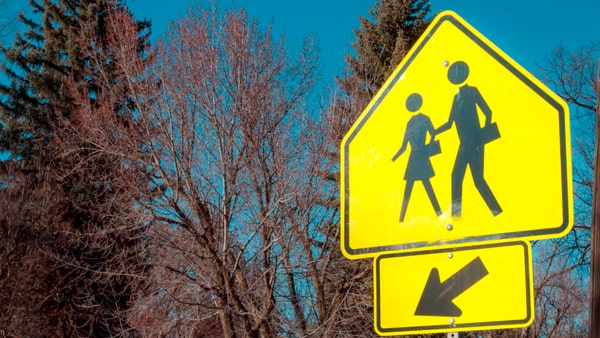
The five-sided warning sign shown identifies:

This road sign means:
  1. A A school crossing area
  2. B A business district
  3. C A sidewalk-only route
  4. D A location where crossing is prohibited

Correct answer: A – A school crossing area

A pentagon-shaped warning sign identifies a school zone or marks a school crossing. Drivers should watch carefully for children and other pedestrians near the roadway. Any posted school-zone speed limit or directions given by authorized traffic controls must also be obeyed.

Source: West Virginia Driver’s Licensing Handbook — Ch. V, “Single Message Shaped Signs—Pentagon”

Question 6

Which color separates traffic lanes moving in the same direction?

  1. A Yellow
  2. B White
  3. C Red
  4. D Black

Correct answer: B – White

White pavement lines separate lanes carrying traffic in the same direction. Broken white lines generally permit lane changes when the movement can be made safely. Solid white lines may mark the pavement edge or separate same-direction lanes where drivers should not change lanes.

Source: West Virginia Driver’s Licensing Handbook — Ch. V, “Pavement Markings”