


West Virginia DMV Sign Test 3

5 out of 5 (46 votes)
80% Passing score
20 Questions
4 Mistakes allowed
West Virginia puts road signs where they matter: on tight mountain curves, at busy intersections in Charleston and Huntington, near school zones, beside railroad crossings, and along long stretches of highway where a driver can get a little too comfortable. So yes, the sign questions on the WV DMV knowledge test are there for a reason. They are not decorative, and they are not filler. This WV DMV practice test is built around road sign recognition, especially the shapes, colors, and meanings that show up in the West Virginia Driver’s Licensing Handbook. You will work through 20 practice questions covering the kinds of traffic-control devices that tend to appear on the real permit test: stop signs, yield signs, warning signs, regulatory signs, guide signs, railroad crossing signs, traffic signals, lane-use signals, and pavement markings. Some of it feels obvious when you read it slowly. The trick, unfortunately, is that driving does not happen slowly. A diamond-shaped warning sign on a rural road outside New River Gorge still needs to register fast, even if you are also watching the grade, the curve, the weather, and the person behind you who has apparently decided patience is optional. The official West Virginia permit knowledge test is for a Class E instruction permit or driver’s license and is based on the state driver’s handbook. The real exam covers more than signs, including traffic laws, rules of the road, safe driving practices, sharing the road, alcohol and DUI laws, pavement markings, and basic driver responsibilities. West Virginia says the knowledge exam has at least 25 questions, and you need 19 correct answers to pass. Questions left unanswered within the test time limit count as wrong, which is one of those small details people tend to learn after they wish they had known it earlier. This West Virginia DMV sign test gives you a focused way to study one of the most visible parts of the exam without pretending it exists in isolation. Road sign questions are part of the broader knowledge test, not a separate road-sign-only exam for a standard Class E learner permit. After you finish, you will see a review of your missed answers with explanations, so the practice is not just scorekeeping dressed up as studying. West Virginia also offers automated testing at DMV locations, and eligible applicants may use the KnowTo Drive online knowledge test from a desktop or laptop with a front-facing camera. Passing online still does not let you drive immediately; you must visit the DMV for processing and permit issuance. Small detail, large consequence. Study the signs, learn the logic behind them, and use this WV DMV practice permit test to walk into the real exam with fewer surprises.
FREE DMV Practice Test App
Study for your West Virginia permit test or driver’s license with the NextDoorDriving app. 700+ DMV questions and answers, 100% free!
Download on the App Store

Sample West Virginia Permit Test Questions

Question 1

The warning symbol shows the right lane narrowing to an end. What should you expect?
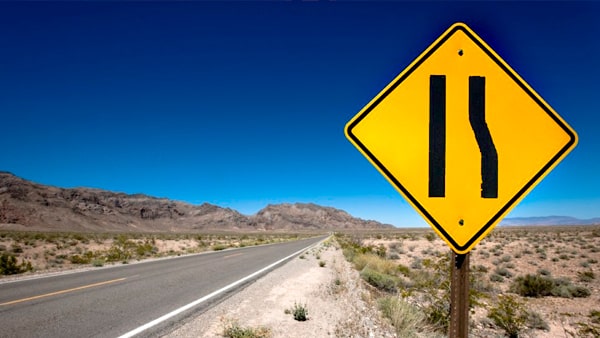
This sign means:
  1. A A lane reduction in which the right lane ends
  2. B The beginning of a divided highway
  3. C A steep hill ahead
  4. D A truck crossing

Correct answer: A – A lane reduction in which the right lane ends

This diamond-shaped warning sign gives advance notice that the right lane will end. The symbol is reversed when the left lane is ending instead. Drivers receive this warning before the reduction so they can prepare for the upcoming lane configuration and merge when it is safe.

Source: West Virginia Driver’s Licensing Handbook — Ch. V, “Diamond & Warning Signs”
Question 2

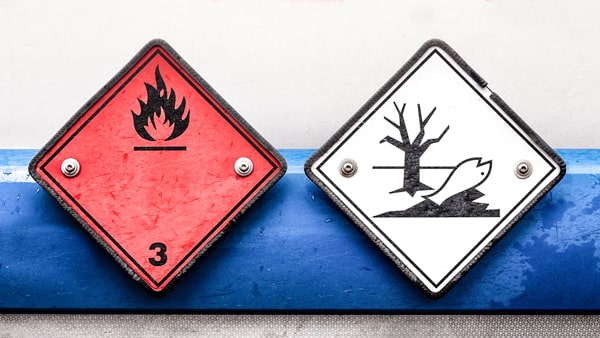
A placarded commercial vehicle is among those required to stop at railroad crossings. What must its driver do, unless an exception applies?

Which of the following is true about vehicles displaying a diamond-shaped sign (indicating a hazardous load)?
  1. A Avoid all controlled-access highways
  2. B Remain below 35 mph
  3. C Stop 15 to 50 feet from the nearest rail, then look and listen
  4. D Proceed before other roadway traffic

Correct answer: C – Stop 15 to 50 feet from the nearest rail, then look and listen

West Virginia law requires specified commercial vehicles, including certain placarded hazardous-material vehicles, to stop between 15 and 50 feet from the tracks. The driver must look and listen in both directions and determine that no train is approaching before crossing. Exceptions include crossings where an officer, flagger, or functioning green traffic signal directs traffic to proceed, and tracks marked out of service.

Source: W. Va. Code § 17C-12-3(a), (b)(3)–(4), (f) — Certain vehicles must stop at all railroad grade crossings.

Question 3

When a traffic signal first turns green, when may you enter the intersection?

  1. A Only after waiting five seconds
  2. B Immediately, even if the intersection is occupied
  3. C After yielding to vehicles and pedestrians lawfully still in the intersection
  4. D Whenever you are first in line

Correct answer: C – After yielding to vehicles and pedestrians lawfully still in the intersection

Under West Virginia law, a green signal permits traffic to proceed straight or turn unless a sign prohibits the movement. Drivers must still yield to vehicles and pedestrians lawfully within the intersection or an adjacent crosswalk when the signal appears. Wait until the intended path is clear before entering.

Source: W. Va. Code § 17C-3-5(a)(1) — Traffic-control signal legend.

Question 4

What does a steady circular green signal permit?

  1. A Slow down and prepare to stop in every case
  2. B Stop before proceeding through the intersection
  3. C Proceed straight or turn when permitted, after yielding as required
  4. D Proceed straight only; turns are prohibited

Correct answer: C – Proceed straight or turn when permitted, after yielding as required

A steady circular green signal permits a driver to proceed through the intersection and to turn right or left unless another traffic-control device prohibits the movement. Turning drivers must yield to vehicles and pedestrians lawfully in the intersection or an adjacent crosswalk. A green light does not authorize entry when the intended path is not clear.

Source: W. Va. Code § 17C-3-5(a)(1) — Traffic-control signal legend., West Virginia Driver’s Licensing Handbook — Ch. V, “Traffic Lights—Circular Green / GO”

Question 5

If a roadway has a double solid yellow centerline, which statement is correct?

  1. A You may cross it for a left turn into a private driveway when the turn is safe and not otherwise prohibited
  2. B The roadway carries traffic in only one direction
  3. C The space between the lines is a center turn lane
  4. D You may cross it to overtake a slow vehicle

Correct answer: A – You may cross it for a left turn into a private driveway when the turn is safe and not otherwise prohibited

The West Virginia handbook identifies a solid yellow centerline as a no-passing marking. State law separately addresses left turns into private roads or driveways, requiring the driver to determine that the turn can be made with reasonable safety and to signal when other traffic may be affected. The lines do not form a center turn lane, and they may not be crossed merely to pass another vehicle.

Source: W. Va. Code § 17C-8-8(a)–(b) — Turning movements and required signals; penalty., West Virginia Driver’s Licensing Handbook — Ch. V, “Pavement Markings”

Question 6

Which warning sign tells you that two-way traffic is ahead?

  1. A The lane-ends sign
  2. B The divided-highway-ends sign
  3. C The sign with arrows pointing in opposite directions
  4. D The sign requiring a left or right turn

Correct answer: C – The sign with arrows pointing in opposite directions

The two-way-traffic warning sign displays one arrow pointing upward and another pointing downward. It warns that vehicles travel in opposing directions on the roadway ahead or reminds drivers that they are on a two-way road. Be prepared to remain to the right of the centerline and encounter oncoming traffic.

Source: West Virginia Driver’s Licensing Handbook — Ch. V, “Diamond & Warning Signs”