


Alaska DMV Practice Test 6

5 out of 5 (45 votes)
80% Passing score
20 Questions
4 Mistakes allowed
The Alaska DMV practice test is not just a warm-up exercise, although, sure, it does a pretty good job of being that too. It is a practical way to get familiar with the same material Alaska expects you to know before it hands over an instruction permit or Class D driver license. The real Alaska General Knowledge Test has 20 questions, a 25-minute time limit, and a passing score of 16 correct answers. That means 80%. You can miss four. Not five. Alaska is generous, apparently, but not that generous. This Alaska permit practice test follows that same 20-question structure, giving you a realistic feel for the DMV written test without making the whole experience feel like someone started a stopwatch just to make your brain fog up. The official test is based on the Alaska Driver Manual, and the subject matter is exactly the sort of driving knowledge that sounds basic until you are actually trying to use it: traffic laws, road signs and signals, right-of-way rules, pavement markings, speed limits, safe driving habits, impaired driving, and sharing the road with pedestrians, bicycles, motorcycles, emergency vehicles, school buses, and large trucks. And yes, turn signals matter. A lot. In Alaska, where roads can shift from city traffic to long rural stretches without much ceremony, drivers need to communicate clearly. Signaling before a turn or lane change is one of those small actions that keeps everyone else from having to guess what you are about to do, which is good, because guessing is a terrible traffic strategy. The official knowledge test may be taken online through KnowTo Drive or through approved in-person and proctored testing options, but this Alaska DMV practice test lets you study without the clock breathing down your neck. If a question trips you up, the hint can give you a nudge, and missed answers come with explanations so you are not just memorizing letters and hoping the same ones show up later. That rarely ends well. This practice test is useful whether you are a teen starting with an instruction permit at 14, an adult applying for a first Alaska license, or a returning driver brushing off old habits. You will still need to handle the rest of the licensing process, including vision screening and, when required, the road test. But the knowledge test comes early, and it deserves real preparation.
FREE DMV Practice Test App
Study for your Alaska permit test or driver’s license with the NextDoorDriving app. 700+ DMV questions and answers, 100% free!
Download on the App Store

Sample Alaska Permit Test Questions

Question 1

A red rectangular sign displaying the words WRONG WAY warns that:
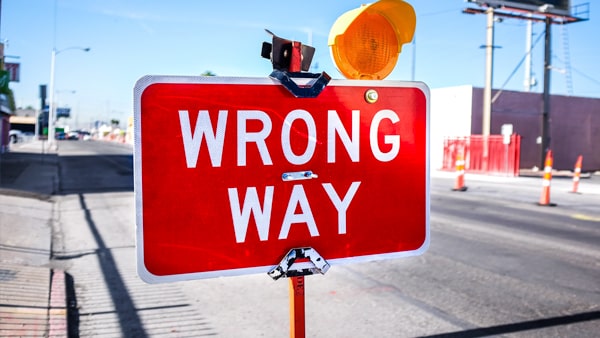
This red and white sign means:
  1. A You may enter after yielding
  2. B The roadway is closed to traffic in every direction
  3. C Only U-turns are prohibited
  4. D You are facing a direction in which traffic is not permitted

Correct answer: D – You are facing a direction in which traffic is not permitted

A WRONG WAY sign warns that your vehicle is pointed against the permitted direction of travel. It may be posted beyond a DO NOT ENTER sign to provide an additional warning. Do not continue traveling past the sign in that direction.

Source: 13 AAC 02.005(a) – Obedience to and Required Traffic-Control Devices, Alaska Driver Manual — “Signs,” “Do Not Enter Sign”

Question 2

When preparing to move left to pass another vehicle, when should you signal?

  1. A Only as the vehicle crosses the lane line
  2. B At any point during the pass
  3. C After entering the passing lane
  4. D Before beginning the lane change, giving others advance notice

Correct answer: D – Before beginning the lane change, giving others advance notice

Alaska requires an appropriate signal before a driver moves right or left on a roadway. The driver manual directs motorists to check traffic and signal left before entering the passing lane, then signal right before returning. Signaling only after the lane change has started does not provide advance notice of the maneuver.

Source: 13 AAC 02.215(a)–(b) – Turning Movements and Required Signals, Alaska Driver Manual — “Passing Safely”

Question 3

Which statement about safety belts is correct?

  1. A They provide protection only above 40 mph
  2. B They are ineffective during low-speed travel
  3. C They are useful only outside cities and towns
  4. D They provide important protection in a crash

Correct answer: D – They provide important protection in a crash

Safety belts provide important protection by restraining occupants during a collision. Their usefulness is not limited to a particular speed or type of roadway. Alaska law requires the use of appropriate safety restraints, subject to the exceptions stated in the statute.

Source: AS 28.05.095 – Use of Safety Belts and Child Safety Devices, Alaska Driver Manual — “Safety Belts,” “Safety Belt Use Is Required by Law”

Question 4

A vehicle behind you is following too closely. Which response is safest?

  1. A Accelerate until the other vehicle falls behind
  2. B Slow gradually and give the following driver time to react
  3. C Brake suddenly to make the driver increase the gap
  4. D Stop checking your mirrors and concentrate only ahead

Correct answer: B – Slow gradually and give the following driver time to react

Remain aware of traffic behind you and avoid an abrupt reduction in speed. The driver manual recommends slowing gradually over a longer distance to give following drivers more time and space to react. Sudden braking may increase the likelihood of being struck from behind.

Source: Alaska Driver Manual — “Control of Vehicle,” “How to Keep From Being Struck”

Question 5

Which action demonstrates defensive driving?

  1. A Using the same one-car-length gap at every speed
  2. B Watching only the vehicle directly ahead
  3. C Moving your eyes and searching for developing hazards
  4. D Doing all of these

Correct answer: C – Moving your eyes and searching for developing hazards

A defensive driver continually gathers information from different parts of the traffic scene. Looking ahead and moving your eyes helps you notice signs, pedestrians, changing traffic, and other hazards. Watching only one vehicle or using a fixed distance at every speed does not account for changing roadway conditions.

Source: Alaska Driver Manual — “Signs,” “How You Can Become a Better ‘Sign’ Driver”, Alaska Driver Manual — “Control of Vehicle,” “How to Avoid Rear End Collisions”

Question 6

When driving a truck down a steep, icy grade, which action is appropriate?

  1. A Follow another vehicle closely to use its tire tracks
  2. B Coast in Neutral to avoid wheel spin
  3. C Slow before the descent and shift to a lower gear
  4. D Accelerate rapidly to increase traction

Correct answer: C – Slow before the descent and shift to a lower gear

The Alaska driver manual’s steep-downgrade warning directs truck drivers to slow and shift to a lower gear. Its winter guidance also instructs drivers to slow well in advance on ice or packed snow and avoid abrupt changes. Coasting downhill in Neutral or with the clutch disengaged is prohibited.

Source: 13 AAC 02.515 – Coasting Prohibited, Alaska Driver Manual — “Signs,” “Warning Sign”, Alaska Driver Manual — “Weather Conditions,” “Skids—Prevention”