Alaska DMV Sign Test 4

5 out of 5 (39 votes)
80% Passing score
20 Questions
4 Mistakes allowed
Getting ready for an Alaska DMV renewal, an instruction permit, or a first driver license is not just a matter of glancing at a few signs and hoping the rest comes back to you. Road signs are one of those areas that feel obvious right up until the question gets oddly specific, or the sign shape matters more than the wording, or a color tells you something before you have time to read the actual sign. That is where this Alaska DMV permit practice test earns its keep. This Alaska road sign test gives you 20 multiple-choice questions built around the signs, colors, shapes, and symbols drivers are expected to recognize on Alaska roads. Red means stop, yield, or pay attention now. Green points you toward permitted movement or directions. Yellow is the road’s way of clearing its throat before something potentially unpleasant shows up. Simple, yes, but not always simple when you are thinking about icy pavement, a rural highway, a school zone, or a construction area that appears after a curve with very little ceremony. And, slightly less glamorous but still important, the road sign knowledge fits into the larger Alaska licensing process. Applicants can apply for an Alaska instruction permit starting at age 14, but they still need to pass the written knowledge test and vision test, submit the application, provide the required identity and residence documents, have parental or guardian consent, and pay the permit fee. Permit holders must drive with a qualified supervising driver, which is probably for the best, even if every new driver thinks they are ready sooner than they are. For drivers ages 16 and 17 moving toward a provisional license, Alaska requires at least 6 months with an instruction permit, no traffic violation conviction or license suspension during the previous 6 months, 40 hours of driving experience, including 10 hours in progressively challenging conditions, parental consent, and a passed road test. Adults 18 and older also need the knowledge test, vision test, required documents, applicable fees, and usually the road test unless exempt. This Alaska DMV practice test is available on desktop or mobile, so you can work through it without making a whole production out of studying. Score 16 out of 20, and you are showing the kind of road sign knowledge that matters before the road test, during renewal, and, more importantly, when the sign ahead is the only warning you are going to get.
FREE DMV Practice Test App
Study for your Alaska permit test or driver’s license with the NextDoorDriving app. 700+ DMV questions and answers, 100% free!
Download on the App Store

Sample Alaska Permit Test Questions

Question 1

When your traffic signal turns green, when may you proceed?

  1. A Only after waiting five seconds
  2. B Immediately, even if the intersection is occupied
  3. C When the intersection is clear, after yielding to lawful traffic and pedestrians
  4. D Whenever the signal is green because your right-of-way is absolute

Correct answer: C – When the intersection is clear, after yielding to lawful traffic and pedestrians

A green signal permits you to proceed, but the intersection must be clear. Alaska regulation requires turning traffic to yield to vehicles or pedestrians lawfully within the intersection or an adjacent crosswalk. A driver turning left must also yield to opposing traffic traveling straight when required.

Source: 13 AAC 02.010(a)(1) – Traffic-control signal legend, Alaska Driver Manual — “Traffic Signals,” “Green Ball”
Question 2

Orange traffic signs and flags alert drivers to:

  1. A Permanent roadway closures only
  2. B Road work, workers or temporary roadway conditions
  3. C Ordinary regulatory speed zones
  4. D High-occupancy vehicle lanes

Correct answer: B – Road work, workers or temporary roadway conditions

Black-and-orange signs identify construction, maintenance, utility work, or other temporary roadway conditions. They may warn about workers, flaggers, equipment, detours, lane changes, or altered surfaces. Drivers should adjust their speed and prepare for the specific condition shown on the sign.

Source: Alaska Driver Manual — Signs, “Construction & Maintenance Sign”, Alaska Driver Manual — “Signs Within Work Areas”

Question 3

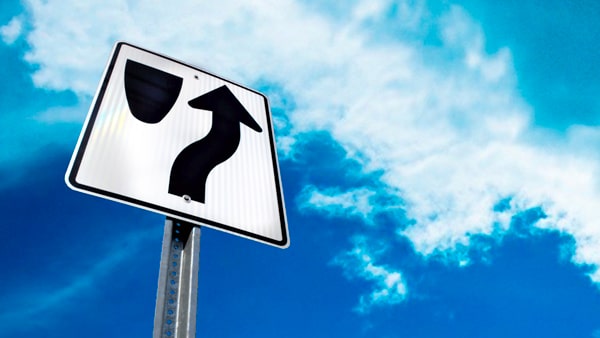
A white rectangular sign shows an arrow passing to the right of an obstruction. What must you do?

This white sign means:
  1. A Keep to the right of the obstruction
  2. B Yield before making a right turn
  3. C Move right only if traveling below the normal speed
  4. D Turn right at the next intersection

Correct answer: A – Keep to the right of the obstruction

A KEEP RIGHT sign directs traffic to pass on the right side of an island, divider, or other obstruction. It is a regulatory sign, not merely a warning or suggestion. Follow the arrow and remain on the designated side of the obstruction.

Source: Alaska Driver Manual — Signs, “Regulatory Sign”

Question 4

Which signal requires you to make a complete stop?

  1. A A flashing red light
  2. B A steady yellow light
  3. C A steady yellow arrow
  4. D A flashing yellow light

Correct answer: A – A flashing red light

A flashing red signal requires a complete stop at the stop line, crosswalk, or intersection boundary. Under Alaska’s rule, you may proceed only after yielding to traffic and pedestrians and determining that movement is safe. A flashing yellow signal instead calls for caution and does not automatically require a stop.

Source: 13 AAC 02.020(a) – Flashing signals, Alaska Driver Manual — “Traffic Signals,” “Flashing Red Ball”

Question 5

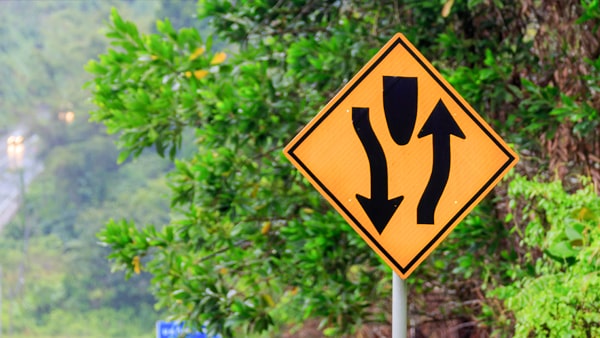
A yellow warning sign shows opposing arrows separated by a divider that begins at the bottom of the symbol. What is ahead?

This sign means:
  1. A The divided highway ends
  2. B A one-way roadway begins
  3. C A one-way roadway ends
  4. D A divided highway begins

Correct answer: D – A divided highway begins

The Divided Highway Begins sign warns that the undivided roadway will separate into two roadways divided by a median or other physical barrier. Traffic traveling in opposite directions will use separate roadways. Keep to the right of the divider as you enter the divided section.

Source: Alaska Traffic Manual — § 2C.21, “Divided Highway (Road) Signs (W6-1 and W6-2)”, Alaska Driver Manual — Signs, “Warning Sign”

Question 6

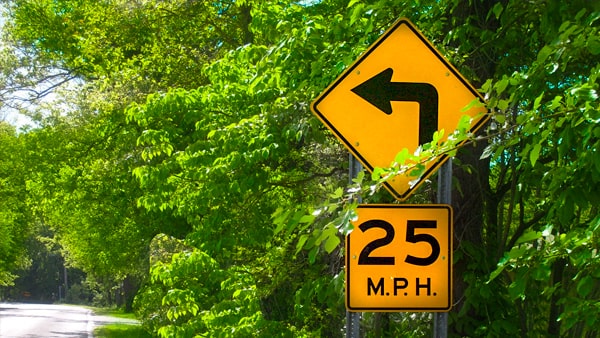
A left-curve warning sign is posted above a 25 MPH advisory speed plaque. What does the combination indicate?

This sign means:
  1. A A left curve with a minimum speed of 25 mph
  2. B A right curve with a minimum speed of 25 mph
  3. C A right curve with an advisory speed of 25 mph
  4. D A left curve with an advisory speed of 25 mph

Correct answer: D – A left curve with an advisory speed of 25 mph

The warning sign identifies a curve to the left, and the plaque displays the advisory speed for that curve. The Alaska Traffic Manual requires advisory speeds to be determined through an engineering study and used with an advance warning sign. Weather, surface, visibility, or traffic conditions may require a lower speed.

Source: Alaska Traffic Manual — § 2C.59, “Advisory Speed Plaque (W13-1P) and Confirmation Advisory Speed Plaque (W13-1aP)”, Alaska Driver Manual — “Speed Limitation Law”