California DMV Test Evaluation

4.6 out of 5 (15135 votes)
80% Passing score
10 Questions
2 Mistakes allowed
Taking your first steps towards earning a California driver's license? This initial DMV practice test is the perfect tool to help you evaluate whether you're truly ready to ace the real thing. Crafted by seasoned driving instructors with years of experience, this California driving test practice features 10 carefully selected questions that span a wide range of driving essentials. Whether you're navigating the bustling streets of Los Angeles, cruising along the Pacific Coast Highway, or merging onto the freeways of San Francisco, this practice test ensures you're equipped with the knowledge you need to stay safe and informed. The questions in this California DMV permit practice test closely mirror those you'll encounter on the actual test, giving you a realistic taste of what's to come. By requiring you to answer at least 8 out of 10 questions correctly, this test provides a quick, low-pressure way to assess your readiness. It's ideal for those who want to quickly check their knowledge on key topics like road signs, speed limits, and right-of-way rules. And while it's a short evaluation, it's a powerful tool to gauge whether you need to hit the books a little harder or if you're ready to move forward with scheduling your official California DMV permit test. Even if you breeze through this DMV learners permit test, it's highly recommended that you continue practicing with additional tests available on our site. Each one offers a different set of questions, covering the diverse and intricate rules of the road you'll face while driving through California's varied landscapes, from the rolling hills of Napa Valley to the vibrant streets of San Diego. Remember, the actual DMV permit test will be more extensive, with 46 questions requiring you to correctly answer at least 39. So, take advantage of this practice test to ensure your knowledge is as comprehensive as possible before stepping into a DMV office.
FREE DMV Practice Test App
Study for your California permit test or driver’s license with the NextDoorDriving app. 700+ DMV questions and answers, 100% free!
Download on the App Store

Sample California Permit Test Questions

Question 1

When turning right at a circular green signal, to whom must you yield?

  1. A Vehicles waiting at a red light on the cross street
  2. B Drivers stopped behind your vehicle
  3. C Pedestrians lawfully within the intersection or an adjacent crosswalk
  4. D Vehicles parked beyond the corner

Correct answer: C – Pedestrians lawfully within the intersection or an adjacent crosswalk

A circular green signal permits a driver to proceed straight or make an otherwise lawful turn. A turning driver must still yield to pedestrians lawfully within the intersection or an adjacent crosswalk, as well as other traffic lawfully there. Begin the turn only when it can be completed without interfering with those road users.

Source: CVC § 21451(a)
Question 2

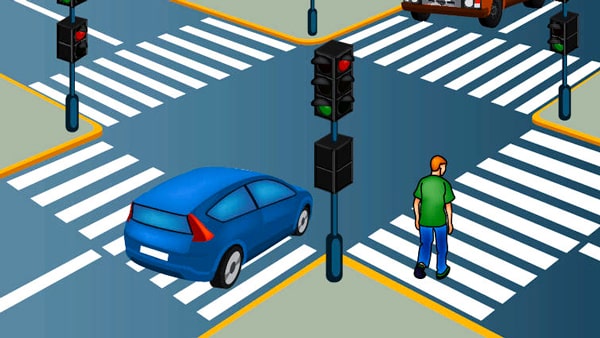
Your light turns green as a pedestrian lawfully starts crossing the street you intend to enter. Who must yield?

You are waiting at a red light to turn right, and a pedestrian on your right is waiting to cross the street you want to enter. Who has the right-of-way when your light turns green?
  1. A You must yield to the pedestrian
  2. B You must yield only if the crosswalk is marked
  3. C The pedestrian must yield because your light is green
  4. D The person who moves first has the right-of-way

Correct answer: A – You must yield to the pedestrian

A driver turning on a circular green signal must yield to pedestrians lawfully within the intersection or an adjacent crosswalk. A pedestrian facing a circular green signal may cross within a marked or unmarked crosswalk, subject to the duty to yield to vehicles already lawfully in the intersection. The turning driver must wait when yielding is required.

Source: CVC § 21451(a), (c)

Question 3

How should you check traffic before merging onto a freeway?

When you enter a freeway, you should check traffic by using:
  1. A Use the inside and outside mirrors only
  2. B Check only the rearview mirror
  3. C Use your mirrors and quickly look over your shoulder
  4. D Check only the left side-view mirror

Correct answer: C – Use your mirrors and quickly look over your shoulder

Before merging, use your mirrors and turn signal, then quickly look over your shoulder to check the blind spot. Merge only into a space large enough for your vehicle to enter safely. The handbook also recommends leaving three seconds of space behind the vehicle ahead and checking blind spots each time you cross another lane.

Source: California Driver’s Handbook — § 6, “Merging”

Question 4

On a street with two lanes in each direction, where should a California driver normally begin a U-turn?

  1. A Always from a center left-turn lane
  2. B From the left-turn lane or far-left lane
  3. C From the far-right lane
  4. D From any open lane

Correct answer: B – From the left-turn lane or far-left lane

The handbook directs drivers making a U-turn to signal and use the left-turn lane or far-left lane. A center left-turn lane may be used when one is provided for the maneuver, but such a lane is not present on every road. The U-turn must also be made only where it is lawful and visibility is adequate.

Source: California Driver’s Handbook — § 6, “U-Turn”

Question 5

Unless a statutory exception applies, when should occupants use seat belts while traveling on a California highway?

  1. A Only at speeds above 40 mph
  2. B Only during low-speed trips
  3. C Only when driving in a city
  4. D On every trip, regardless of speed

Correct answer: D – On every trip, regardless of speed

CVC § 27315 generally requires drivers and passengers age 16 or older to be properly restrained by safety belts on a highway, subject to specified exceptions. The handbook explains that lap and shoulder belts increase the chance of survival in most types of collisions. Their use is not limited to a particular speed or type of road.

Source: CVC § 27315(d), (e), (g), California Driver’s Handbook — § 8, “Seat Belts”

Question 6

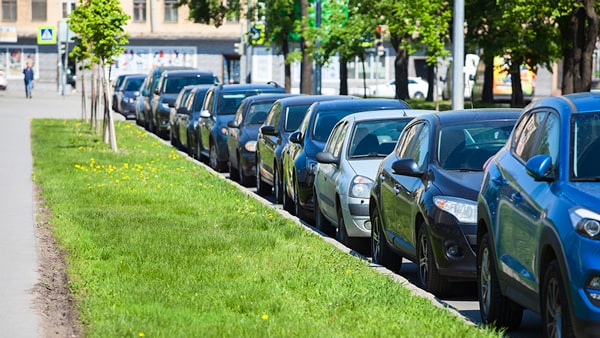
When parking on the right side of a level, two-way California road with a curb, how must the vehicle be positioned?

When you park on a level road next to a curb:
  1. A The right-hand wheels must be parallel to and within 18 inches of the curb
  2. B The front wheels must point sharply toward the center of the road
  3. C The brakes do not need to be set
  4. D The front wheels must be turned into the curb

Correct answer: A – The right-hand wheels must be parallel to and within 18 inches of the curb

CVC § 22502(a) requires the right-hand wheels to be parallel to and within 18 inches of the right-hand curb, subject to the section’s exceptions. The special wheel-turning rules for hills do not apply to ordinary level-road parking. Before leaving a motor vehicle unattended on a highway, the driver must effectively set its brakes and stop the motor.

Source: CVC § 22502(a), CVC § 22515(a)