California DMV Permit Practice Test 2

4.8 out of 5 (8292 votes)
80% Passing score
20 Questions
4 Mistakes allowed
Studying for the California DMV test sounds innocent enough until the Driver’s Manual starts tossing tiny, testable details at you like confetti with legal consequences. This updated California DMV practice test gives you 20 multiple-choice questions that work as a quick gut-check before the real CA permit test — not a full California driver's education course, obviously, but a useful way to see whether the handbook actually stuck. This California DMV permit practice test is built around real permit-test territory, not random driving trivia, not “my cousin said this was on the test,” and definitely not vibes. The official California permit test changes a bit depending on your age, because apparently even the DMV enjoys plot twists. If you are under 18, the written knowledge test has 46 questions, and you need 38 correct answers to pass, meaning you can miss 8. If you are 18 or older, the CA DMV permit test has 36 questions, and you need 30 correct, so only 6 misses. The DMV lists the passing score as 80%, although the math is fussier: 38 out of 46 is about 82.6%, and 30 out of 36 is about 83.3%. There is no official time limit, as long as you finish before the DMV office closes for the day — which is generous, but in a very fluorescent-lighting kind of way. The questions in this California DMV practice test cover the stuff the real DMV written test cares about: traffic laws, road signs, right-of-way decisions, safe driving habits, DUI and substance abuse rules, seat belt requirements, the hands-free cell phone law, and California’s “Move Over” law, where drivers must slow down and, when possible, change lanes for stopped emergency vehicles. Hints are there when a DMV test question gets weirdly slippery, and missed answers come with explanations, because “wrong” is more useful when it tells you exactly what went sideways. Eligible applicants can take the official California DMV test online from home with a webcam-equipped computer, while minors need parental supervision and consent. In-person DMV permit test options are still available at California DMV offices, usually on a touchscreen kiosk, with paper tests by request. Pass the DMV test online, though, and you still have to visit the DMV for biometrics, a photo, and the actual physical permit. The $45 application fee covers up to 3 knowledge test attempts within 12 months. Minors who fail must wait 7 calendar days before retesting, not counting the day they failed. So yes, using a DMV permit practice test first is the less dramatic route.

FREE DMV Practice Test App
Study for your California permit test or driver’s license with the NextDoorDriving app. 700+ DMV questions and answers, 100% free!
Download on the App Store

Sample California Permit Test Questions

Question 1

If your California driving privilege has been revoked and you have no valid restricted authorization, what may you do on a public road?

  1. A Drive only during an emergency
  2. B Drive only between home, work, and school
  3. C Do not drive
  4. D Drive when accompanied by a licensed adult

Correct answer: C – Do not drive

CVC § 12500(a) prohibits driving on a highway without a valid driver’s license unless an express exemption applies. A revoked privilege does not permit ordinary driving to work, school, or during a personal emergency. For revocations governed by CVC § 14601.1, a first knowing violation may bring up to six months in jail, a $300 to $1,000 fine, or both.

Source: CVC § 12500(a), CVC § 14601.1(a), (b)(1)

Question 2

Which condition ahead is a clear reason to reduce speed and prepare to stop?

You should usually drive slower when:
  1. A You are passing a large truck on a freeway
  2. B You want a better view of a collision scene
  3. C Brake lights appear on several vehicles ahead
  4. D Nearby drivers are traveling faster than you

Correct answer: C – Brake lights appear on several vehicles ahead

A line of brake lights indicates that traffic ahead is slowing or stopping. Scanning at least 10 seconds ahead gives you more time to reduce speed smoothly and preserve following distance. California’s Basic Speed Law also requires a reasonable and prudent speed that accounts for existing traffic and roadway conditions.

Source: CVC § 22350, California Driver’s Handbook — § 8, “Scan Your Surroundings”, California Driver’s Handbook — § 8, “Tailgating (Following Too Closely)”

Question 3

Which habit is a basic part of defensive driving?

  1. A Stare at the center of the lane
  2. B Stay alert, keep your eyes moving, and scan ahead
  3. C Rely on other drivers to correct your mistakes
  4. D Wait until the last moment to respond to danger

Correct answer: B – Stay alert, keep your eyes moving, and scan ahead

Defensive driving requires awareness of changing traffic conditions. Keep your eyes moving and scan at least 10 seconds ahead so you have time to recognize and react to hazards. Check traffic behind you regularly with the mirrors and by turning your head when necessary rather than focusing on only one point.

Source: California Driver’s Handbook — § 8, “Scan Your Surroundings”, California Driver’s Handbook — § 8, “Know What Is Behind You”

Question 4

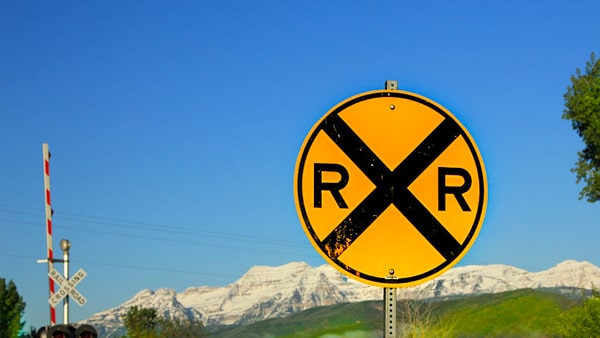
A round yellow sign marked with a black “X” and “RR” warns that you are approaching:

This sign is a warning that you are approaching:
  1. A An ordinary intersection
  2. B A pedestrian crosswalk
  3. C A railroad crossing
  4. D A blasting zone

Correct answer: C – A railroad crossing

A yellow-and-black circular sign warns that a railroad crossing is ahead. Reduce speed and be ready to look and listen for trains as you approach. Allow any train to pass, obey crossing signals and gates, and enter the crossing only when it is safe.

Source: California Driver’s Handbook — § 7, “Yellow and Black Circular Sign or X-shaped Sign”

Question 5

When parking an automatic-transmission vehicle on a hill, what should you always do in addition to setting the parking brake?

  1. A Shift the transmission into Park
  2. B Keep the front wheels parallel to the roadway
  3. C Leave the transmission in Neutral
  4. D Always turn the wheels toward the curb

Correct answer: A – Shift the transmission into Park

When parking on a hill, set the parking brake and leave an automatic-transmission vehicle in Park. A manual-transmission vehicle should be left in gear. The correct wheel direction depends on whether the vehicle faces uphill or downhill and whether a curb is present, making “always toward the curb” inaccurate.

Source: California Driver’s Handbook — § 6, “Parking on a Hill”

Question 6

Your signal turns green, but vehicles still block the intersection. Under California law, what should you do?

  1. A Enter the intersection and wait there
  2. B Enter if you can drive around the other vehicles
  3. C Wait until there is enough room to clear the intersection without obstructing traffic
  4. D Enter because the green signal gives you priority

Correct answer: C – Wait until there is enough room to clear the intersection without obstructing traffic

The Anti-Gridlock Act prohibits entering an intersection, even with a signal to proceed, unless there is enough space on the other side for your vehicle. You must be able to enter without obstructing vehicles traveling from either side. Wait behind the intersection until sufficient space is available and proceeding is otherwise safe.

Source: CVC § 22526(a), (g) — Anti-Gridlock Act of 1987