


California Driving Test Practice 4

4.8 out of 5 (5514 votes)
80% Passing score
20 Questions
4 Mistakes allowed
California driving rules have a funny way of sounding simple until the DMV asks about them with that very DMV-ish seriousness. This California DMV practice test leans into one of the sneakier areas: child safety seats. Not glamorous, no. Not the part of the California Driver’s Manual anyone is bragging about mastering. But if you are taking the real California permit test, renewing your license, or just trying not to be the person who “kind of remembers” where a child restraint is supposed to go, it matters. This 20-question California driving test practice is built around child passenger safety, correct car seat installation, restraint use, and those small legal details that can turn into missed questions if you skim too fast. You will need 16 correct answers to hit the 80% passing score on this drivers permit practice test, which is a nice, tidy little benchmark before the official test gets involved and makes everything slightly more annoying. The real California written knowledge test comes from the DMV Driver’s Manual and covers traffic laws, road safety, substance abuse rules, DUI regulations, and plenty of everyday driving responsibilities. Applicants under 18 get 46 multiple-choice questions and must answer 38 correctly. Adults 18 and over get 36 questions and need 30 correct answers. The DMV calls the passing threshold 80%, although, because math enjoys being inconvenient, that works out to about 82.6% for minors and 83.3% for adults. You may be able to take the official knowledge test online from home with a webcam-equipped computer, or in person at a California DMV office. Minors testing online need parental consent and remote supervision. And here’s the little catch — passing online does not mean you get to skip the DMV entirely. You still have to show up in person for biometric data, a photo, and the actual physical permit. The California driver’s license application fee is $45 and covers up to three knowledge test attempts within 12 months. If you are under 18 and fail, there is a 7-calendar-day waiting period before you can retest, not counting the day you failed. So, yes, practicing child safety seat rules now is not exactly thrilling. But it is cheaper, calmer, and much less irritating than learning them after the fact.
FREE DMV Practice Test App
Study for your California permit test or driver’s license with the NextDoorDriving app. 700+ DMV questions and answers, 100% free!
Download on the App Store

Sample California Permit Test Questions

Question 1

In California, which child must be secured in a child passenger restraint system rather than using only a safety belt?

  1. A A five-year-old who is 4 feet 4 inches tall
  2. B A seven-year-old who is 4 feet 10 inches tall
  3. C A nine-year-old who is properly secured by a safety belt

Correct answer: A – A five-year-old who is 4 feet 4 inches tall

A child under eight generally must ride in an appropriate child passenger restraint system in a rear seat. An under-eight child who is at least 4 feet 9 inches tall may use a properly fitted safety belt instead. Children from age eight through 15 must be secured by either an appropriate restraint system or safety belt. A first restraint-law conviction carries a $100 fine; a later conviction carries a $250 fine, subject to specified program alternatives.

Source: CVC §§ 27360(a), 27360.5(a), 27363(d), CVC § 27360.6(a)–(b)
Question 2

How should you direct your vision while driving?

  1. A Keep looking only at the center of your lane
  2. B Concentrate exclusively on the vehicle directly ahead
  3. C Look ahead only when no vehicle is following you
  4. D Keep your eyes moving and scan ahead and around your vehicle

Correct answer: D – Keep your eyes moving and scan ahead and around your vehicle

Keep your eyes moving so you remain aware of the entire driving environment. Scan the road at least 10 seconds ahead to identify hazards early and reduce last-minute movements. Your observation should also include the sides of the road, mirrors, and areas beyond the vehicle immediately ahead.

Source: California Driver’s Handbook — § 8, “Scan Your Surroundings”

Question 3

You received your provisional license three months ago. If no exception applies, which trip may you make alone?

  1. A Drive to school at 6 a.m.
  2. B Drive home alone at midnight
  3. C Take a 17-year-old friend to school at noon

Correct answer: A – Drive to school at 6 a.m.

During the first 12 months of a California provisional license, an unsupervised driver generally may not drive from 11 p.m. to 5 a.m. or transport passengers under age 20. Driving alone at 6 a.m. does not violate either restriction. Documented exceptions exist for specified medical, school, employment, and family needs. A violation may result in community service or a fine of up to $35 for a first offense and $50 for a later offense.

Source: CVC § 12814.6(b)(1)–(2), (e)(1)

Question 4

Which description best identifies a vehicle's blind spot?

  1. A The area visible through the rear window
  2. B Anything reflected in the rearview mirror
  3. C Everything shown in a properly adjusted side mirror
  4. D An area you cannot see by looking ahead or using the mirrors

Correct answer: D – An area you cannot see by looking ahead or using the mirrors

Blind spots are areas around your vehicle that are not visible when you look straight ahead or use the mirrors. For most vehicles, they are located along the sides and slightly behind the driver. Check them by briefly looking over the appropriate shoulder before changing lanes, merging, turning, backing, or leaving a parking space.

Source: California Driver’s Handbook — § 8, “Blind Spots”

Question 5

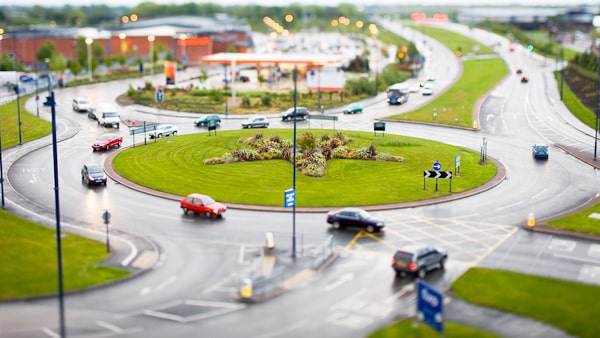
At a roundabout, which traffic must an entering driver yield to?

You have the right-of-way when you are:
  1. A Only vehicles approaching from behind
  2. B Only vehicles using the outside lane
  3. C Vehicles waiting to enter from another approach
  4. D All traffic already circulating in the roundabout

Correct answer: D – All traffic already circulating in the roundabout

When approaching a California roundabout, slow down and yield to all traffic already circulating within it. Enter to the right only when a sufficiently large gap allows you to merge safely. Follow posted signs and lane markings, travel counterclockwise, and signal when changing lanes or leaving the roundabout.

Source: California Driver’s Handbook — § 7, “Roundabouts”

Question 6

A truck ahead swings left while signaling a right turn. Which action is especially dangerous?

  1. A Driving between the truck and the right curb
  2. B Waiting behind the truck until it finishes turning
  3. C Increasing the space between your vehicle and the truck
  4. D Watching the truck's turn signal and movement

Correct answer: A – Driving between the truck and the right curb

Large trucks often need extra space to complete right turns because their rear wheels follow a shorter path than their front wheels. A truck may swing left before turning right, creating what appears to be an open space beside the curb. Do not enter that space; the truck may close it as the turn is completed.

Source: California Driver’s Handbook — § 7, “Turning”