


California DMV Sign Test 3

4.8 out of 5 (2198 votes)
80% Passing score
20 Questions
4 Mistakes allowed
Studying road signs for the California driving test sounds simple until you realize the DMV is not handing you a neat little “road signs only” exam with a bow on top. California does not have a separate standalone road signs test. Convenient? Maybe. Mildly annoying when you are trying to study one thing at a time? Also yes. Road sign questions are mixed into the main DMV knowledge test, right alongside the other rules, so anything about sign color, shape, or meaning counts toward your overall score. That is why this CA road signs test is still worth your time. It gives you a focused way to practice the sign stuff without pretending the official test works differently than it actually does. You will see the usual suspects: octagonal stop signs, triangular yield signs, warning signs, regulatory signs, guide signs, and those signs that seem obvious until the answer choices start looking suspiciously similar. California roads do not exactly lack variety either. One minute you are dealing with city traffic in Los Angeles, the next you are imagining some winding road near Napa or a rural highway outside Yosemite where the sign is basically your only early warning before things get interesting. This California DMV signs test includes 20 multiple-choice questions on road sign shapes, meanings, colors, and recognition. You will need 16 correct answers to pass this practice test. On the real California permit test, though, there is no separate road-sign missed-question limit. Road sign questions count with everything else. Applicants under 18 may miss 8 total questions on the full knowledge test, while applicants 18 and over may miss 6 total questions. So, yes, the signs matter, but not in their own tiny DMV kingdom. The official DMV test is also available in English, Spanish, Arabic, Chinese, French, German, Korean, Vietnamese, and more than 30 languages total. Audio or oral testing is available through touchscreen terminal headsets, and video testing in American Sign Language, or ASL, is available on touchscreen terminals too. A few age details, because California likes details. The minimum age for a provisional instruction permit is 15½. Applicants under 18 must complete driver education. Adults 18 and older do not need driver education or professional behind-the-wheel training. So whether you are using this as California permit test practice, a DMV practice test warm-up, or just a quick reality check before the real knowledge test, learning your signs is not optional. Annoying, maybe. Useful, absolutely.
FREE DMV Practice Test App
Study for your California permit test or driver’s license with the NextDoorDriving app. 700+ DMV questions and answers, 100% free!
Download on the App Store

Sample California Permit Test Questions

Question 1

An overhead sign marks your lane EXIT ONLY. What will happen if you remain in that lane?
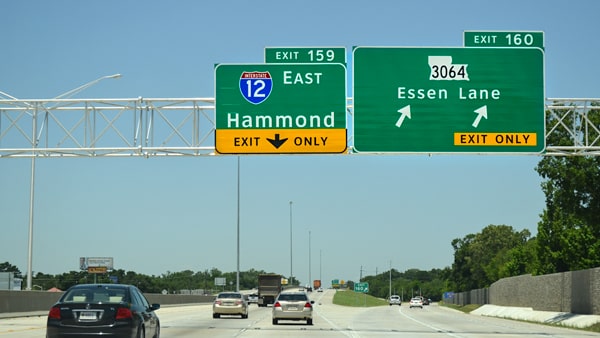
If you see this sign above your lane, you:
  1. A. You will be prohibited from using the exit
  2. B. You may either exit or continue on the freeway
  3. C. The lane will continue through the interchange
  4. D. The lane will leave the freeway at the exit

Correct answer: D. – The lane will leave the freeway at the exit

An EXIT ONLY panel identifies an interchange lane that drops from the freeway and becomes an exit lane. Staying in that lane requires you to take the exit. If you want to continue on the freeway, make a safe and legal lane change before the exit lane separates.

Source: California MUTCD 2026 — Ch. 2E, “Guide Signs—Freeways and Expressways”, California Driver’s Handbook — § 6, “End of Lane Markings”

Question 2

After stopping at a stop sign’s limit line, you cannot see cross traffic clearly. What should you do next?

  1. A. Wait five seconds and then enter
  2. B. Sound the horn and proceed
  3. C. Listen for traffic without moving forward
  4. D. Move forward slowly, check for traffic and pedestrians, and proceed when clear

Correct answer: D. – Move forward slowly, check for traffic and pedestrians, and proceed when clear

California law requires the initial stop at the marked limit line. If your view is blocked after stopping, move forward slowly until you can see, while continuing to check for vehicles, bicyclists, and pedestrians. Enter the intersection only when the way is clear and applicable right-of-way requirements have been satisfied.

Source: CVC § 22450(a), California Driver’s Handbook — § 7, “Blind Intersections”

Question 3

Why should you look left and right before entering an intersection after your light turns green?

  1. A. A vehicle, bicyclist, or pedestrian may still be in your path
  2. B. A green light gives you priority over everyone already there
  3. C. Cross traffic always receives a green arrow at that time
  4. D. You only need to check straight ahead after entering

Correct answer: A. – A vehicle, bicyclist, or pedestrian may still be in your path

A circular green signal permits you to proceed, but you must yield to traffic and pedestrians lawfully within the intersection or an adjacent crosswalk. Look left, right, and ahead before entering to identify anyone still in your path. Proceed only when there is enough clear space to do so safely.

Source: CVC § 21451(a), California Driver’s Handbook — § 7, “Intersections”

Question 4

Your signal turns green, but vehicles are still occupying the intersection. What should you do?

  1. A. Wait until the vehicles clear before entering
  2. B. Enter if you can steer around the vehicles
  3. C. Pull into the intersection and wait there
  4. D. Honk and enter because your light is green

Correct answer: A. – Wait until the vehicles clear before entering

A green signal does not authorize you to drive into the path of vehicles already within the intersection. California law requires a driver facing green to yield to traffic and pedestrians lawfully there. Wait until the intersection is clear and there is sufficient space for you to proceed.

Source: CVC § 21451(a), California Driver’s Handbook — § 7, “Solid Green Light”

Question 5

In California, you are waiting to turn left on a circular green light while oncoming traffic is heavy. What should you do?

  1. A. Abandon the turn and use the next intersection
  2. B. Stop with your vehicle extending into the crosswalk
  3. C. Yield until a gap allows the turn to be made safely
  4. D. Turn immediately because the light is green

Correct answer: C. – Yield until a gap allows the turn to be made safely

A left-turning driver must yield to approaching vehicles that are close enough to create a hazard and must continue yielding until the turn can be made with reasonable safety. A circular green signal permits the turn but does not cancel this duty. Wait for a safe gap before completing the maneuver.

Source: CVC § 21801(a), CVC § 21451(a)

Question 6

What restriction is indicated by a red-painted curb?

  1. A. No stopping, standing, or parking, except for a bus at a marked bus loading zone
  2. B. Parking is limited to commercial vehicles
  3. C. Parking is reserved for people with disabilities

Correct answer: A. – No stopping, standing, or parking, except for a bus at a marked bus loading zone

Under California law, a red curb means no stopping, standing, or parking, whether the vehicle is attended or unattended. The stated exception permits a bus to stop where the red zone is marked or signposted as a bus loading zone. A red curb is not a commercial loading or disabled-parking zone.

Source: CVC § 21458(a)(1)