California Road Signs Test 2

4.8 out of 5 (2475 votes)
80% Passing score
20 Questions
4 Mistakes allowed
California road signs are not tested in their own neat little DMV bubble, even though it would be nice if the state made things that tidy. Instead, road sign identification is built directly into the main California DMV knowledge test, along with traffic laws, road safety, substance abuse and DUI regulations, and the other rules covered in the California Driver’s Manual. That means this CA road sign test is best used as focused practice for one important slice of the larger written knowledge test — the part where sign color, shape, and meaning can absolutely cost you a question if you only half-remember what you saw in the handbook. This California road sign practice test includes 20 multiple-choice questions designed to help you review the signs you are most likely to see on California roads and in DMV-style questions. It is not a separate official DMV sign test, and there is no special road-sign-only score you need to pass. Road sign questions count toward your overall missed-question limit on the real California permit test. Applicants under 18 take a 46-question knowledge test and must answer 38 correctly, so they may miss 8 total questions. Applicants 18 and over take a 36-question test and must answer 30 correctly, which means they may miss 6 total questions. The DMV lists the passing threshold as 80%, though the required raw scores work out a little higher in practice — about 82.6% for minors and 83.3% for adults. The real California DMV written test can be taken in person at a DMV office, often on a touchscreen kiosk, with a paper version available by request. Eligible applicants may also take the knowledge test online from home using a webcam-equipped computer, though minors under 18 need remote parental supervision and consent. Passing online does not mean you are completely done, of course, because the DMV still wants to see you in person for biometric data, a photo, and the physical permit document. Everyone also has to pass a vision test before receiving an instruction permit or driver’s license. Use this California DMV signs practice test as a low-pressure way to sharpen your road sign knowledge before the real exam. Take it once, notice which signs make you hesitate, then take it again until the answers stop feeling like educated guesses. Since the $45 California driver’s license application fee covers up to 3 knowledge test attempts within 12 months, it makes sense to practice before using one of them. And if you are under 18, failing the official test means waiting 7 calendar days before trying again, not counting the day you failed — another small DMV detail that makes a little extra practice feel less optional.
FREE DMV Practice Test App
Study for your California permit test or driver’s license with the NextDoorDriving app. 700+ DMV questions and answers, 100% free!
Download on the App Store

Sample California Permit Test Questions

Question 1

When an edge line marks the right side of a roadway, what type of line is used?

  1. A Broken white
  2. B Solid yellow
  3. C Solid white
  4. D Broken yellow

Correct answer: C – Solid white

A right edge line is a solid white line marking the outside edge of the traveled way. Edge lines help drivers identify roadway boundaries, especially where visibility is reduced. A yellow edge line is used on the left side of certain divided or one-way roadways.

Source: California MUTCD 2026 Edition — § 3B.09, “Edge Line Pavement Markings”
Question 2

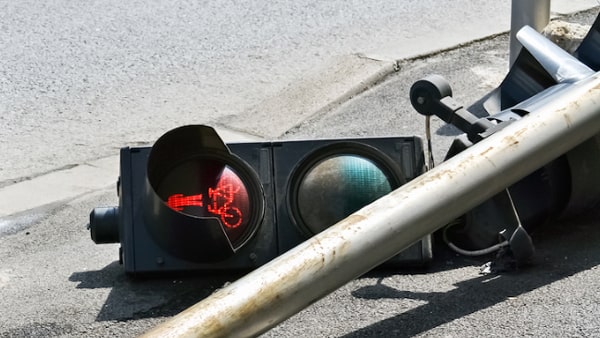
What must you do when a traffic signal at an intersection is not operating?

When a traffic signal light is not working, you should:
  1. A Stop only when another vehicle is present
  2. B Slow down but continue without stopping
  3. C Stop, then proceed cautiously when it is safe
  4. D Drive through as though the signal were green

Correct answer: C – Stop, then proceed cautiously when it is safe

California law requires a driver approaching an intersection with an inoperative traffic signal to stop. After stopping, the driver may proceed cautiously when it is safe. If vehicles arrive from different roads at the same time, the driver on the left generally yields to the vehicle on the immediate right.

Source: CVC § 21800(d)(1)–(2), California Driver’s Handbook — § 7, “Traffic Light Not Working”

Question 3

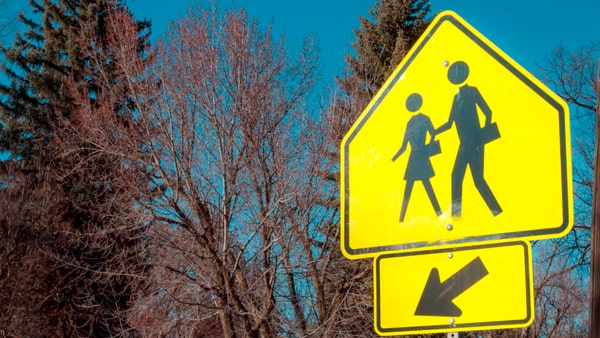
A five-sided school sign with a downward-pointing arrow marks what location?

This road sign means:
  1. A A school crossing
  2. B A business district
  3. C An area where pedestrians must remain on the sidewalk
  4. D A location where crossing is prohibited

Correct answer: A – A school crossing

A School Crossing assembly uses the school symbol with a diagonal downward-pointing arrow to show the location of the crossing. It is used at crossings adjacent to schools or on established school pedestrian routes. Approach cautiously and be prepared to yield or stop for children in the crosswalk.

Source: California MUTCD 2026 Edition — § 7B.03, “School Zone and School Crossing Signs”, California Driver’s Handbook — § 7, “5-sided Sign”

Question 4

For what purpose may you stop at a yellow-painted curb?

  1. A Loading or unloading passengers or freight
  2. B Unlimited parking by buses
  3. C Parking an emergency vehicle only
  4. D Parking a vehicle displaying a disabled-person placard only

Correct answer: A – Loading or unloading passengers or freight

In California, a yellow curb permits stopping only to load or unload passengers or freight for the time allowed by local ordinance. Posted days, hours, and time restrictions must be observed. The driver’s handbook notes that a noncommercial driver is usually required to remain with the vehicle.

Source: CVC § 21458(a)(2), (b), California Driver’s Handbook — § 6, “Parking at Colored Curbs”

Question 5

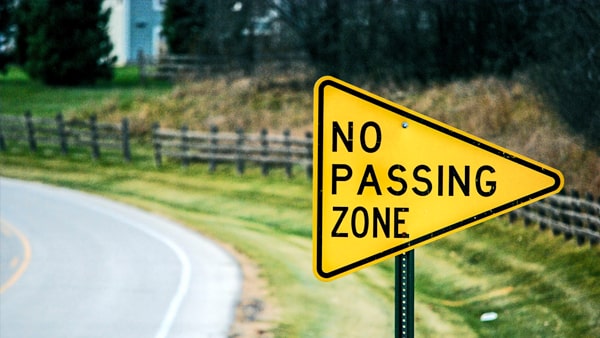
What does a yellow pennant-shaped sign posted on the left side of the roadway identify?

The sign with this shape and color is a _____________ sign.
  1. A The beginning of a no-passing zone
  2. B A wrong-way entrance
  3. C A railroad crossing
  4. D A required stop

Correct answer: A – The beginning of a no-passing zone

The NO PASSING ZONE sign is a pennant-shaped warning sign pointing to the right. When used, it is installed on the left side of the roadway at the beginning of a no-passing zone. Pavement markings or DO NOT PASS signs may also identify the restriction.

Source: California MUTCD 2026 Edition — § 2C.53, “NO PASSING ZONE Sign (W14-3)”

Question 6

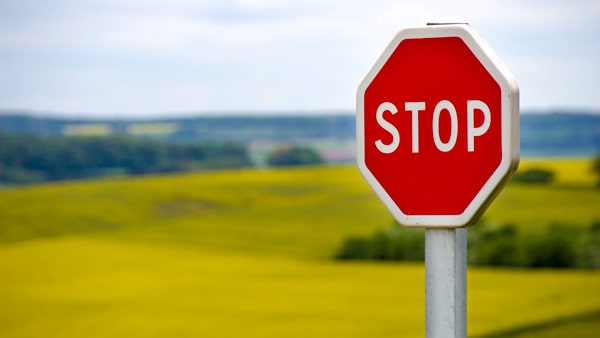
What is required when you approach a STOP sign?

This sign means:
  1. A Stop only when another vehicle is approaching
  2. B Make a complete stop, then proceed when it is safe
  3. C Slow substantially and continue without stopping if clear
  4. D Stop only for traffic on the intersecting roadway

Correct answer: B – Make a complete stop, then proceed when it is safe

California requires a complete stop at the marked limit line. If there is no limit line, stop before entering the near crosswalk; if neither is present, stop at the entrance to the intersecting roadway. Check traffic in all directions and proceed only when it is safe and applicable right-of-way rules permit.

Source: CVC § 22450(a), California Driver’s Handbook — § 7, “STOP Sign”