


California DMV Practice Test

4.7 out of 5 (10717 votes)
80% Passing score
20 Questions
4 Mistakes allowed
This California DMV practice test is for anyone who would rather find out they forgot a road sign rule here, in private, than at the DMV while a touchscreen quietly judges them. It includes 20 multiple-choice questions covering the same general topics found on the real California DMV knowledge test: traffic laws, road safety, right-of-way, traffic signals, road signs, DUI and substance abuse rules, and those small California driving laws that always seem easy until they appear in question form. Use this DMV permit practice test as a warm-up for the official CA permit test, not as a magic answer key. California does not publish actual DMV written test questions, so this California permit practice test is designed to mirror the style, wording, and subject matter of the real exam without pretending to be the real thing. At the end, you will see which permit test questions you missed, the correct answers, and the areas that need more review. Annoying? A little. Useful? Very. The real California DMV written test changes depending on age. Applicants under 18 take 46 multiple-choice questions and must answer 38 correctly, so they can miss 8. Adults 18 and over take 36 questions and must answer 30 correctly, meaning 6 misses are allowed. The DMV calls the passing threshold 80%, though the actual required scores are about 82.6% for minors and 83.3% for adults. DMV math, apparently, likes to keep things spicy. California does not have a separate road signs test. Road sign questions are built directly into the main DMV knowledge test, where sign color, shape, and meaning all count toward the total score. So this CA DMV practice test includes road sign practice along with regular permit test practice, because that is how the real test handles it. Eligible applicants may take the official knowledge test online with a webcam-equipped computer or in person at a California DMV office. Minors testing online need remote parental supervision and consent. In-person DMV test options may include a touchscreen kiosk or paper test by request. Passing online still means visiting the DMV for identity steps, biometrics, a photo, and the physical permit. Before the real California permit test, applicants must also pass a vision test, bring proof of identity and date of birth, proof of Social Security number or legal presence, two California residency documents, any name-change paperwork, a completed application, and the $45 fee. That fee covers up to 3 knowledge test attempts within 12 months. Teens must be at least 15½, complete driver education with DL 400C or OL 237, and have parent or guardian consent.
FREE DMV Practice Test App
Study for your California permit test or driver’s license with the NextDoorDriving app. 700+ DMV questions and answers, 100% free!
Download on the App Store

Sample California Permit Test Questions

Question 1

At a crossing with more than one track, one train has just cleared. What should you do before crossing?
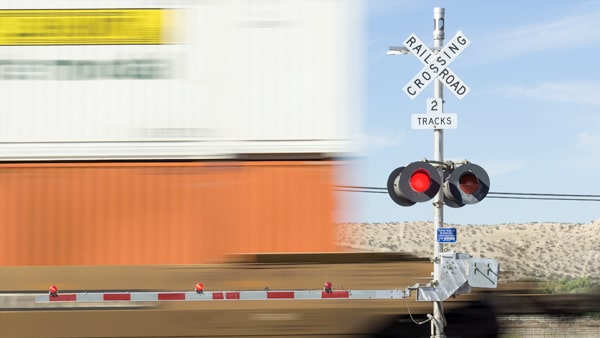
After a train has passed, you should:
  1. A Wait for a green traffic signal in every case
  2. B Cross immediately behind the train
  3. C Sound the horn and begin crossing
  4. D Check both directions for another train and cross only when the warnings have stopped and it is safe

Correct answer: D – Check both directions for another train and cross only when the warnings have stopped and it is safe

Do not enter a railroad crossing while warning lights are flashing or other crossing devices indicate that a train is coming. Because many crossings have multiple tracks, look in both directions after the first train passes. Proceed only after the warnings stop and you have verified that every track can be crossed safely.

Source: California Driver’s Handbook — § 7, “Near Railroad or Light Rail Tracks”
Question 2

Under CVC § 23536, which penalties are specified for a first California DUI conviction under CVC § 23152?

  1. A A county jail term
  2. B A fine of $390 to $1,000
  3. C Suspension of the person’s driving privilege
  4. D All of these choices

Correct answer: D – All of these choices

CVC § 23536(a) specifies 96 hours to six months in county jail and a fine of $390 to $1,000 for a first conviction under CVC § 23152. Subdivision (c) also requires suspension of the person’s driving privilege. Each consequence listed in the answer choices is included in the statute.

Source: CVC § 23536(a), (c)

Question 3

Outside specified farm, emergency-response, and supervised-parade exceptions, when may someone ride in the cargo bed of a pickup on a California highway?

  1. A When a seat has been bolted to the truck bed
  2. B When the rider is accompanied by an adult
  3. C When the sides of the bed are at least 24 inches high
  4. D When the rider is secured by a restraint system meeting federal standards

Correct answer: D – When the rider is secured by a restraint system meeting federal standards

CVC § 23116 generally prohibits transporting or riding with a person in the back of a pickup or flatbed truck on a highway. The general restraint exception applies when that person is secured by a system meeting the federal standards identified in the statute. Separate exceptions cover certain farm or ranch transportation, public-agency emergencies, and supervised low-speed parades.

Source: CVC § 23116(a)–(f)

Question 4

Which situation should a driver treat as requiring extra attention to potential hazards?

  1. A A child near the roadway
  2. B A driver looking at a phone or navigation system
  3. C Workers and equipment in a work zone
  4. D All of these choices

Correct answer: D – All of these choices

Children near a roadway, distracted drivers, and activity in work zones all require careful observation. The handbook tells drivers to watch for children near schools and identifies phones and navigation systems as common distractions. In work zones, drivers should expect lane changes, equipment, and sudden slowing or stopping.

Source: California Driver’s Handbook — § 7, “Around Children”, California Driver’s Handbook — § 7, “Road Workers and Work Zones”, California Driver’s Handbook — § 8, “Do Not Drive Distracted”

Question 5

Which driving behavior is unsafe because it limits your awareness of surrounding hazards?

  1. A Using the three-second rule for following distance
  2. B Fixing your gaze only on the roadway directly ahead
  3. C Keeping your eyes moving and scanning ahead
  4. D Checking blind spots before changing lanes

Correct answer: B – Fixing your gaze only on the roadway directly ahead

Focusing only on the roadway directly ahead can prevent you from noticing hazards beside or behind your vehicle. Keep your eyes moving and scan at least 10 seconds ahead to allow time to react. The handbook also recommends a three-second following distance and checking blind spots before changing lanes.

Source: California Driver’s Handbook — § 8, “Scan Your Surroundings”, California Driver’s Handbook — § 8, “Tailgating (Following Too Closely)”, California Driver’s Handbook — § 8, “Blind Spots”

Question 6

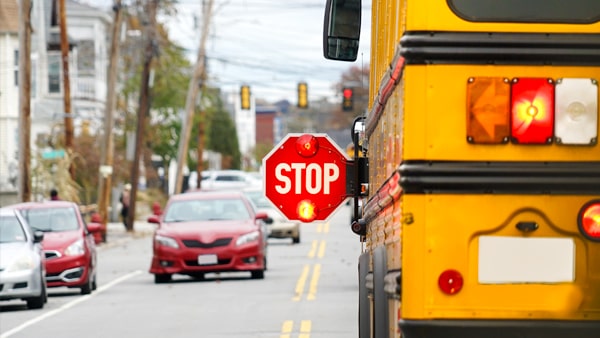
You are following a stopped school bus on the same roadway in California. Its red lights and stop arm are operating. What must you do?

What does it mean when a school bus is stopped and its red lights are flashing?
  1. A Pass if no children are visible
  2. B Stop before passing and remain stopped until the red lights and stop arm stop operating
  3. C Pass slowly on the left
  4. D Proceed if the bus driver signals you forward

Correct answer: B – Stop before passing and remain stopped until the red lights and stop arm stop operating

CVC § 22454 requires a driver meeting or overtaking a qualifying stopped school bus to stop before passing it. The driver may not proceed until the flashing red lights and stop arm, if equipped, cease operation. A driver on the other roadway of a divided or multiple-lane highway is exempt under the conditions stated in subdivision (b).

Source: CVC § 22454(a), (b)