Illinois DMV Practice Test 4

4.8 out of 5 (782 votes)
80% Passing score
20 Questions
4 Mistakes allowed
Illinois puts plenty of weight on everyday safety rules, and child passenger protection is one of those areas where the details actually matter. This Illinois rules of the road practice test leans into that practical side of driving, with a clear focus on child safety seats, passenger protection, and the kind of rule-based judgment that shows up on the Illinois DMV permit test. The questions come from the official Illinois driver’s manual, so the material is not random trivia dressed up as test prep. It is the stuff Illinois expects drivers to know. This Illinois permit practice test gives you 20 multiple-choice questions and asks for 16 correct answers to pass. The real Class D written knowledge test is longer, with at least 35 questions, and the passing score is 80%. On a 35-question exam, that means 28 right, 7 wrong at most. Road signs are mixed into the written knowledge test, too, not handled as some separate little road-sign ritual for standard applicants. That catches people more often than it should, mostly because signs feel familiar until the wording gets annoyingly specific. Unlimited retakes make this DMV practice test useful in a way the real testing window is not. Illinois gives applicants 3 attempts within 1 year from the first attempt, which is generous enough, sure, but not something you want to burn through because you skimmed child restraint rules or guessed your way through right-of-way questions. Here, a missed answer is just feedback. A little irritating, maybe, but useful feedback. For teen drivers, the test is only the front door. Illinois allows an instruction permit at 15, an initial license at 16, and full licensing at 18. Before that initial license, teens must hold the permit for 9 months, complete 50 supervised driving hours with 10 at night, and finish driver education, including at least 6 hours behind the wheel with a certified instructor. A parent or legal guardian has to certify those practice hours, and applicants under 18 also have to satisfy school attendance requirements. Adult applicants have their own fine print. First-time drivers ages 18-20 who have not completed approved driver education need a 6-hour adult course. Everyone still has to meet vision standards, bring the correct documents, and pay the license fee for their age group. So, yes, this Illinois DMV knowledge test is test prep. It is also a cleaner way to understand the process before the state is the one grading you.
FREE DMV Practice Test App
Study for your Illinois permit test or driver’s license with the NextDoorDriving app. 700+ DMV questions and answers, 100% free!
Download on the App Store

Sample Illinois Permit Test Questions

Question 1

If lifting a stuck gas pedal with your toe does not release it, what should you do next?

  1. A Shift into Neutral and brake gently
  2. B Apply the parking brake immediately
  3. C Switch off the ignition while moving
  4. D Pump the brakes rapidly while remaining in Drive

Correct answer: A – Shift into Neutral and brake gently

The Illinois manual first advises hooking your toe under a stuck gas pedal to try to free it. If the pedal remains stuck, shift the transmission into Neutral and brake gently to reduce speed. Avoid sudden parking-brake use, which could cause a loss of control.

Source: Illinois Rules of the Road — Ch. 11, “Equipment Failure” — “Stuck Gas Pedal””]},{

Question 2

Which ability should a teen develop through Illinois’ supervised driving period before driving alone?

  1. A The ability to depend on quick reflexes
  2. B The ability to avoid all nighttime driving
  3. C Practical driving skills and experience
  4. D The ability to drive below every posted limit

Correct answer: C – Practical driving skills and experience

The graduated licensing program requires permit holders to complete at least 50 hours of supervised driving, including 10 hours at night. The state’s parent-teen guidance is intended to help young drivers learn the skills needed before driving independently. Supervised practice develops judgment and vehicle-control experience that classroom instruction alone cannot provide.

Source: Illinois Rules of the Road — Ch. 3, “Graduated Driver Licensing Program” and “Parental Responsibility””]},{

Question 3

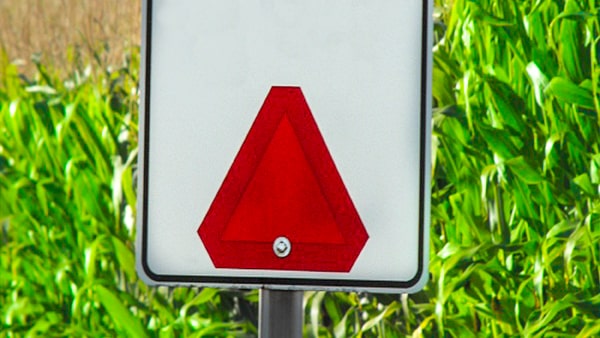
An orange triangular emblem displayed on the rear of a vehicle identifies it as a:

An orange and red sign of this shape always means:
  1. A Vehicle required to yield at every intersection
  2. B Vehicle with priority over other traffic
  3. C Slow-moving vehicle
  4. D Roadside emergency vehicle

Correct answer: C – Slow-moving vehicle

Certain farm vehicles, animal-drawn vehicles, and special mobile equipment operated on a highway must display a slow-moving vehicle emblem on the rear. The Illinois manual tells drivers to use caution and prepare to slow when approaching these vehicles. The emblem is an identification device, not a grant of right-of-way.

Source: 625 ILCS 5/12-709 — Slow-moving vehicle emblem”]},{, Illinois Rules of the Road — Ch. 5, “Slow-Moving Vehicles””]},{

Question 4

In Illinois, what must you do when a school bus is stopped with its red signals operating and stop arm extended?

When a school bus has its lights flashing and its Stop arm extended, you must:
  1. A Stop before reaching the bus and remain stopped until permitted to proceed
  2. B Pass after the children have left the bus
  3. C Always stop when meeting the bus on the opposite side of a four-lane roadway
  4. D Drive past slowly while watching for children

Correct answer: A – Stop before reaching the bus and remain stopped until permitted to proceed

A driver meeting or overtaking a stopped school bus must stop before reaching it when the required visual signals are operating. The driver may proceed when the bus moves, the bus driver signals traffic to proceed, or the visual signals stop operating. An opposing driver generally need not stop when the bus is across a roadway having four or more lanes with at least two lanes in each direction.

Source: 625 ILCS 5/11-1414(a), (e) — Approaching, overtaking, and passing school bus”]},{

Question 5

What does a green arrow displayed over a highway lane indicate?

This green arrow on a lane use control signal means that:
  1. A The lane may be used, subject to other signs and signals
  2. B Traffic is prohibited from using the lane
  3. C Traffic in the lane has unconditional right-of-way
  4. D Every driver must merge into the lane

Correct answer: A – The lane may be used, subject to other signs and signals

Overhead lane signals regulate which lanes are open to traffic. A green arrow indicates that the lane may be used, but drivers must continue to obey all other traffic-control signs and signals. By comparison, a red X means the lane must not be used.

Source: Illinois Rules of the Road — Ch. 10, “Lane Signals””]},{

Question 6

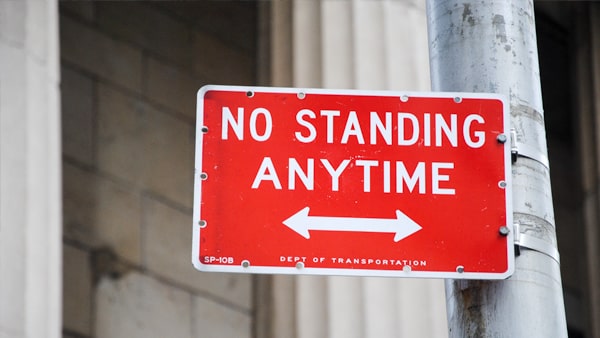
At a location marked NO STANDING, when may you briefly halt your vehicle?

A "no standing sign" at a certain location means:
  1. A Never, even to receive a passenger
  2. B Whenever the driver stays behind the wheel
  3. C While actually picking up or dropping off passengers
  4. D While loading or unloading property

Correct answer: C – While actually picking up or dropping off passengers

Under Illinois law, “standing” means halting a vehicle except while temporarily and actually receiving or discharging passengers. A NO STANDING restriction therefore permits that limited passenger activity. It does not permit waiting merely because the driver remains in the vehicle or stopping to load merchandise.

Source: 625 ILCS 5/1-194 — Stand or standing”]},{