


Illinois Road Signs Test Simulator

4.8 out of 5 (383 votes)
80% Passing score
25 Questions
5 Mistakes allowed
A good Illinois DMV practice test should do more than toss a few road signs at you and call it preparation. The actual Class D written exam is built around the Illinois Secretary of State’s Rules of the Road, which means the test reaches into traffic laws, right-of-way, lane use, turns, passing, parking, speed rules, signals, pavement markings, safe driving habits, and yes, the road signs everyone thinks they already know until the wording gets a little slippery. This Illinois road signs test simulator keeps the focus on that sign-heavy part of the permit test, where a lot of people lose points they really did not need to lose. Each session gives you 20 questions drawn from a larger question bank, so the practice does not go stale after one or two runs. You might see regulatory signs, warning signs, school-zone signs, railroad crossings, work-zone signs, sign shapes, colors, traffic signals, and pavement markings mixed in ways that feel closer to the real written test than a tidy flashcard drill. And after you finish, the review section lets you go back through missed answers with hints and explanations, which is the part that quietly does most of the work. Not flashy. Just the part that helps the rule stick. One thing worth knowing upfront: Illinois does not give standard Class D applicants a separate road-sign-only permit test. Road sign questions are folded into the full knowledge exam. The written test has at least 35 questions, and you need 80% to pass, so on a 35-question version that means 28 correct answers. You get 3 attempts within 1 year from your first attempt, which sounds generous until you are planning another trip to a Secretary of State facility because you rushed the first one. The licensing path depends on who is applying, too. Teen drivers usually begin the permit process at 15 with parent or guardian consent, approved driver education enrollment, proper documents, a vision screening, and the written exam. Adults 18 and older follow a different route, though first-time applicants may need the 6-hour Adult Driver Education Course before getting licensed. So, yes, the practice test is about signs and rules, but it also fits into the bigger Illinois permit process. Better to know that before you are halfway through the line, checking your documents and wondering what else you missed.
FREE DMV Practice Test App
Study for your Illinois permit test or driver’s license with the NextDoorDriving app. 700+ DMV questions and answers, 100% free!
Download on the App Store

Sample Illinois Permit Test Questions

Question 1

When a green arrow controls your dedicated turn lane, which action is required?

  1. A Proceed because everyone in the intersection must yield to you
  2. B Turn in the arrow’s direction after yielding to anyone lawfully in the intersection or crosswalk
  3. C Turn in any direction if the roadway appears open
  4. D Enter without checking for pedestrians or other traffic

Correct answer: B – Turn in the arrow’s direction after yielding to anyone lawfully in the intersection or crosswalk

In Illinois, traffic facing a green arrow may enter the intersection only to make the movement shown by the arrow. Drivers must still yield to pedestrians, bicyclists, and other traffic lawfully using the intersection or an adjacent crosswalk. A green arrow does not authorize ignoring someone who remains in the vehicle’s path.

Source: 625 ILCS 5/11-306(a)(2) – Traffic-control signal legend, Rules of the Road 2026 — Ch. 10, “Arrows”

Question 2

What hazard does a SHOULDER DROP-OFF sign identify?

What should you be most concerned about when you see this sign?
  1. A Headlights may shine at different heights
  2. B The shoulder contains tire-damaging spikes
  3. C Standing water is always present on the shoulder
  4. D A sudden elevation difference may make leaving or reentering the pavement hazardous

Correct answer: D – A sudden elevation difference may make leaving or reentering the pavement hazardous

This sign warns of an unprotected drop between the travel lane and the adjacent shoulder. If wheels drift onto the shoulder, grip the steering wheel, ease off the accelerator, brake gently, and check traffic before gently returning to the pavement. Jerking the wheel may send the vehicle into another traffic lane.

Source: Illinois Manual on Uniform Traffic Control Devices (11th ed.) — § 2C.29, “Shoulder Signs (W8-4, W8-9, W8-17, W8-23, and W8-25)”, Rules of the Road 2026 — Ch. 11, “Driving Off the Pavement”

Question 3

Which warning-sign symbol indicates that a divided highway is ending?

  1. A A traffic lane narrowing from one side
  2. B Two opposing arrows with the median ending between them
  3. C One upward and one downward arrow with no median symbol
  4. D One arrow branching left and another branching right

Correct answer: B – Two opposing arrows with the median ending between them

The divided-highway-ends symbol shows opposing traffic paths and a median that stops ahead. It warns that the physical separation between opposite directions of travel will end. Drivers will then continue toward an undivided, two-way section of roadway.

Source: Rules of the Road 2026 — Ch. 9, “Divided Highway”

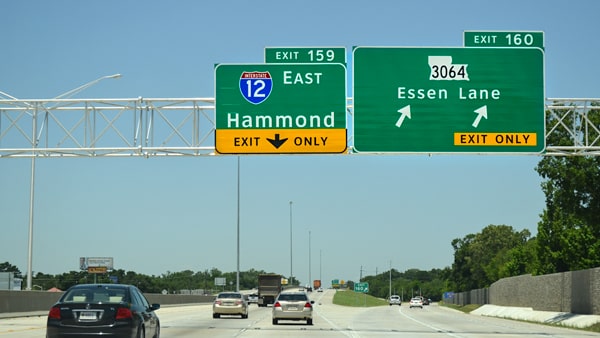
Question 4

If an EXIT ONLY panel is posted above your lane, remaining in that lane will:

If you see this sign above your lane, you:
  1. A Prevent you from using the exit
  2. B Allow you to choose the exit or continue straight
  3. C Carry you through the interchange on the main roadway
  4. D Take you off the main roadway at the exit

Correct answer: D – Take you off the main roadway at the exit

An EXIT ONLY panel identifies a lane drop at an interchange. The marked lane leaves the main roadway rather than continuing as a through lane. A driver who remains in that lane will follow the exit, while the through route continues in another lane.

Source: Illinois Manual on Uniform Traffic Control Devices (11th ed.) — § 2E.28, “Signing for Interchange Lane Drops without an Optional Exit Lane”

Question 5

What is permitted when double solid yellow lines separate opposing traffic?

  1. A Crossing carefully to make a left turn into a driveway
  2. B Using both lanes as a one-way roadway
  3. C Crossing the lines for any purpose
  4. D Crossing to pass a slower vehicle

Correct answer: A – Crossing carefully to make a left turn into a driveway

In Illinois, double solid yellow center lines separate traffic moving in opposite directions and prohibit passing. They may be crossed to make a left turn to or from an alley, private road, driveway, or street. The driver must wait until the turn can be made safely without conflicting with approaching traffic.

Source: Rules of the Road 2026 — Ch. 10, “Yellow Center Lines”, Rules of the Road 2026 — Ch. 10, “Yellow No Passing Lines”

Question 6

A steady yellow arrow appears while you are waiting in a dedicated right-turn lane. What does it tell you?

  1. A The green-arrow phase is ending, so be ready to obey the next signal
  2. B Begin turning after checking only for pedestrians
  3. C Remain stopped regardless of the signal that follows
  4. D Accelerate to complete the turn before the signal changes

Correct answer: A – The green-arrow phase is ending, so be ready to obey the next signal

A constantly illuminated yellow arrow warns that the green-arrow phase is ending or that the signal is about to turn red. It does not direct drivers to accelerate through the turn. Watch the next signal indication and obey it.

Source: Rules of the Road 2026 — Ch. 10, “Arrows”