Illinois Road Signs Test

4.6 out of 5 (2628 votes)
80% Passing score
10 Questions
2 Mistakes allowed
Road signs do more work on the Illinois written test than many applicants expect. They count toward the same score as traffic laws, right-of-way rules, lane use, turns, passing, parking, speed laws, pavement markings, and the safe-driving material pulled from the Illinois Secretary of State’s Rules of the Road. So, yes, you need to know what a Stop sign looks like. Obviously. But you also need to know what a sign is telling you to do when there is traffic behind you, a work-zone barrel in the wrong-feeling place, or a lane marking that suddenly makes the whole intersection a little less friendly. This Illinois road signs practice test is built around the signs and visual cues drivers are expected to understand before they get comfortable behind the wheel. It covers the familiar ones, the ones people rush past in the manual, and the ones that tend to show up where driving gets a bit more fussy: school zones, railroad crossings, construction areas, rural roads, busy city streets, and intersections that seem designed by someone who had a long week. You will see regulatory signs, warning signs, traffic signals, pavement markings, and the shape-and-color clues that help you identify a sign before you have time to overthink it. The official Illinois Class D written test must include at least 35 questions, and you need 80 percent to pass. On a 35-question exam, that means 28 correct answers, which sounds manageable until a few careless misses start chewing through the margin. Illinois also allows 3 attempts to pass the written and/or road tests within 1 year from your first attempt, but nobody should be planning their study schedule around attempt number three. Our free Illinois driving signs practice test gives you 20 multiple-choice questions based on current traffic rules and real driving situations. The point is not just to memorize signs like flashcards, although, fine, a little memorizing helps. The better goal is to understand what each sign means when you are actually moving, merging, slowing, yielding, or trying not to become the person everyone else is honking at. Take it more than once, miss a few, learn why, and then take it again. That is the whole advantage of practicing here before the official test makes it count.

FREE DMV Practice Test App
Study for your Illinois permit test or driver’s license with the NextDoorDriving app. 700+ DMV questions and answers, 100% free!
Download on the App Store

Sample Illinois Permit Test Questions

Question 1

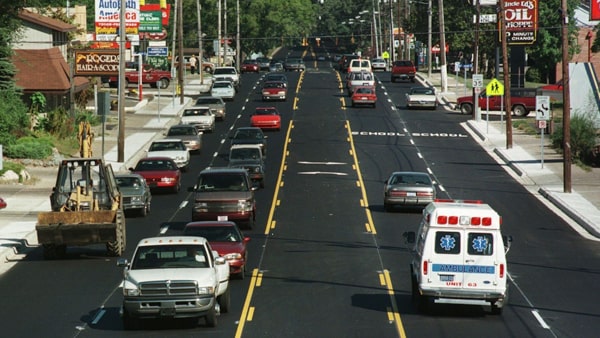
A center lane marked with left-turn arrows for traffic from both directions is reserved for:

The center lane in the illustration is used for:
  1. A Ordinary through travel
  2. B Preparing for and making left turns or permitted U-turns
  3. C Passing slower vehicles
  4. D Emergency vehicles

Correct answer: B – Preparing for and making left turns or permitted U-turns

Illinois law limits a two-way left-turn lane to drivers preparing for or making a left turn into or from the roadway, or preparing for or making a lawful U-turn. When this lane is provided, a left turn may not be made from another lane. It is not a through-travel or passing lane.

Source: 625 ILCS 5/11-801(b)(1), (b)(2) – Required position and method of turning, Rules of the Road 2026 — Ch. 10, “Two-Way Left Turn Lanes”

Question 2

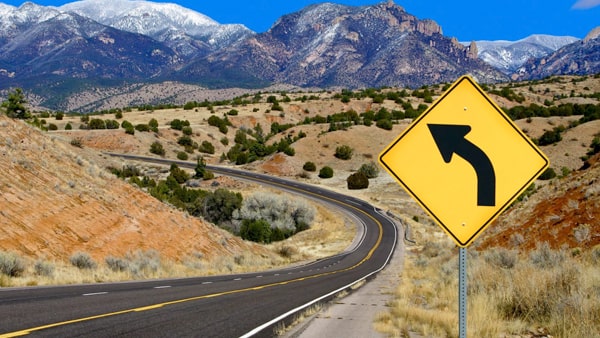
The arrow on the pictured warning sign bends to the left. What condition does it identify?

This sign is used to warn drivers about:
  1. A An intersection ahead
  2. B A construction zone
  3. C A left curve ahead
  4. D A reduction in traffic lanes

Correct answer: C – A left curve ahead

The sign warns that the roadway curves to the left ahead. The shape of the arrow identifies the direction of the curve, and a smaller plaque may show a recommended maximum safe speed. Reduce speed before entering the curve rather than braking suddenly while traveling through it.

Source: Rules of the Road 2026 — Ch. 9, “Turns and Curves”, Rules of the Road 2026 — Ch. 11, “Curves”

Question 3

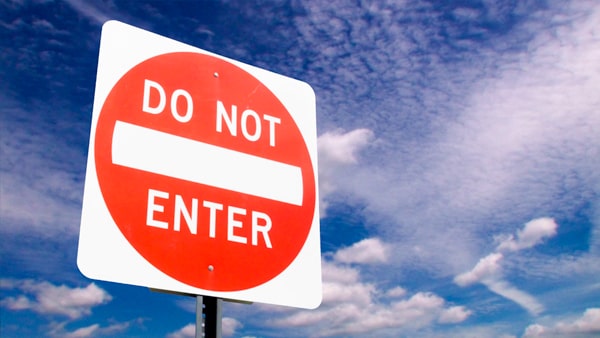
What movement is prohibited by a DO NOT ENTER sign?

This sign is used to prevent:
  1. A Entering a parking area that is full
  2. B Driving near any construction project
  3. C Entering a street with no outlet
  4. D Entering a roadway or ramp from the prohibited direction

Correct answer: D – Entering a roadway or ramp from the prohibited direction

A DO NOT ENTER sign marks a roadway that drivers may not enter from that direction. It commonly appears at one-way streets and at expressway ramps where entry would place a vehicle against the lawful traffic flow. A WRONG WAY sign may also be posted farther along the prohibited approach.

Source: Rules of the Road 2026 — Ch. 9, “Do Not Enter”, Rules of the Road 2026 — Ch. 9, “Wrong Way”

Question 4

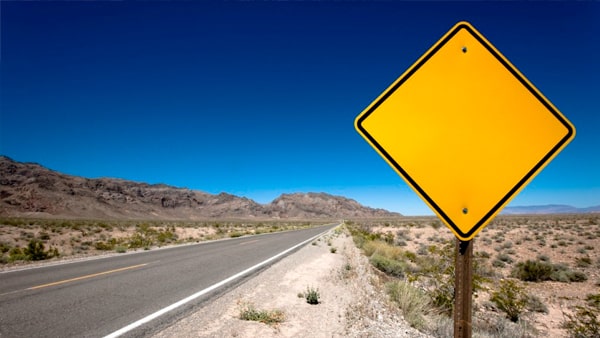
A yellow diamond-shaped sign generally provides:

A yellow and black diamond-shaped sign:
  1. A Warning of a condition or possible hazard ahead
  2. B Directions to destinations and towns
  3. C Notice of a traffic law or prohibition
  4. D Information limited to construction zones

Correct answer: A – Warning of a condition or possible hazard ahead

A diamond shape generally identifies a warning sign. Yellow warning signs alert drivers to roadway conditions or possible hazards that may require special attention. Orange diamond signs serve a similar warning function in construction and maintenance areas.

Source: Rules of the Road 2026 — Ch. 9, “Shapes of Signs”, Rules of the Road 2026 — Ch. 9, “Warning Signs”

Question 5

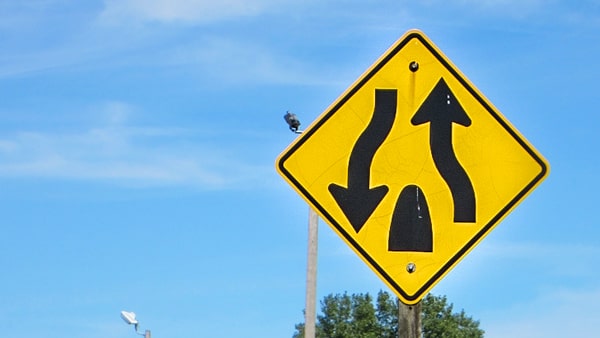
What change does the pictured median-ending warning sign announce?

This sign means:
  1. A A required turn at the next intersection
  2. B The divided highway is ending
  3. C A one-way roadway begins
  4. D The roadway is closed ahead

Correct answer: B – The divided highway is ending

This sign is placed before the end of a divided highway. The center strip separating opposing traffic will end, and the roadway ahead will carry two-way traffic without that divider. Be attentive as you approach the transition.

Source: Rules of the Road 2026 — Ch. 9, “Divided Highway”

Question 6

At a stop sign with a marked crosswalk but no stop line, where must you stop?

  1. A Before entering the crosswalk
  2. B Exactly 50 feet before the intersection
  3. C Where a stop line would normally be painted
  4. D With the front wheels inside the crosswalk

Correct answer: A – Before entering the crosswalk

Illinois law requires a driver at a stop sign to stop at the marked stop line. If there is no stop line, the stop must be made before entering the crosswalk on the near side of the intersection. Only when neither is present does the driver stop where approaching traffic can be seen before entering the intersecting roadway.

Source: 625 ILCS 5/11-1204(b) – Stop and yield signs, Rules of the Road 2026 — Ch. 9, “Stop”