


Indiana Road Signs Test

4.6 out of 5 (381 votes)
80% Passing score
10 Questions
2 Mistakes allowed
The Indiana road signs section is one of those parts of the permit test that people tend to treat like the “easy” half, mostly because the signs look familiar. Stop sign, speed limit sign, school crossing, railroad crossing? Simple. Then the test starts asking about shapes, colors, pavement markings, flashing signals, work-zone signs, and what a sign is telling you before you even get close enough to read the words on it. That is where a little focused practice starts to matter. This Indiana BMV road signs practice test is built around the signs portion of the learner’s permit knowledge exam. The real Indiana knowledge test is based on the official Indiana Driver’s Manual and covers traffic laws, safe driving habits, traffic maneuvers, and road signs. It is multiple choice, but Indiana does not simply lump everything together and call it good. The BMV scores the test in two parts: traffic maneuvers and traffic signs. You need at least 80% on each section to pass. The full permit test is commonly reported as 50 questions, with 34 questions covering traffic laws and maneuvers and 16 questions covering road signs. So, practically speaking, you should be aiming for at least 28 correct answers on the rules section and at least 13 correct answers on the road signs section. That leaves very little room for casual guessing on signs — only about three misses before things get uncomfortable. This Indiana road signs test gives you practice with the kinds of signs and markings you are expected to recognize: regulatory signs, warning signs, school-zone signs, work-zone signs, railroad signs, traffic signals, pavement markings, sign colors, and sign shapes. It also follows the general ideas behind the Manual on Uniform Traffic Control Devices, the national standard that keeps road signs mostly consistent from state to state. Indiana follows those standards, but you still need to know the local driving details that show up in the Indiana Driver’s Manual, including rules around school crossings and flashing red lights. Use this BMV road signs test slowly enough that you actually learn from it. Missed questions are not just little red Xs; they are usually the exact places where your memory is fuzzy. And since Indiana knowledge exam results are valid for 180 days, while failed attempts require waiting until the next business day to retest, it is worth tightening up the signs section before you walk into the BMV.
FREE DMV Practice Test App
Study for your Indiana permit test or driver’s license with the NextDoorDriving app. 700+ DMV questions and answers, 100% free!
Download on the App Store

Sample Indiana Permit Test Questions

Question 1

A building blocks your view of cross traffic at a stop-controlled intersection. Before moving beyond the painted stop line for a better view, you must:

  1. A. Wait five seconds without stopping again
  2. B. Sound the horn to warn cross traffic
  3. C. Listen for traffic instead of making a complete stop
  4. D. Make a complete stop at the line and yield before entering

Correct answer: D. – Make a complete stop at the line and yield before entering

The solid white line is the required stopping point when one is present. A blocked view does not permit a driver to roll beyond that line without first making a complete stop. After stopping, the driver must yield to vehicles already in the intersection or approaching closely enough to present a hazard before entering.

Source: IC 9-21-8-32 – Stop Signs at Intersections; Duty to Obey, Indiana Driver’s Manual — Ch. 6, “Approaching a Red Light or Stop Sign”
Question 2

Orange signs, cones, and barrels appear ahead on a highway. What should you be prepared for?

  1. A. An unrestricted lane change at the normal speed
  2. B. Workers and temporary changes in the traffic pattern
  3. C. A lane ending in every situation
  4. D. A requirement to accelerate through the area

Correct answer: B. – Workers and temporary changes in the traffic pattern

Orange signs warn of temporary conditions associated with construction or maintenance. Indiana guidance tells drivers to remain alert for workers, narrow or shifting lanes, reduced speed limits, and slowing traffic. Follow the signs and markings rather than assuming that every work zone has the same lane arrangement.

Source: Indiana Driver’s Manual — Ch. 6, “Orange Traffic Signs”, Indiana Driver’s Manual — Ch. 7, “Work Zone Safety Driving Tips”

Question 3

Which centerline marking prohibits passing for traffic in both directions?

  1. A. A broken white line
  2. B. Two solid yellow lines
  3. C. A broken yellow line
  4. D. A solid white line

Correct answer: B. – Two solid yellow lines

Yellow centerlines separate traffic moving in opposite directions. A solid yellow line on your side of the centerline prohibits crossing it to pass; with two solid yellow lines, the restriction applies in both directions. A driver may cross a solid yellow line for a turn when that movement is otherwise permitted.

Source: Indiana Driver’s Manual — Ch. 7, “Lane Markings—Yellow Lane Markings”, Indiana Driver’s Manual — Ch. 7, “Changing Lanes and Passing Other Vehicles—Prohibited Passing”

Question 4

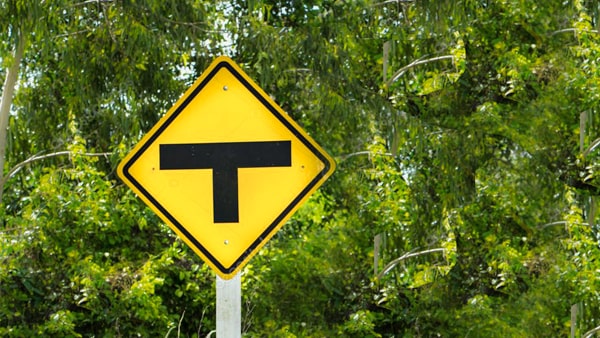
A yellow diamond sign shows a vertical line ending at a horizontal line. What type of roadway feature is ahead?

This sign shows one type of:
  1. A. A sharp right turn
  2. B. A T-intersection
  3. C. A required lane change
  4. D. A winding road

Correct answer: B. – A T-intersection

The T-intersection sign warns that the road you are traveling on meets another road and does not continue straight through. The sign identifies the intersection’s general configuration. It does not itself establish a stop or yield requirement, so obey any separate traffic-control sign at the junction.

Source: Indiana Driver’s Manual — Ch. 6, “Warning Signs—‘T’ Intersection”, 2025 Indiana Manual on Uniform Traffic Control Devices — § 2C.41, “Intersection Warning Signs”

Question 5

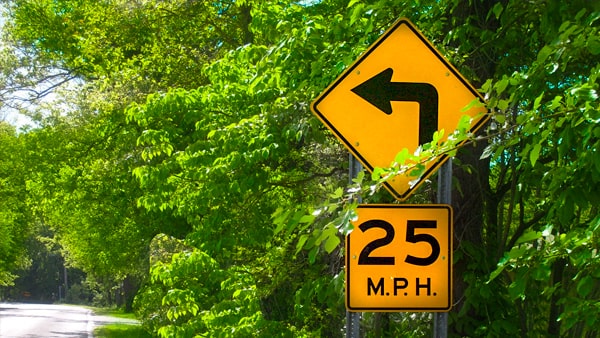
A left-curve warning sign has a 25 MPH advisory plaque below it. What does the combination mean?

This sign means:
  1. A. Left curve ahead; drivers must travel at least 25 mph
  2. B. Right curve ahead; drivers must travel at least 25 mph
  3. C. Right curve ahead; 25 mph is the advisory speed
  4. D. Left curve ahead; 25 mph is the advisory speed

Correct answer: D. – Left curve ahead; 25 mph is the advisory speed

The warning sign shows that the road curves left, and the plaque gives an advisory speed of 25 mph for the curve. An advisory speed is not a minimum-speed requirement or an ordinary regulatory speed-limit sign. Drivers should select a lower speed when weather, visibility, traction, or other conditions make that necessary.

Source: Indiana Driver’s Manual — Ch. 6, “Speed Advisory Signs”, Indiana Driver’s Manual — Ch. 7, “Reduce Speed in Dangerous Conditions”

Question 6

What does a steady yellow traffic signal tell an approaching driver?

  1. A. Proceed without checking the intersection
  2. B. Yield but continue at the same speed
  3. C. The right-of-way is ending; prepare to stop
  4. D. Stop immediately regardless of your distance from the intersection

Correct answer: C. – The right-of-way is ending; prepare to stop

A steady yellow signal means the green indication has ended and the signal is about to turn red. Stop before entering the intersection when you can do so safely. If you are already too close to stop safely when the yellow appears, you may complete your movement carefully.

Source: Indiana Driver’s Manual — Ch. 6, “Driving through an Intersection”