Iowa Permit Practice Test 2

4.7 out of 5 (122 votes)
80% Passing score
20 Questions
4 Mistakes allowed
Iowa’s permit process is not just a quick spin through road signs and obvious safety rules, even though, yes, there will be plenty of that too. The official knowledge test is built around Iowa driving law, everyday safety judgment, and the state-specific details that new drivers are expected to know before they get behind the wheel. This Iowa permit practice test gives you a practical way to work through that material before you take the real DOT test at an Iowa DMV location, a county treasurer office, or, for eligible minors, through Iowa’s Skip the Trip testing option. The test includes 20 questions selected to mirror the kind of topics that matter on the actual exam. You will see material on seat belt rules, traffic signs, right-of-way decisions, safe driving habits, Iowa’s graduated driver licensing system, and headlight use during bad weather. Nothing here is meant to feel like trivia for trivia’s sake. The point is to check whether the rules are clear enough in your head that you can apply them without pausing too long and overthinking every answer, which—fine—is exactly what people tend to do when they are nervous. There are also a few licensing details worth knowing before test day. Iowa applicants generally need a vision screening or a completed vision report, and under-18 instruction permit applicants must pass both the knowledge test and the vision test. The main unrestricted vision benchmark is 20/40 visual acuity with both eyes or with the better eye, and corrective lenses may be used if that is what gets you to the required standard. Field-of-vision results can matter too, sometimes leading to mirror restrictions or additional review. It is the sort of paperwork-adjacent information people skip, then wish they had not skipped. After you complete this Iowa drivers license practice test, you will get a performance summary showing what you missed and what the correct answers were. That feedback is where the real studying happens, frankly. You can retake the practice test as often as needed, which makes it useful for first-time drivers, teens working toward an instruction permit, adults brushing up, and seniors who want to stay current. It is not a substitute for driver’s education or the Iowa driver’s manual, but it fits neatly beside both—and it can make the actual Iowa permit test feel a lot less unfamiliar.
FREE DMV Practice Test App
Study for your Iowa permit test or driver’s license with the NextDoorDriving app. 700+ DMV questions and answers, 100% free!
Download on the App Store

Sample Iowa Permit Test Questions

Question 1

On a vertical signal face using only circular lights, what is the order from top to bottom?

From top to bottom, the following is the proper order for traffic lights:
  1. A. Red, yellow, green
  2. B. Red, green, yellow
  3. C. Green, red, yellow
  4. D. Green, yellow, red

Correct answer: A. – Red, yellow, green

Iowa law places the circular red indication above circular yellow and circular green on a vertical traffic-signal face. Accordingly, a standard three-light vertical signal is arranged red, yellow, then green from top to bottom. Horizontal signal faces place red toward the left.

Source: Iowa Code § 321.258 — Arrangement of lights on official traffic-control signals
Question 2

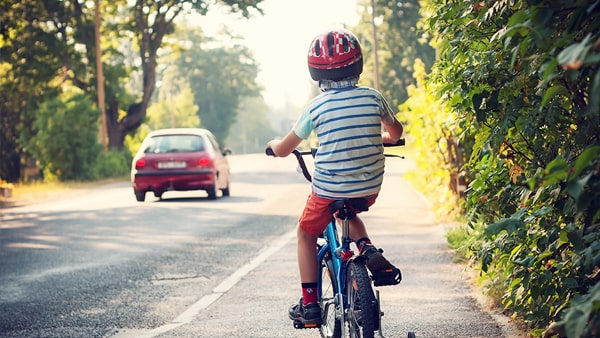
When children are playing near a roadway, which hazard should you be ready for?

When you drive through an area where children are playing, you should expect them:
  1. A. They will always wait for an adult before crossing
  2. B. They will consistently stop and check at the curb
  3. C. A child may enter the road without checking traffic
  4. D. They will remain outside the roadway

Correct answer: C. – A child may enter the road without checking traffic

Children tend to act quickly and may not check traffic before entering the roadway. Children who are focused on playing can be especially difficult to predict. Iowa driving manuals treat their presence as a serious hazard, so watch closely, reduce speed as conditions require, and be prepared to stop.

Source: Iowa Commercial Driver’s License Manual — § 2.8, “Seeing Hazards”, Iowa Driver’s License Manual — Ch. 2, § 2.3, “Warning Signs”

Question 3

Your handheld phone rings while you are driving, and answering would require picking it up. What should you do?

If you are a minor and your cell phone rings while you are driving, you should:
  1. A. Hold it briefly to answer the call
  2. B. Let it go to voicemail until you are safely stopped off the roadway
  3. C. Read the caller information before deciding
  4. D. Send a short message saying you are driving

Correct answer: B. – Let it go to voicemail until you are safely stopped off the roadway

Iowa prohibits holding, viewing, or manipulating an electronic device while driving unless the vehicle is completely stopped off the traveled roadway, subject to specific exceptions. Voice-activated or hands-free use is permitted, but picking up the phone is not hands-free use. A violation is a moving violation and simple misdemeanor with a scheduled fine of $100.

Source: Iowa Code § 321.276(1)(b), (2), (4) — Use of electronic device while driving, Iowa Code § 805.8A(14)(l) — Scheduled violations

Question 4

When parking downhill where there is no curb, your front wheels should point:

When parking downhill and the curb is absent, your front wheels must be turned:
  1. A. Toward the traffic lane
  2. B. Straight ahead
  3. C. Toward the side of the road, away from traffic
  4. D. In the direction used for an uphill curbside space

Correct answer: C. – Toward the side of the road, away from traffic

When no curb is present, point the wheels so the vehicle would roll away from traffic if it began moving. Place an automatic transmission in Park and properly engage the parking brake. This wheel position reduces the chance that an unattended vehicle will roll into the traveled lane.

Source: The Parent’s Supervised Driving Program Manual — Skill Eight, “Parking—Part Two: Parallel Parking on a Hill”

Question 5

An emergency vehicle displaying flashing red or red-and-blue lights is approaching from behind. What must you do?

  1. A. Pull as close as possible to the right edge, stop clear of the intersection, and wait for it to pass
  2. B. Accelerate until you find a wider section of road
  3. C. Remain in your lane and reduce your speed slightly
  4. D. Stop immediately without moving toward the right edge

Correct answer: A. – Pull as close as possible to the right edge, stop clear of the intersection, and wait for it to pass

Iowa law requires you to yield, move parallel to and as close as possible to the right edge or curb, and stop clear of an intersection. Remain stopped until the emergency vehicle passes unless a police officer directs otherwise. If you are already within an intersection, the driver’s manual directs you to clear it before pulling over.

Source: Iowa Code § 321.324(2) – Operation on approach of emergency vehicles, Iowa Driver’s License Manual — § 2.23, “Emergency Vehicles”

Question 6

Which statement about blood alcohol concentration (BAC) testing is accurate?

  1. A. A breathalyzer is one method used to test BAC
  2. B. BAC can be tested only with a blood sample
  3. C. Refusing a breath test prevents an OWI conviction
  4. D. A breath test measures only a driver’s reaction time

Correct answer: A. – A breathalyzer is one method used to test BAC

The Iowa driver’s manual identifies breathalyzer, urine, and blood testing as methods normally used to test BAC. A breathalyzer analyzes a breath sample rather than reaction time. Refusing a breath test does not guarantee that a person will avoid an OWI conviction and may result in license revocation.

Source: Iowa Driver’s License Manual — § 3.8, “Alcohol and Drugs”