


Iowa Practice Permit Test 4

4.9 out of 5 (93 votes)
80% Passing score
20 Questions
4 Mistakes allowed
Studying for the Iowa permit test is partly about knowing road signs, turns, signals, and all the usual driving-test material. Fair enough. But Iowa also expects you to understand the stuff that tends to get treated like fine print, including child passenger safety and the correct use of child safety seats. This Iowa DMV permit practice test pulls that material into a 20-question review, so you are not walking into the real exam with a heroic amount of confidence and a suspiciously thin grasp of the details. The practice permit test uses multiple-choice and true-or-false questions, with a passing target of 16 correct answers. That makes it a useful run-through for the official Iowa DOT test format, especially because you can review the answers afterward and read explanations for the ones you miss. And honestly, that is where most of the learning happens. Getting a question wrong in practice is mildly irritating. Getting it wrong at the DMV, after arranging your schedule and finding your documents and maybe standing in line under fluorescent lighting, feels a little more personal. Speaking of documents, Iowa licensing is not just “show up and smile.” For a driver’s license or ID, you generally need proof of identity and date of birth, lawful status or lawful presence, your Social Security number if you have one, and two documents showing current Iowa residency. For REAL ID or first-time licensing, Iowa DOT’s basic rule is one document for identity and date of birth, one for Social Security, two for Iowa residence, and legal name-change documents if they apply. The address documents need to show your current name and current physical Iowa address, not a P.O. box. Utility bills, bank statements, leases, mortgage papers, insurance documents, tax records, school enrollment papers, and government documents can all work, assuming they actually match what Iowa DOT asks for. Minors get the added joy of parent or guardian written consent for an instruction permit, plus identification, residency proof, and Social Security documentation. Some teen licensing steps may also require Iowa DOT forms for parental consent or a special minor’s restricted license. The fees are small, but still worth knowing: a Class C instruction permit is $6 and valid for four years, a Class C operator license is $4 per year, and a replacement card is $10. Credit card payments may add $1.50, and some county offices may tack on convenience or out-of-county fees. So yes, study the Iowa permit test questions — but check the paperwork too, because the paperwork is where optimism often goes to sit down quietly.
FREE DMV Practice Test App
Study for your Iowa permit test or driver’s license with the NextDoorDriving app. 700+ DMV questions and answers, 100% free!
Download on the App Store

Sample Iowa Permit Test Questions

Question 1

When parallel parking along the right-hand curb on an Iowa roadway, your right wheels must be:
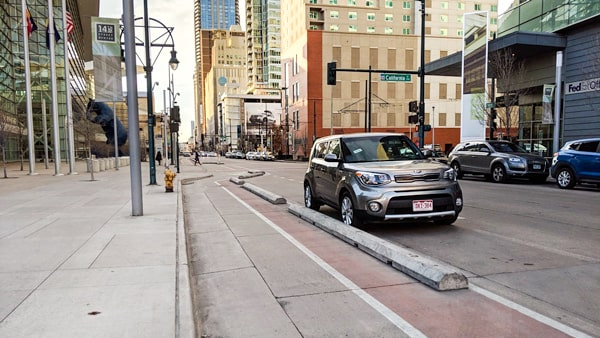
When you park on a level road next to a curb:
  1. A. Parallel to and within 18 inches of the curb
  2. B. Turned sharply toward the roadway
  3. C. At least 18 inches from the curb
  4. D. Touching the curb

Correct answer: A. – Parallel to and within 18 inches of the curb

A vehicle parked beside a curb must generally have its right-hand wheels parallel to and within 18 inches of the right-hand curb. Local authorities may allow different arrangements, such as angle parking or left-side parking on a one-way roadway. The statewide curb-distance rule is 18 inches, not 12 inches.

Source: Iowa Code § 321.361(1)–(3) — Additional parking regulations, Iowa Driver’s License Manual — Ch. 2, § 2.25, “Parking”

Question 2

Which statement about seat belts is correct?

  1. A. They are useful only during high-speed travel
  2. B. Being thrown from a vehicle usually improves survival chances
  3. C. They normally prevent occupants from escaping a submerged vehicle
  4. D. They reduce the risk of death or injury in a crash

Correct answer: D. – They reduce the risk of death or injury in a crash

The driver’s manual identifies seat belts as the most effective way to prevent death and injury in a crash. They help keep occupants inside the vehicle and properly positioned during an impact. Iowa law also requires drivers and front-seat occupants to wear properly adjusted and fastened belts while the vehicle is moving forward, subject to listed exceptions.

Source: Iowa Code § 321.445(2) — Safety belts and safety harnesses — use required, Iowa Driver’s License Manual — Ch. 3, § 3.5, “Seat Belts and Child Restraints”

Question 3

After stopping and before entering an intersection, which scanning pattern should you use?

  1. A. Look ahead and then left only
  2. B. Look right and left once
  3. C. Scan ahead, then look left, right, and left again
  4. D. Check only the rearview and side mirrors

Correct answer: C. – Scan ahead, then look left, right, and left again

First identify the intersection and scan ahead to make sure your path through it is clear. Then look left, right, and left again for approaching vehicles and pedestrians. The second look to the left helps detect traffic coming from the direction that will reach your path first.

Source: Iowa Driver’s License Manual — Ch. 5, § 5.1, “Intersections”

Question 4

During extremely dusty conditions on a gravel road, which lights should you use?

  1. A. Parking lights only
  2. B. Interior dome lights
  3. C. Low-beam headlights
  4. D. High-beam headlights

Correct answer: C. – Low-beam headlights

Dust can obstruct your view of approaching or crossing vehicles. The Iowa manual directs drivers to use low-beam headlights during extremely dusty conditions so the vehicle is more visible to others. Slow down and proceed cautiously because multiple vehicles can create dense dust clouds and severely reduce visibility.

Source: Iowa Driver’s License Manual — Ch. 5, § 5.6, “Rural Roads — Dust”

Question 5

Unless a sign prohibits it, what must you do before turning right at a red light?

  1. A. Stop and yield to lawful vehicle and pedestrian traffic
  2. B. Wait for a green arrow in every situation
  3. C. Move into the left lane
  4. D. Slow down without stopping

Correct answer: A. – Stop and yield to lawful vehicle and pedestrian traffic

Iowa permits a cautious right turn at a steady red signal unless a sign prohibits the turn. You must first stop at the required stopping point. Make the turn only in a manner that does not interfere with vehicles or pedestrians lawfully using the intersection.

Source: Iowa Code § 321.257(1), (2)(a) — Official traffic-control signal, Iowa Driver’s License Manual — Ch. 4, § 4.8, “Turns on Red, After a Stop”

Question 6

Which center marking prohibits you from crossing into the opposing lane to pass?

  1. A. A broken yellow line on your side
  2. B. A solid yellow line on your side
  3. C. A broken white lane line
  4. D. A solid white edge line

Correct answer: B. – A solid yellow line on your side

Do not cross a solid yellow center line on your side to pass another vehicle. Iowa law prohibits driving left of a distinctive center line that directs traffic to remain right. When one side is broken and the other is solid, only traffic next to the broken line may pass when the maneuver is otherwise safe and lawful.

Source: Iowa Code § 321.304(3) — Prohibited passing, Iowa Driver’s License Manual — Ch. 4, § 4.10, “Passing”