


New York Road Signs Test

4.7 out of 5 (516 votes)
80% Passing score
10 Questions
2 Mistakes allowed
A good NY DMV practice test should prepare you for the way New York actually tests new drivers, not just throw a few road signs on the screen and call it useful. For a standard Class D or junior Class DJ learner permit, the official written knowledge test has 20 multiple-choice questions. You need at least 14 correct answers to pass overall, and road signs have their own little requirement inside that score: 4 of the questions cover signs, and at least 2 of those 4 must be answered correctly. So the road sign portion is not separate, exactly, but it is important enough that you should not treat it as filler. This free New York road sign test focuses on that part of the exam in a direct, practical way. It gives you 20 practice questions built around sign recognition, sign meanings, and the quick judgment you need when a sign is not just a shape and a color, but an instruction. The topics come from the same world as the New York State Driver’s Manual: regulatory signs, warning signs, guide signs, railroad crossings, school-area signs, lane-use signs, turn restrictions, stop and yield signs, divided-highway signs, and the other signs that tend to look obvious after someone explains them and slightly less obvious when you are moving through traffic. The test is online, free, and available 24/7, which is helpful because permit prep rarely happens in one neat, uninterrupted study session. You may be fitting it around school, work, appointments, or the DMV checklist itself—vision test, proof of identity, residency documents, fees, and, for younger applicants, the junior permit rules that come after the written test. Not all of that has to be dealt with at once. This NY DMV sign test gives you one manageable piece to work on before test day. Use it as a real practice permit test, not just a quick confidence check. The actual New York permit test is based on the official driver’s manual, and the sign questions are there for a reason. They check whether you can recognize what a sign means quickly enough to respond correctly. That matters for passing the exam, yes, but it also matters once you are driving on New York roads and the sign is no longer part of a quiz.
FREE DMV Practice Test App
Study for your New York permit test or driver’s license with the NextDoorDriving app. 700+ DMV questions and answers, 100% free!
Download on the App Store

Sample New York Permit Test Questions

Question 1

Which color is used for lines separating traffic moving in opposite directions?

  1. A White
  2. B Red
  3. C Black
  4. D Yellow

Correct answer: D – Yellow

Yellow lines separate lanes carrying traffic in opposite directions. They can be solid, broken, or used in combinations that provide additional information about crossing or passing. White lines ordinarily separate lanes of traffic moving in the same direction.

Source: New York State Driver’s Manual — Ch. 4, “Pavement Markings—Edge and Lane Lines”
Question 2

On a two-way roadway, solid yellow centerlines separate:

  1. A A center turn lane from regular traffic
  2. B A bicycle lane from motor vehicles
  3. C Lanes moving in the same direction
  4. D Traffic moving in opposite directions

Correct answer: D – Traffic moving in opposite directions

Yellow centerlines identify lanes carrying traffic in opposite directions. A solid yellow line still marks this opposing-traffic boundary, although its solid pattern also places greater restrictions on crossing than a broken line. White lane lines are used to separate ordinary lanes moving in the same direction.

Source: New York State Driver’s Manual — Ch. 4, “Pavement Markings—Edge and Lane Lines”

Question 3

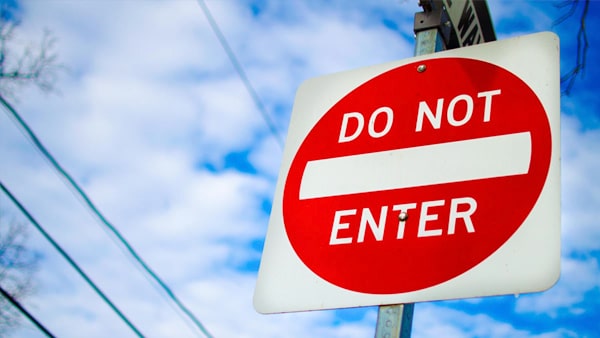
A red circular sign with a horizontal white bar means:

This sign means:
  1. A Stop
  2. B No U-turn
  3. C Yield
  4. D Do not enter

Correct answer: D – Do not enter

The DO NOT ENTER sign prohibits traffic from entering in the direction where the sign faces. It is commonly used at locations where entry would place a driver against the permitted flow of traffic, such as the wrong end of a one-way roadway. Do not proceed beyond it.

Source: New York State Driver’s Manual — Sign Chart, “Road Signs You Must Know”

Question 4

How should you respond to a flashing yellow traffic signal?

  1. A Continue at the same speed without checking traffic
  2. B Stop before entering the intersection
  3. C Proceed through the intersection with caution
  4. D Wait until the signal changes to green

Correct answer: C – Proceed through the intersection with caution

Under New York law, a flashing yellow signal permits you to proceed only with caution. Check traffic and other conditions before entering or passing the signal, and reduce speed when necessary to proceed cautiously. A stop is not required solely because the signal is flashing yellow.

Source: N.Y. VTL § 1113(b) – Flashing signal indications, New York State Driver’s Manual — Ch. 4, “Traffic Signals”

Question 5

You face a red circular light together with a green arrow pointing right. What may you do?

  1. A Proceed straight through the intersection
  2. B Turn right as directed by the arrow after any required yielding
  3. C Remain stopped until the circular light turns green
  4. D Travel in any direction if the intersection appears open

Correct answer: B – Turn right as directed by the arrow after any required yielding

A green right arrow shown with a red circular light permits cautious travel in the arrow’s direction. Other movements remain prohibited by the red signal. Before turning, yield to traffic lawfully within the intersection or an adjacent crosswalk when the arrow appears.

Source: N.Y. VTL § 1111(a)(2) – Traffic-control signal indications, New York State Driver’s Manual — Ch. 4, “Traffic Signals”

Question 6

In New York, can a painted curb by itself tell you the time limit for parking?

  1. A Yes; every painted curb allows 15 minutes
  2. B Yes; it always designates passenger loading
  3. C No; check the posted parking signs for restrictions
  4. D No; parking beside every painted curb is prohibited

Correct answer: C – No; check the posted parking signs for restrictions

A curb color alone does not establish the applicable parking time limit. New York’s traffic-control rules use signs as the primary method of communicating nonstatutory parking restrictions. Read the posted sign for permitted hours, time limits, and any stopping, standing, or parking prohibition.

Source: 17 NYCRR Ch. V, Part 3, § 3B.23 – Curb Markings