New York Road Signs Test 4

4.9 out of 5 (201 votes)
80% Passing score
20 Questions
4 Mistakes allowed
A good NY DMV road signs test should do more than ask whether you recognize a Stop sign. That part, hopefully, is handled. The harder piece is knowing what New York expects you to notice fast: sign shape, color, symbol, wording, and the small differences between signs that look almost the same when you are tired, rushing, or already annoyed about being at the DMV in the first place. This NY DMV practice test gives you 20 multiple-choice questions focused on the road signs and traffic sign knowledge used on the New York DMV test. It is built to feel close to the real testing format, without pretending to be a leaked copy of the exam. The DMV does not release its actual questions, so the better approach is to study the same material from the right angle — warning signs, regulatory signs, guide signs, construction signs, school-zone signs, and the color-and-shape clues that tell you what a sign means before the words fully register. To pass this practice version, you will need 16 correct answers out of 20. For permit applicants, this is only one piece of the larger licensing process, and it helps to know that before you show up half-prepared with a folder full of almost-useful paperwork. New York applicants generally need to complete form MV-44, pass the vision and knowledge tests, pay the required fee, and bring proof of identity, date of birth, New York State residence, and Social Security number or an acceptable alternative. The state uses a point-based identity system, usually requiring documents worth at least 6 points, including at least one proof with your signature. REAL ID and Enhanced documents bring extra requirements, including lawful status or citizenship proof, depending on what you are applying for. Fees vary by age and county, which is the kind of detail people tend to discover at the counter rather than before it. Class D and DJ permit or license fees depend on the applicant’s age, and residents of certain Metropolitan Commuter Transportation District counties may pay an added MCTD fee. Replacements, amendments, and Enhanced permits or licenses cost extra. Later, when it is time for the road test, your first permit or license fee includes a limited number of attempts, but after two failed non-commercial road tests, more fees apply, and New York requires at least a 14-day wait before another try. So yes, this New York road signs practice test is about signs. But really, it is about walking into the DMV process with fewer surprises. Learn the sign meanings, get comfortable with the format, and make the easy points actually easy.

FREE DMV Practice Test App
Study for your New York permit test or driver’s license with the NextDoorDriving app. 700+ DMV questions and answers, 100% free!
Download on the App Store

Sample New York Permit Test Questions

Question 1

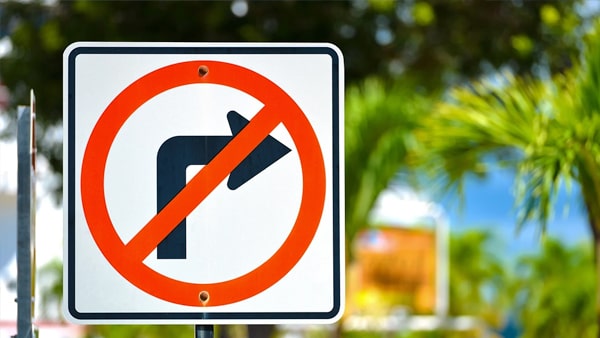
What maneuver does the pictured regulatory sign prohibit?

This sign means:
  1. A. Making a U-turn
  2. B. Turning left
  3. C. Turning right
  4. D. Making any turn

Correct answer: C. – Turning right

This is a No Right Turn sign. In New York, a regulatory sign containing a slashed right-turn arrow prohibits that specific movement. Other movements remain subject to any additional signs, signals, and pavement markings at the intersection.

Source: Manual on Uniform Traffic Control Devices, 11th ed. — § 2B.26, “Movement Prohibition Signs (R3-1 through R3-4, R3-18, and R3-27)”, New York State Driver's Manual — Ch. 4, “Other Regulation Signs”

Question 2

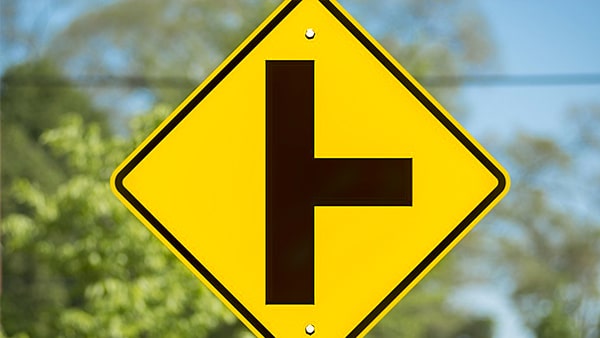
What roadway condition is shown by this warning sign?

This sign means:
  1. A. Traffic must turn right
  2. B. A side road enters from the right
  3. C. Traffic must continue straight
  4. D. Right turns are prohibited

Correct answer: B. – A side road enters from the right

This Side Road sign warns that another roadway joins from the right. It indicates the presence and general configuration of an intersection where traffic may enter or turn. It does not require drivers on the main road to turn.

Source: Manual on Uniform Traffic Control Devices, 11th ed. — § 2C.41, “Intersection Warning Signs (W2-1 through W2-8)”

Question 3

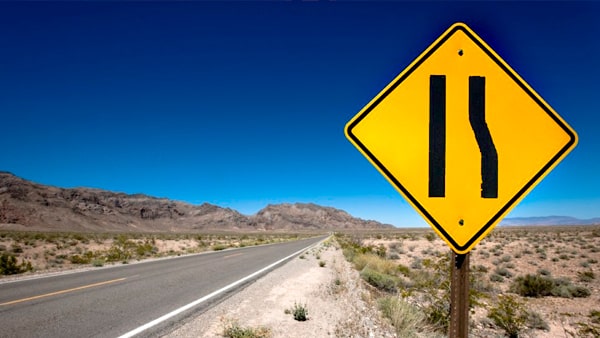
Which condition does this warning sign indicate?

This sign means:
  1. A. The right lane ends ahead
  2. B. A divided highway begins
  3. C. A steep hill is ahead
  4. D. Trucks may enter the roadway

Correct answer: A. – The right lane ends ahead

The Lane Ends sign warns of an upcoming reduction in the number of traffic lanes. In the pictured version, the right lane ends while the left lane continues. It is different from signs warning of merging traffic entering from another roadway.

Source: Manual on Uniform Traffic Control Devices, 11th ed. — § 2C.47, “Lane Ends Signs (W4-2 and W9-1)”

Question 4

A solid yellow line is paired with a broken yellow line next to your lane. When may you cross the lines to pass?

You may cross a double line to pass another vehicle if the line on your side is:
  1. A. Only when passing a slow truck
  2. B. Only during daylight hours
  3. C. When passing is safe and will not interfere with traffic
  4. D. Whenever no vehicle is directly beside you

Correct answer: C. – When passing is safe and will not interfere with traffic

In New York, a driver beside the broken line may cross to pass if the maneuver can be completed safely without interfering with traffic. A driver beside the solid line may not cross to pass. The broken marking permits consideration of a pass; it does not guarantee that roadway and traffic conditions are safe.

Source: New York State Driver's Manual — Ch. 4, “Pavement Markings—Edge and Lane Lines”

Question 5

When must you remain on your side of a single broken white or yellow line?

  1. A. When crossing it would be unsafe or interfere with traffic
  2. B. When entering a driveway on the left
  3. C. When going around a disabled vehicle
  4. D. When passing on a one-way street

Correct answer: A. – When crossing it would be unsafe or interfere with traffic

A single broken line may generally be crossed to pass or change lanes. The movement is permitted only when it can be made safely and without interfering with traffic. The color indicates whether the line separates traffic moving in the same direction or in opposite directions.

Source: New York State Driver's Manual — Ch. 4, “Pavement Markings—Edge and Lane Lines”

Question 6

What colors are normally used on a highway sign showing the direction and distance to an exit?

  1. A. Black lettering on yellow
  2. B. White lettering on black
  3. C. White lettering on red
  4. D. White lettering on green

Correct answer: D. – White lettering on green

New York identifies destination signs by their green background and white letters or symbols. These guide signs show directions and distances to places, including highway exits. Yellow signs generally warn of conditions ahead, while red and white are commonly associated with regulatory messages.

Source: New York State Driver's Manual — Ch. 4, “Destination Signs”