


Minnesota Practice Permit Test 6

4.7 out of 5 (345 votes)
80% Passing score
20 Questions
4 Mistakes allowed
Your MN permit test prep should cover more than a few memorized road signs and lucky guesses. This sixth Minnesota permit test practice gives you 20 realistic questions modeled around the kind of material you can expect on the actual DMV knowledge test, and you’ll need at least 16 correct answers to pass. It leans especially into turn signals, which may sound like basic driver-ed territory, because it is—but Minnesota expects you to understand exactly when and how to communicate your moves before you make them. That matters on real roads. A missed signal during a lane change on I-94, a lazy merge, a last-second turn near a crowded intersection in Minneapolis or St. Paul—small habits get noticed quickly when traffic is tight, pavement is slick, or roadwork has pinched three lanes into what feels like one and a half. So this MN DMV practice test does not treat signaling like a throwaway topic. It gives it the attention it deserves, along with the broader rules and judgment calls that show up on the permit test. The test is fully updated for 2026, which is important because old DMV test cheat sheets tend to float around long after they should have been retired. Some are harmlessly vague. Some are confidently wrong. Either way, that is not how you want to study for a state exam. With this Minnesota driver permit practice test, you can work through the questions, review what you missed, and tighten up the details before the real thing. There is also the licensing paperwork, which people sometimes remember too late. For a standard Minnesota license, instruction permit, or ID card, you generally need two primary documents, or one primary and one secondary document. Documents not in English need a translation and translation attestation. Under Minnesota’s Driver’s License for All law, residents may apply for a standard credential without proving legal presence in the United States, though applicants eligible for a Social Security number should know or provide it. REAL ID and enhanced licenses are different animals, paperwork-wise. A Minnesota REAL ID requires identity, Social Security, and residency documents, and originals are expected. An enhanced driver’s license requires U.S. citizenship, Minnesota residency, and a minimum age of 16. Teen drivers need parent or guardian approval and driver education proof, such as a Blue Card or Pink Card for the permit stage; later, the road test and provisional license bring in the supervised driving log and completed education requirements. The test is the first gate, basically, but it is not the only one.
FREE DMV Practice Test App
Study for your Minnesota permit test or driver’s license with the NextDoorDriving app. 700+ DMV questions and answers, 100% free!
Download on the App Store

Sample Minnesota Permit Test Questions

Question 1

On a two-lane road, your low speed is creating a traffic hazard. What should you do?

  1. A. Continue in the center of your lane regardless of traffic behind you
  2. B. Drive as close as practicable to the right-hand curb or edge
  3. C. Stop immediately in the travel lane
  4. D. Activate your hazard lights and continue at the same position

Correct answer: B. – Drive as close as practicable to the right-hand curb or edge

Minnesota does not use the five-vehicle turnout rule stated in some other jurisdictions. On a roadway with one lane in your direction, a driver traveling slowly enough to create a traffic hazard must operate as close as practicable to the right-hand curb or edge. This positioning can provide safer separation from other traffic, but the driver must remain on a lawful portion of the roadway.

Source: Minn. Stat. § 169.18, subd. 10(a) – DRIVING RULES.
Question 2

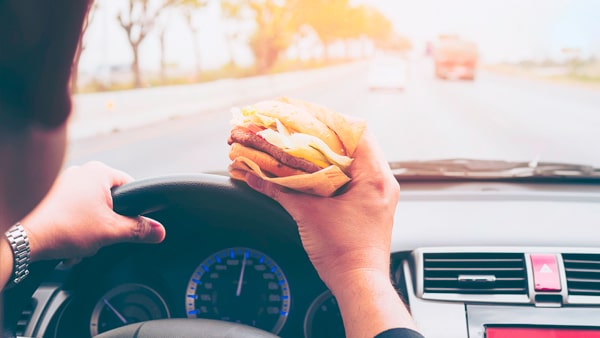
Why are eating and drinking unsafe activities while driving?

Drivers who eat and drink while driving:
  1. A. They eliminate ordinary driving errors
  2. B. They make it impossible to drive below the speed limit
  3. C. They improve concentration by preventing hunger
  4. D. They divert attention and may delay recognition of and response to hazards

Correct answer: D. – They divert attention and may delay recognition of and response to hazards

The Minnesota Driver’s Manual identifies eating and drinking as in-vehicle distractions. Distraction may involve looking away from the road, removing a hand from the steering wheel or shifting mental attention away from driving. Distracted drivers can fail to recognize hazards and react more slowly to changing traffic conditions.

Source: Minnesota Driver’s Manual — Ch. 6, “Distracted driving”

Question 3

When may you turn left at a steady red light?

  1. A. Whenever no oncoming traffic is visible
  2. B. When turning from a two-way street onto a one-way street
  3. C. After stopping, when turning from a one-way street onto a one-way street carrying traffic in the direction of the turn, unless prohibited
  4. D. Whenever the vehicle ahead completes the same turn

Correct answer: C. – After stopping, when turning from a one-way street onto a one-way street carrying traffic in the direction of the turn, unless prohibited

Minnesota allows this left turn only after a complete stop and only from a one-way street onto another one-way street where traffic moves to the left. The turn is prohibited when an official sign forbids it. Before turning, the driver must yield to pedestrians and other traffic lawfully proceeding through the intersection.

Source: Minn. Stat. § 169.06, subd. 4(3)(i)(B) – SIGNS AND SIGNALS.

Question 4

After parking an automatic-transmission vehicle on a hill and setting the parking brake, what else should you do?

  1. A. Shift into Park and turn the front wheels in the proper direction for the slope
  2. B. Leave the wheels parallel to the roadway
  3. C. Leave the transmission in neutral
  4. D. Always turn the wheels away from the curb

Correct answer: A. – Shift into Park and turn the front wheels in the proper direction for the slope

Place an automatic-transmission vehicle in Park and engage the parking brake. When facing downhill, turn the wheels toward the curb or shoulder. When facing uphill, turn them away from the curb if one is present; without a curb, turn them toward the shoulder.

Source: Minnesota Driver’s Manual — Ch. 3, “Parking” and “Parking on a hill”

Question 5

Approximately what share of Minnesota’s fatal traffic crashes occur after dark?

  1. A. About one-quarter
  2. B. About one-third
  3. C. Nearly one-half
  4. D. Nearly all

Correct answer: C. – Nearly one-half

The Minnesota Driver’s Manual states that nearly half of the state’s fatal traffic crashes occur after dark. Darkness reduces visibility and can make hazards harder to detect in time. Before driving at night, ensure your lights and windshield are in good condition and use a speed that allows you to respond within the visible roadway ahead.

Source: Minnesota Driver’s Manual — Ch. 6, “Night driving”

Question 6

When driving in the far-right freeway lane near an entrance ramp, which traffic should you check for?

  1. A. Only vehicles traveling behind you in your lane
  2. B. Vehicles entering the freeway from the ramp
  3. C. Only vehicles preparing to exit from the left lane
  4. D. Traffic traveling on the opposite side of the freeway

Correct answer: B. – Vehicles entering the freeway from the ramp

Vehicles commonly enter a freeway beside the far-right lane, making ramp traffic an important hazard to monitor. Scan ahead and check your mirrors for vehicles looking for a gap. If you choose to change lanes to create additional space, first verify that the lane movement can be made safely; entering traffic does not automatically receive the right-of-way.

Source: Minn. Stat. § 169.18, subd. 7(1) – DRIVING RULES., Minnesota Driver’s Manual — Ch. 6, “Freeway driving”