Minnesota Road Signs Test

4.4 out of 5 (1305 votes)
80% Passing score
10 Questions
2 Mistakes allowed
Minnesota road signs do not get their own separate learner’s permit exam, which is worth knowing before you start studying. They are folded into the regular Minnesota Class D knowledge test—the same written permit test used for a standard passenger-vehicle instruction permit. So when you practice road signs, you are not preparing for some side quiz that lives off in its own little DMV corner. You are studying material that can show up on the real 40-question MN permit test, where you need 32 correct answers to pass and can miss up to 8 total. This MN DMV road signs practice test is built to help you get comfortable with the signs, signals, pavement markings, and traffic-control details covered in the official Minnesota Driver’s Manual. The real knowledge test pulls from that manual, including the “Signs, Signals, and Pavement Markings” section, so the point here is not to memorize random sign trivia. It is to recognize what a sign is telling you quickly, whether it is a warning shape, a regulatory color, a lane marking, or one of those construction-zone signs that suddenly feels very relevant when half the road is missing in July. You will work through 20 multiple-choice questions focused on Minnesota road sign knowledge. The questions are designed around the kinds of signs and markings drivers actually need to understand across the state, from Twin Cities traffic to rural highways, snow-covered streets, school zones, work zones, and all the ordinary places where a missed sign can turn into a bad habit fast. A couple of study aids are built in, too. When a question slows you down, a hint can nudge you in the right direction without simply handing you the answer. If you choose incorrectly, you will see an explanation so the mistake actually teaches you something instead of just sitting there looking rude. You can retake the MN road sign test as often as needed, which is useful because road signs get easier with repetition—the shapes, colors, symbols, and meanings start to stick. Use this Minnesota DMV practice test before taking the real Class D knowledge test, especially if road signs are the part you keep second-guessing. They count toward the same overall permit test score, and there is no special road-sign-only missed-question limit, so every sign question is just one more chance to protect your passing score.
FREE DMV Practice Test App
Study for your Minnesota permit test or driver’s license with the NextDoorDriving app. 700+ DMV questions and answers, 100% free!
Download on the App Store

Sample Minnesota Permit Test Questions

Question 1

When your signal turns green, which condition must you verify before entering the intersection?

  1. A. The intersection and your intended path are clear
  2. B. The vehicle behind you has started moving
  3. C. Every cross-street vehicle is behind its stop line
  4. D. The far-side pedestrian signal displays a raised hand

Correct answer: A. – The intersection and your intended path are clear

A green signal permits you to proceed once the intersection is clear. Minnesota’s signal law still requires drivers to yield to vehicles and pedestrians lawfully within the intersection or adjacent crosswalk. Scan for traffic from both sides and confirm that your path is open before moving.

Source: Minn. Stat. § 169.06, subd. 5(a)(1)(i) – Signs, Signals, Markings, Minnesota Driver’s Manual — Ch. 6, “Using the Scan, Identify, Predict, Decide and Execute (SIPDE) System”

Question 2

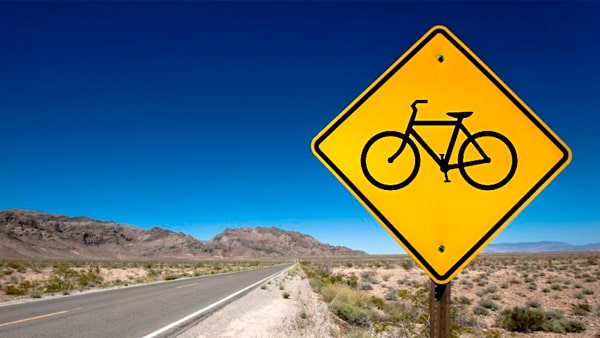
A bicycle-symbol warning sign placed before a roadway crossing indicates that:

This sign means:
  1. A. A children’s playground is nearby
  2. B. Bicycles may be rented nearby
  3. C. A recreational parking area is ahead
  4. D. Bicyclists may enter or cross the roadway ahead

Correct answer: D. – Bicyclists may enter or cross the roadway ahead

The bicycle warning sign alerts drivers to a location where bicyclists may unexpectedly enter or cross the roadway. It may have a yellow or fluorescent yellow-green background. Watch the roadway and its edges for bicyclists and be prepared to respond safely to the crossing activity.

Source: Minnesota MUTCD, 11th Edition including Revision 1 — § 2C.54, “Vehicular Traffic Warning Signs (W11-1)”, Minnesota Driver’s Manual — Ch. 5, “Warning signs”

Question 3

Your light turns green, but vehicles are still occupying the intersection. What should you do?

  1. A. Wait until the intersection is clear before entering
  2. B. Drive around the vehicles if another lane appears open
  3. C. Enter and wait behind the remaining vehicles
  4. D. Sound your horn and proceed

Correct answer: A. – Wait until the intersection is clear before entering

Traffic facing a green signal must yield to vehicles and pedestrians lawfully within the intersection. Wait until those road users clear your path before proceeding. The driver’s manual also directs drivers not to enter a signal-controlled intersection unless they can move through it immediately, continuously, and completely, subject to stated exceptions.

Source: Minn. Stat. § 169.06, subd. 5(a)(1)(i) – Signs, Signals, Markings, Minnesota Driver’s Manual — Ch. 5, “Intersection gridlock”

Question 4

A yellow or fluorescent yellow-green pentagon showing an adult and child means:

This road sign means:
  1. A. A stop sign is ahead
  2. B. A school or approved school crossing is ahead
  3. C. A shopping area is ahead
  4. D. Pedestrians must remain on the sidewalk

Correct answer: B. – A school or approved school crossing is ahead

Pentagon-shaped school warning signs indicate that a school or an approved school crosswalk is ahead. Watch for children and be prepared to stop. A school crossing sign placed at the crossing may include an arrow pointing toward the crosswalk.

Source: Minnesota Driver’s Manual — Ch. 5, “School Zone” and “School Crossing”

Question 5

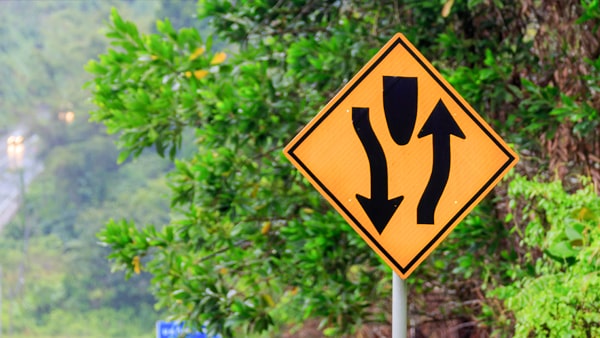
A yellow diamond sign showing traffic separating around the beginning of a median means:

This sign means:
  1. A. Divided highway ends
  2. B. One-way roadway begins
  3. C. One-way roadway ends
  4. D. Divided highway begins

Correct answer: D. – Divided highway begins

The Divided Highway Begins sign warns that the roadway ahead separates into opposing roadways divided by a median or another physical barrier. Stay to the right of the divider. The similar Divided Highway Ends sign shows the divided roadways coming together rather than separating.

Source: Minnesota Driver’s Manual — Ch. 5, “Divided Highway Begins”, Minnesota MUTCD, 11th Edition including Revision 1 — § 2C.20, “Divided Highway Sign (W6-1)”

Question 6

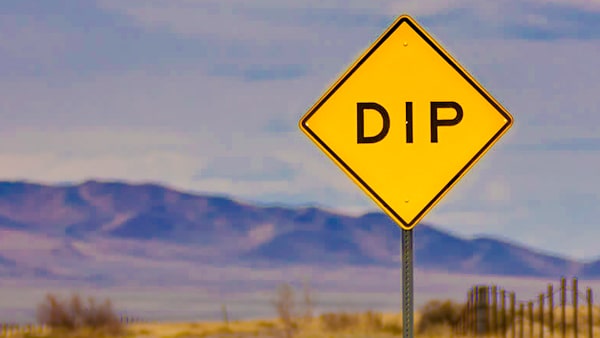
A yellow diamond-shaped sign displaying the word “DIP” warns of:

This sign means:
  1. A. A sharp depression in the roadway ahead
  2. B. A soft roadway shoulder
  3. C. A pedestrian crossing
  4. D. A required complete stop

Correct answer: A. – A sharp depression in the roadway ahead

The DIP sign is used in advance of a sharp depression in the roadway profile. It does not indicate a soft shoulder, pedestrian crossing, or mandatory stop. Treat it as advance warning of a roadway condition and select a speed that allows you to respond safely.

Source: Minnesota MUTCD, 11th Edition including Revision 1 — § 2C.26, “BUMP and DIP Signs (W8-1 and W8-2)”, Minnesota Driver’s Manual — Ch. 5, “Warning signs”