


New Jersey Drivers Ed Practice Test 8

4.8 out of 5 (531 votes)
80% Passing score
20 Questions
4 Mistakes allowed
This NJ permit practice test is built for the parts of the New Jersey knowledge test that deserve actual attention, not a half-awake skim through the Driver Manual and a little optimism. It gives you 20 multiple-choice questions, with a strong focus on intersections, right-of-way rules, four-way stops, traffic signals, and the small judgment calls that show up constantly once you are driving in New Jersey. Jughandles, busy local roads, circles that feel like everyone learned a different rulebook — yes, those are part of the larger picture too. The official New Jersey permit knowledge test is the MVC written driver test for first-time drivers, and it is based on the New Jersey Driver Manual. The real test covers New Jersey traffic laws, safe driving rules, road signs and signals, GDL restrictions, DUI and alcohol laws, vehicle operation, driver responsibility, and safety topics tied to the road test. So, fairly broad. Not impossible, just broader than people sometimes expect when they hear “permit test.” On the actual general knowledge exam at an MVC testing center, you get 50 questions and need 40 correct answers to pass. That is an 80% passing score, with no more than 10 missed questions. This New Jersey DMV practice test is shorter than the official exam, but that is partly the point. It lets you work through a focused set of questions without turning practice into a full sit-down production every time. You can take the drivers ed practice test as often as you need, from a phone, tablet, or desktop. After each attempt, you get a summary showing what you missed and the correct answers, which is where the useful part really starts — because guessing correctly once does not mean you know the rule, and missing the same kind of intersection question twice is a pretty loud hint. Use this driver ed practice test alongside the New Jersey Driver Manual, especially if you are preparing for the NJ drivers ed written test for the first time. And one practical note: if you fail the official MVC knowledge test, you must wait 7 days before retaking it. Better to find the weak spots here, where the only thing on the line is a few minutes and maybe your patience.
FREE DMV Practice Test App
Study for your New Jersey permit test or driver’s license with the NextDoorDriving app. 700+ DMV questions and answers, 100% free!
Download on the App Store

Sample New Jersey Permit Test Questions

Question 1

A broken white line between traffic lanes indicates that:
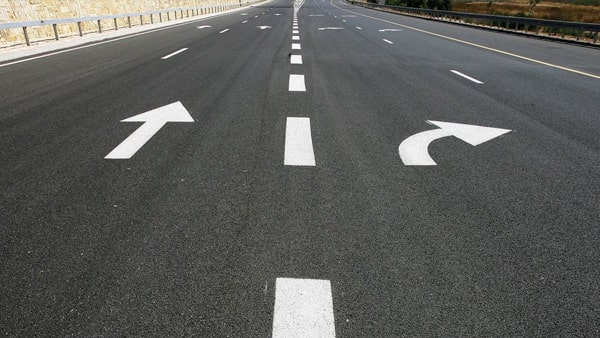
A broken white center line on the roadway means:
  1. A Turns from either lane are prohibited
  2. B Drivers must reduce speed before crossing it
  3. C Traffic on opposite sides of the line travels in opposite directions
  4. D A lane change is permitted after the driver verifies it can be made safely

Correct answer: D – A lane change is permitted after the driver verifies it can be made safely

A broken white line separates lanes carrying traffic in the same direction and may be crossed for a lane change. Before moving over, signal and confirm that the destination lane is clear. State law requires a vehicle to remain within one lane and not leave it until the driver has first determined that the movement can be made safely.

Source: N.J.S.A. 39:4-88(b) – Traffic on marked lanes, New Jersey Driver Manual — “Driver Responsibility,” “Pavement Markings”
Question 2

During New Jersey rush-hour traffic, may you enter an intersection when there is not enough room to clear it?

  1. A Yes, if some cross traffic can pass around you
  2. B No, even if you have a green light or otherwise have the right-of-way
  3. C Yes, if you are turning rather than going straight
  4. D Yes, if your vehicle is small enough to leave part of a lane open

Correct answer: B – No, even if you have a green light or otherwise have the right-of-way

The law prohibits driving into an intersection when traffic ahead prevents your vehicle from clearing it without obstructing other traffic. A green light or right-of-way does not remove this restriction. Remain behind the intersection until enough space opens on the far side for your entire vehicle.

Source: N.J.S.A. 39:4-67 – Obstructing passage of other vehicles or street cars prohibited; clearance of intersections

Question 3

When may a driver cross double solid yellow centerlines?

  1. A To pass a slower vehicle
  2. B Only during daylight
  3. C Whenever no opposing vehicle is visible
  4. D To make a lawful left turn into or from a driveway or side road

Correct answer: D – To make a lawful left turn into or from a driveway or side road

Double solid yellow centerlines prohibit passing in both directions. A driver may cross them when making a lawful left turn into or from a driveway or side road. Before turning, signal and yield to approaching traffic, pedestrians, and other road users whose path would be crossed.

Source: New Jersey Driver Manual — “Driver Responsibility,” “Pavement Markings”

Question 4

Pedestrian right-of-way rules apply at which crosswalks?

  1. A Marked crosswalks only
  2. B Marked crosswalks and unmarked crosswalks at intersections
  3. C Only crosswalks controlled by a stop sign
  4. D Only crosswalks controlled by a traffic signal

Correct answer: B – Marked crosswalks and unmarked crosswalks at intersections

New Jersey law protects pedestrians in both marked crosswalks and unmarked crosswalks at intersections. Drivers must stop and remain stopped for pedestrians crossing within a marked crosswalk and must yield to pedestrians within an unmarked intersection crosswalk. Pedestrians also may not suddenly enter the path of a vehicle that is too close for the driver to yield or stop.

Source: N.J.S.A. 39:4-36(a) – Driver to yield to pedestrians, exceptions; violations, penalties, New Jersey Driver Manual — “Safe Driving Rules and Regulations,” “Pedestrians in a Crosswalk”

Question 5

A steady yellow traffic signal warns that which signal will appear next?

  1. A Flashing yellow
  2. B Steady green
  3. C Steady red
  4. D Flashing red

Correct answer: C – Steady red

A steady yellow light warns that the signal is changing from green to red. Stop before entering the intersection when you can do so safely. If you are already in the intersection, or are too close to stop safely before entering, continue through carefully rather than stopping abruptly within the intersection.

Source: New Jersey Driver Manual — “Driver Responsibility,” “Traffic Signals”

Question 6

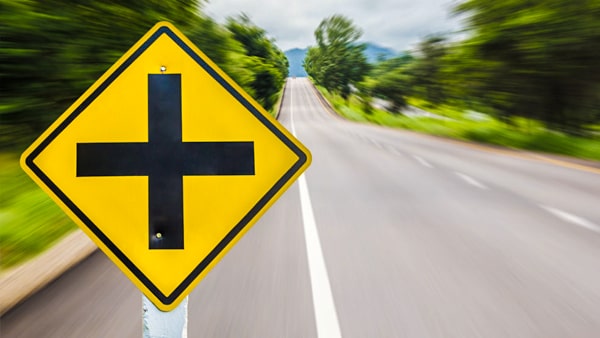
What does a yellow diamond sign containing a black cross symbol warn of?

This sign means:
  1. A A religious facility
  2. B A first-aid station
  3. C A crossroad ahead
  4. D A railroad crossing

Correct answer: C – A crossroad ahead

The crossroad warning sign indicates that another road intersects the roadway ahead. It is a warning sign rather than a regulatory or service sign. Reduce speed as conditions require, watch for vehicles entering from either side, and obey any traffic controls located at the intersection.

Source: New Jersey Driver Manual — “Driver Responsibility,” “Warning Signs”