New Jersey DMV Sign Test 3

4.8 out of 5 (378 votes)
80% Passing score
20 Questions
4 Mistakes allowed
This New Jersey road signs test is built for one job: helping you recognize signs by shape, color, symbol, and meaning before the real MVC knowledge test asks you to do it under pressure. The focus here is road sign recognition, especially the visual clues drivers are expected to understand quickly — the octagon that means stop, the triangle that means yield, the warning signs that ask you to adjust before the road gives you a reason to regret not adjusting. It sounds basic, and in some ways it is. Still, basic is exactly where plenty of permit applicants lose points. The practice test includes 20 questions covering the design and purpose of common New Jersey traffic signs. Score 16 or higher and you are in decent shape; miss more than that, and it is probably worth slowing down and reviewing the signs again, not in a panicked way, just in the practical way people should study before dealing with the MVC. This NJ MVC road signs test is not a cheat sheet, and it is not pretending to be the full exam. It is a targeted study tool for one of the most visible parts of driving knowledge, which is also one of the easiest parts to neglect because everyone assumes they “know signs” already. Sure. Until the answer choices start looking suspiciously similar. On the actual New Jersey permit knowledge test, road signs are folded into the larger written driver exam. The MVC test is based on the New Jersey Driver Manual and covers traffic laws, safe driving rules, signs and signals, GDL restrictions, DUI and alcohol laws, vehicle operation, driver responsibility, and road-test safety topics. The standard knowledge test has 50 multiple-choice questions, and you need 40 correct answers — 80 percent — to pass. If you fail, the retake wait is 7 days. The licensing process continues beyond the written test, so keep the bigger picture in view. Permit holders under 21 must complete at least 50 supervised driving hours, including 10 at night, before receiving a probationary license. Road test day brings its own requirements too: valid ID, an examination permit, a qualified supervising New Jersey licensed driver, proper GDL decals for drivers under 21, and a registered, insured, inspection-ready vehicle with examiner access to the emergency brake. But first, there is the knowledge test. And before that, there is knowing what the signs are telling you.
FREE DMV Practice Test App
Study for your New Jersey permit test or driver’s license with the NextDoorDriving app. 700+ DMV questions and answers, 100% free!
Download on the App Store

Sample New Jersey Permit Test Questions

Question 1

Which centerline marking prohibits passing by traffic in either direction?

  1. A A broken white line
  2. B Two solid yellow lines
  3. C A broken yellow line
  4. D A single solid white line

Correct answer: B – Two solid yellow lines

Two solid yellow centerlines separate opposing traffic and prohibit crossing the lines to pass. The New Jersey manual directs motorists to remain in their lane at this marking. A broken yellow line permits passing from the side where the broken line appears, but only when the maneuver is otherwise safe.

Source: New Jersey Driver Manual — Ch. 11, “Road Markings”
Question 2

Under New Jersey law, what must you do before turning right at a red signal when the turn is permitted?

  1. A Stop fully, observe traffic, and yield as required
  2. B Proceed if a red arrow is displayed
  3. C Move into the left lane first
  4. D Slow down without stopping

Correct answer: A – Stop fully, observe traffic, and yield as required

A right turn on red is permitted unless an official sign prohibits it. Before turning, the driver must come to a full stop, observe traffic in all directions, and yield to vehicles traveling in the direction of the turn. The driver must also stop and remain stopped for pedestrians crossing the roadway into which the vehicle is turning.

Source: N.J.S.A. 39:4-115 – Making right or left turn

Question 3

A yellow diamond sign with a black arrow bending sharply to the right warns that:

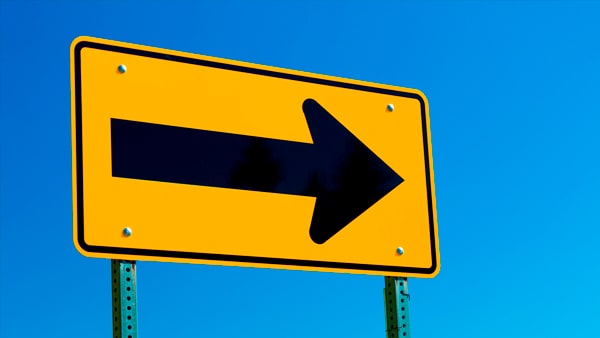
When you see this black and yellow sign, it means:
  1. A The road becomes one-way to the right
  2. B A construction detour begins to the right
  3. C The roadway makes a sharp right turn ahead
  4. D A side road enters from the right

Correct answer: C – The roadway makes a sharp right turn ahead

A sharply bent arrow warns that the road changes direction abruptly. Drivers should recognize it as a roadway-hazard warning and reduce speed before reaching the turn. It is different from a side-road symbol, a one-way regulatory sign, or an orange construction-detour sign.

Source: New Jersey Driver Manual — Ch. 11, “Warning Signs”

Question 4

What does a yellow, five-sided sign showing children indicate?

This road sign means:
  1. A A stop sign is ahead
  2. B A school area or school crossing is ahead
  3. C A shopping area is ahead
  4. D Pedestrians must remain on the sidewalk

Correct answer: B – A school area or school crossing is ahead

A yellow pentagon is used for school-related warnings. It may identify a school area or a location where students cross the roadway. Drivers should watch carefully for children and respond to any posted school-zone speed limits, crossing guards, or additional traffic-control devices.

Source: New Jersey Driver Manual — Ch. 11, “Traffic Signs”

Question 5

You are turning left on a green signal. Which traffic must you yield to before completing the turn?

  1. A Only vehicles approaching from behind
  2. B Only vehicles waiting on the cross street
  3. C Opposing traffic in the intersection or close enough to be an immediate hazard
  4. D No traffic, because a green signal gives an unconditional right-of-way

Correct answer: C – Opposing traffic in the intersection or close enough to be an immediate hazard

New Jersey law requires a driver within an intersection who intends to turn left to yield to opposing traffic that is already in the intersection or close enough to create an immediate hazard. After yielding and giving the required signal, the driver may complete the turn. A steady green signal alone does not authorize the driver to turn across hazardous oncoming traffic.

Source: N.J.S.A. 39:4-90 – Right of way at intersections

Question 6

At a New Jersey intersection, what does a red-and-white triangular YIELD sign require?

  1. A Stop only when an emergency vehicle approaches
  2. B Continue after looking in one direction
  3. C Come to a complete stop in every situation
  4. D Slow to a reasonable speed, yield, and stop if necessary

Correct answer: D – Slow to a reasonable speed, yield, and stop if necessary

A driver approaching a YIELD sign must slow to a reasonable speed for the existing conditions and visibility. The driver must stop if necessary and yield to traffic on the intersecting street that is close enough to be an immediate hazard. If no such traffic is present, the law does not require an automatic full stop.

Source: N.J.S.A. 39:4-144 – Stopping or yielding right of way before entering stop or yield intersections