New Jersey DMV Sign Test 4

4.8 out of 5 (364 votes)
80% Passing score
20 Questions
4 Mistakes allowed
New Jersey road signs deserve their own study time, partly because they show up everywhere and partly because the MVC knowledge test expects you to know what they mean without overthinking it. This NJ road signs test gives you a focused way to practice that specific slice of the exam: sign colors, shapes, symbols, signals, warnings, regulatory signs, guide signs, school-zone signs, work-zone signs, and the little visual clues that drivers are supposed to process quickly. Not eventually. Quickly. The practice test includes 20 multiple-choice questions, with a passing score of 16 correct answers. That makes it shorter than the full New Jersey permit knowledge test, but still serious enough to show whether your sign knowledge is solid or just sort of floating around in your head in a half-remembered way. After you finish, you can review the questions you missed along with the correct answers, which is where the actual studying usually happens — not during the confident first pass, but in the mildly humbling second look. A useful thing to know, because this gets misunderstood: New Jersey does not publish a separate road-sign-only passing score for the standard auto knowledge test. Road sign questions are folded into the regular MVC written driver test for first-time drivers. The real exam has 50 questions, and you need 40 correct answers to pass, which works out to 80%. So, yes, signs matter, but they count alongside everything else: New Jersey traffic laws, safe driving rules, GDL restrictions, DUI and alcohol laws, driver responsibility, vehicle operation, and road-test safety topics. The main source for the real test is the New Jersey Driver Manual, which the MVC makes available in English, Spanish, Chinese, Tagalog, Gujarati, and Korean. This NJ DMV practice test is meant to work with that manual, not pretend the manual does not exist. Use the manual for the official rules, then use this NJ permit sign test to see whether the road signs and signals are actually sticking in your memory. You can retake the New Jersey road signs practice test as many times as you need, which is useful because signs are often learned best through repetition. A red octagon should not require a committee meeting in your brain. Same with yellow warning signs, green guide signs, railroad crossings, lane-use signs, and the rest of the visual language New Jersey drivers are expected to recognize before the situation gets busy.
FREE DMV Practice Test App
Study for your New Jersey permit test or driver’s license with the NextDoorDriving app. 700+ DMV questions and answers, 100% free!
Download on the App Store

Sample New Jersey Permit Test Questions

Question 1

A white edge line on the right bends inward toward your lane. What does this indicate?

  1. A An intersection is immediately ahead
  2. B A work zone begins at that point
  3. C All traffic must turn left
  4. D The roadway becomes narrower

Correct answer: D – The roadway becomes narrower

An edge line marks the outside boundary of the travel lane and separates it from the shoulder. When that boundary shifts inward, the usable roadway is becoming narrower. Stay within the marked lane and adjust your position for the reduced width ahead.

Source: New Jersey Driver Manual — Appendix: Driver Safety, “Road Markings”
Question 2

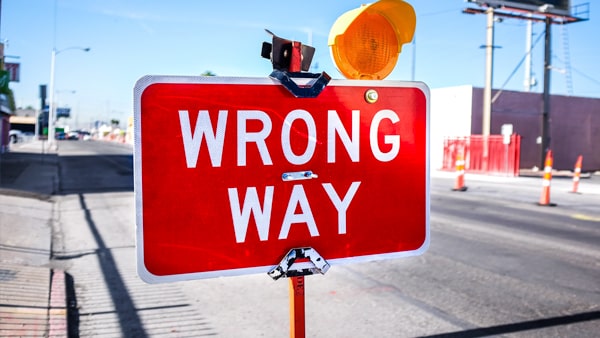
What does the red-and-white WRONG WAY sign tell a driver?

This red and white sign means:
  1. A Enter only after yielding to other traffic
  2. B The roadway is closed in every direction
  3. C U-turns are prohibited at this location
  4. D The vehicle is traveling against the permitted direction of traffic

Correct answer: D – The vehicle is traveling against the permitted direction of traffic

In New Jersey, a WRONG WAY sign warns that the vehicle is moving against the lawful direction of traffic. The driver should not continue farther along that roadway. Stop in a safe location and correct the vehicle’s direction when it can be done safely.

Source: New Jersey Driver Manual — Appendix: Driver Safety, “Traffic Signs, Signals and Road Markings”

Question 3

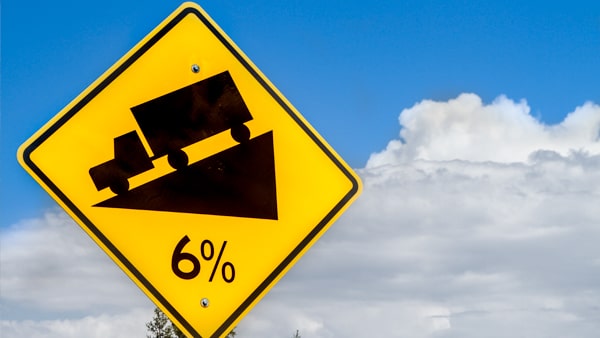
What condition is indicated by the warning sign shown?

This sign means:
  1. A Only trucks weighing less than 18,000 pounds may proceed
  2. B A hill or downgrade is ahead
  3. C A truck service area is ahead
  4. D Trucks are prohibited

Correct answer: B – A hill or downgrade is ahead

The sign warns drivers of a hill or downgrade ahead. Hills are among the road hazards where motorists should reduce speed as conditions require. Entering the grade at a controlled speed helps the driver respond to changes in the roadway and traffic.

Source: New Jersey Driver Manual — Defensive Driving, “Hills, Bridges and Other Road Hazards”, New Jersey Driver Manual — Appendix: Driver Safety, “Traffic Signs, Signals and Road Markings”

Question 4

On a two-way road with double solid yellow centerlines, which maneuver may be made when it is safe?

  1. A Turning left into a private driveway
  2. B Traveling as though the road were one-way
  3. C Using the center as a continuous turn lane
  4. D Crossing the lines to pass a slow vehicle

Correct answer: A – Turning left into a private driveway

The New Jersey manual states that double solid yellow lines prohibit passing. Between intersections, however, solid centerlines may be crossed carefully when entering or leaving a driveway in a business or residential area. Check for opposing traffic and complete the left turn only when the path is clear.

Source: New Jersey Driver Manual — Safe Driving Rules and Regulations, “Turning Regulations”, New Jersey Driver Manual — Appendix: Driver Safety, “Road Markings”
Question 5

After stopping and before entering an intersection, where should you scan for hazards?

  1. A Ahead and to the left
  2. B To the left and right only
  3. C To the left, right, and ahead
  4. D Ahead and to the right

Correct answer: C – To the left, right, and ahead

Before moving into an intersection, look left, right, and ahead for vehicles, pedestrians, bicyclists, and other hazards. A stop or favorable signal does not guarantee that the intersection is already clear. Enter only after completing this scan and determining that it is safe to proceed.

Source: New Jersey Driver Manual — Safe Driving Rules and Regulations, “Intersections”, New Jersey Driver Manual — Safe Driving Rules and Regulations, “Stopping Regulations”

Question 6

The illustrated warning sign indicates that your road will:

This sign means:
  1. A End, requiring a left or right turn
  2. B Meet a T-intersection
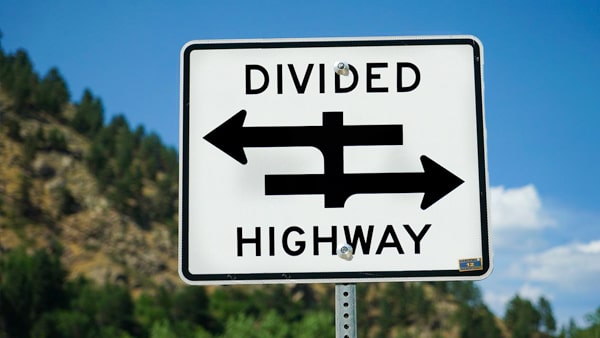
  3. C Intersect a divided highway
  4. D Pass over a divided highway

Correct answer: C – Intersect a divided highway

In New Jersey, this sign warns that the road ahead intersects a divided highway. The divided highway has separate roadways for opposing traffic, usually separated by a median or barrier. Watch the lane markings and signs carefully when entering or crossing it.

Source: New Jersey Driver Manual — Appendix: Driver Safety, “Traffic Signs, Signals and Road Markings”