


New Jersey DMV Knowledge Test Practice 9

4.9 out of 5 (440 votes)
80% Passing score
20 Questions
4 Mistakes allowed
This free NJ DMV knowledge test practice focuses on school bus safety, one of those topics New Jersey expects drivers to understand clearly, not vaguely, not “I think I remember this from the manual” clearly. The 20-question practice test is built around real driving situations involving school buses: when to stop, where to stop, what to do when children are loading or unloading, and how those rules apply on different types of roads. It is a focused piece of NJ driving test practice, which is useful because school bus questions are not filler. They are about protecting children in places where one bad guess can matter. The format is straightforward enough to use without making a whole production out of studying. You can take this NJ DMV knowledge test online practice on a phone, tablet, or desktop, whenever you have a few minutes and enough attention to actually read the wording. And yes, it is free, which helps. A free practice test still needs to be worth taking, though, so the point here is not just clicking through 20 questions. It is getting comfortable with the specific rules before they show up on the real MVC knowledge test, dressed up in slightly different language. That practice matters even more when you place it inside New Jersey’s larger licensing process. First-time drivers move through the Graduated Driver License program, and the exact route depends mostly on age. A 16-year-old usually begins with a Special Learner’s Permit through a high school driver education program or licensed driving school, including 6 hours of behind-the-wheel instruction in a dual-controlled vehicle. Drivers who are 17 or older usually use the Examination Permit route, but they still have to pass the knowledge test, meet the vision requirement, complete supervised practice, and pass the road test. So, no, being older does not magically remove the paperwork-and-testing portion of the experience. Once a permit is validated, New Jersey adds supervised-driving rules that are worth knowing before they become someone’s correction in the passenger seat. Under-21 applicants must complete at least 6 months of supervised driving before the road test, with 50 total practice hours and 10 at night. The supervising driver must sit in front, be at least 21, hold a valid New Jersey license, and have at least 3 years of driving experience. After the road test comes the probationary license stage, with its own restrictions: passenger limits, required seat belts, no handheld or hands-free interactive wireless devices, and no driving from 11:01 p.m. to 5:00 a.m. Drivers under 21 also need red GDL decals on the front and rear plates, and skipping them can mean a $100 fine. So the school bus practice test is the immediate study tool, but the bigger picture is this: New Jersey wants new drivers to know both the road rules and the licensing rules well enough to use them without guessing.
FREE DMV Practice Test App
Study for your New Jersey permit test or driver’s license with the NextDoorDriving app. 700+ DMV questions and answers, 100% free!
Download on the App Store

Sample New Jersey Permit Test Questions

Question 1

At a stop sign with no painted stop line, where should you stop when a crosswalk is present?

  1. A Before and within five feet of the nearest crosswalk
  2. B In the middle of the crosswalk
  3. C Just beyond the crosswalk
  4. D At least 15 feet before the corner

Correct answer: A – Before and within five feet of the nearest crosswalk

New Jersey law requires a complete stop within five feet of the nearest crosswalk or marked stop line on the near side of the intersection. If no stop line is painted, stop before and close to the crosswalk rather than blocking it. Proceed only after yielding to traffic that is close enough to present an immediate hazard.

Source: N.J.S.A. 39:4-144(a) – Stopping or yielding right of way before entering stop or yield intersections
Question 2

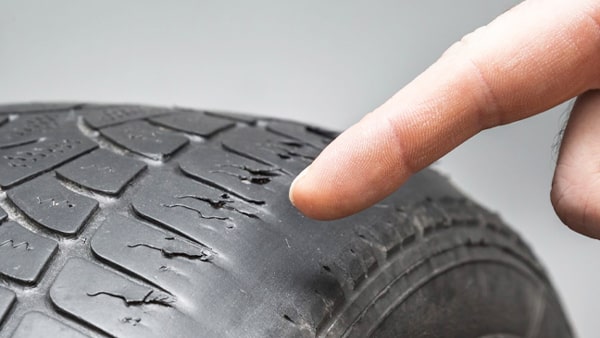
Badly worn tires can:

Worn or bald tires:
  1. A Increase the risk of hydroplaning
  2. B Reduce control on wet pavement
  3. C Make braking and turning ineffective during hydroplaning
  4. D Cause all of these problems

Correct answer: D – Cause all of these problems

Bald or badly worn tires increase the chance of hydroplaning and loss of control on wet pavement. During severe hydroplaning, braking may become virtually impossible and the vehicle may not respond to steering. New Jersey also classifies tires as unsafe when specified tread-wear indicators contact the roadway in two adjacent major grooves at three locations around the tire.

Source: N.J.S.A. 39:3-72 – Tire equipment, New Jersey Driver Manual — “Defensive Driving,” “Hydroplaning”

Question 3

Under good driving conditions, the recommended minimum following interval is:

  1. A One second
  2. B Two seconds
  3. C At least three seconds
  4. D Exactly five seconds at every speed

Correct answer: C – At least three seconds

Use the three-seconds-plus rule by selecting a fixed point and counting after the vehicle ahead passes it. Your vehicle should reach that point no sooner than three seconds later under favorable conditions. This interval provides space to react if the leading vehicle stops suddenly. Increase the interval to four or more seconds during bad weather or poor road conditions.

Source: New Jersey Driver Manual — “Defensive Driving,” “Three Seconds-Plus Rule”

Question 4

Why does alcohol-impaired driving endanger motorists who do not drink?

  1. A It affects only the impaired driver's vehicle
  2. B Impaired judgment and reaction can endanger everyone sharing the road
  3. C It matters only when police are nearby
  4. D It creates a risk only for other people who have been drinking

Correct answer: B – Impaired judgment and reaction can endanger everyone sharing the road

Alcohol can impair judgment, reaction time, coordination, balance, vision, and distance perception. These effects increase the risk of driving errors and crashes. The driver manual notes that alcohol-related crashes can kill or seriously injure passengers, pedestrians, and other motorists, making impaired driving a danger to everyone using the roadway.

Source: New Jersey Driver Manual — “Drinking, Drugs, and Health,” “Effects of Alcohol”

Question 5

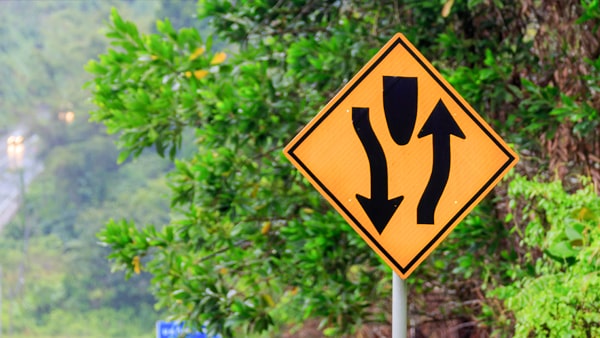
A yellow diamond warning sign shows opposing traffic flows becoming separated by a median. What does it mean?

This sign means:
  1. A Divided highway ends
  2. B One-way roadway begins
  3. C One-way roadway ends
  4. D Divided highway begins

Correct answer: D – Divided highway begins

The sign warns that a divided highway begins ahead. Opposing traffic will travel on separate roadways divided by a median, barrier, or other physical separation. Enter the roadway section on the right side of the divider and remain alert for the change in the road's layout.

Source: New Jersey Driver Manual — “Driver Responsibility,” “Warning Signs”

Question 6

You have a green light, but stopped traffic fills the roadway beyond the intersection. When may you enter?

  1. A Only when enough space is available to clear the intersection without blocking traffic
  2. B Whenever the lane you want is partially open
  3. C Immediately, because the signal is green
  4. D After sounding the horn to warn cross traffic

Correct answer: A – Only when enough space is available to clear the intersection without blocking traffic

New Jersey prohibits entering an intersection when traffic ahead leaves insufficient space for the vehicle on the far side. Wait behind the intersection even when the signal is green. Enter only when your vehicle can clear the intersection without obstructing vehicles or streetcars using the cross street.

Source: N.J.S.A. 39:4-67 – Obstructing passage of other vehicles or street cars prohibited; clearance of intersections