Pennsylvania DMV Practice Test 5

4.9 out of 5 (128 votes)
80% Passing score
20 Questions
4 Mistakes allowed
Pennsylvania gives new drivers a fairly clear path to a learner’s permit, but the knowledge test still deserves real attention. The official PennDOT permit test is based on the Pennsylvania Driver’s Manual and covers traffic signs, PA driving laws, and safe-driving practices. There are 18 multiple-choice questions on the real test, and you need 15 correct answers to pass. That leaves room for only 3 misses, which is not a lot once the questions start getting into BAC limits, DUI penalties, and the legal consequences of impaired driving. This Pennsylvania permit practice test gives you 20 focused questions built to match the kind of material you are expected to know for the PA DMV written test. It puts extra weight on blood alcohol content, legal alcohol limits, and what can happen when a driver gets behind the wheel impaired. And yes, that material can feel a little heavy compared with road signs and basic right-of-way rules, but PennDOT includes it for a reason. The real test is not just checking whether you can recognize a stop sign. It is checking whether you understand the rules that keep a license from becoming a liability. The questions are tied to the official PA driver’s manual, which matters more than it sounds like it should. Generic driving knowledge is fine in a broad, vague sense, but Pennsylvania has its own laws, procedures, signs, and test expectations. A PA PennDOT permit test practice session should keep you inside that lane. If you miss a question, the explanation gives you the rule behind the answer instead of leaving you to guess your way through the same mistake again. Hints are there too, useful when you are close but not quite close enough — which, honestly, is where a lot of studying happens. For adults 18 and older, the licensing process still begins with a learner’s permit. A first-time adult applicant typically studies the manual, completes Form DL-180, gets the required physical exam and provider approval, visits a PennDOT Driver License Center, passes the eye screening and knowledge test, receives a learner’s permit, practices driving, and then schedules the road test. The 6-month permit-holding period and 65 supervised driving hours apply to drivers under 18, not adult applicants. Use this PA PennDOT learners permit practice test to tighten up the details before test day, especially the impaired-driving rules that are easy to skim and expensive to misunderstand.
FREE DMV Practice Test App
Study for your Pennsylvania permit test or driver’s license with the NextDoorDriving app. 700+ DMV questions and answers, 100% free!
Download on the App Store

Sample Pennsylvania Permit Test Questions

Question 1

You are in the left lane of a multilane highway and need to take an exit on the right. What should you do?

  1. A Cross every lane in one continuous movement
  2. B Accelerate until you are faster than all surrounding traffic
  3. C Slow sharply before each lane change
  4. D Move one lane at a time until you reach the proper exit lane

Correct answer: D – Move one lane at a time until you reach the proper exit lane

Move toward the exit lane well in advance and change only one lane at a time. Signal for every lane change and verify that the next lane is clear before entering it. Do not swerve across several lanes to reach an exit at the last moment. If you cannot reach the exit safely, continue to the next exit rather than stopping or backing on the highway.

Source: Pennsylvania Driver's Manual — Ch. 3, “Negotiating Highways and Interchanges”
Question 2

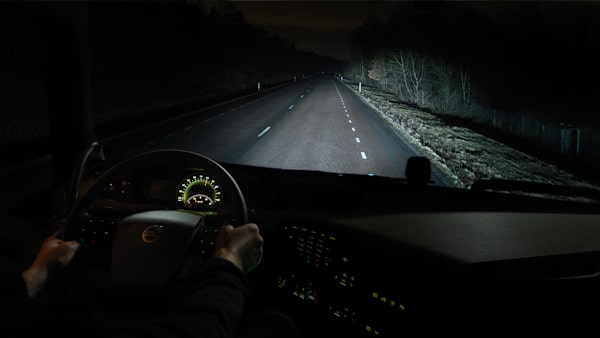
Compared with signs and other roadside objects, what is generally hardest to see at night?

At night, it is hardest to see:
  1. A Reflective road signs
  2. B Pedestrians
  3. C Vehicles displaying headlights
  4. D Illuminated streetlights

Correct answer: B – Pedestrians

The Pennsylvania Driver's Manual identifies pedestrians as the hardest objects to see at night compared with signs and other roadside objects. Reduced light also limits distance judgment, color perception, and side vision. Drivers should use a speed that allows them to stop within the distance illuminated by their headlights and remain alert for pedestrians, bicyclists, animals, and other unexpected hazards.

Source: Pennsylvania Driver's Manual — Ch. 3, “Driving At Night”

Question 3

When a curve or hill crest blocks your view of the roadway ahead, you should:

  1. A Reduce speed enough to stop within the clear distance ahead
  2. B Switch to high beams so approaching drivers see you
  3. C Stop in your lane until the roadway becomes visible
  4. D Sound your horn continuously while proceeding

Correct answer: A – Reduce speed enough to stop within the clear distance ahead

Pennsylvania law requires an appropriate speed when approaching a curve or hill crest. You may not drive faster than allows you to stop within the assured clear distance ahead. Reducing speed prepares you for traffic, a stopped vehicle, or another hazard beyond the area you can see.

Source: 75 Pa.C.S. § 3361 – Driving vehicle at safe speed

Question 4

Traffic is backed up beyond a railroad crossing. When may you drive onto the tracks?

  1. A When an approaching train appears to be moving slowly
  2. B When your entire vehicle can clear all of the tracks
  3. C When the front half of your vehicle can cross
  4. D Whenever no train is currently visible

Correct answer: B – When your entire vehicle can clear all of the tracks

Do not enter a railroad crossing unless there is enough space for your entire vehicle beyond the tracks. If traffic ahead is stopped or moving too slowly, remain before the crossing until it clears. Your decision must not depend only on whether a train is presently visible.

Source: Pennsylvania Driver’s Manual — Ch. 3, “Railroad Crossings”

Question 5

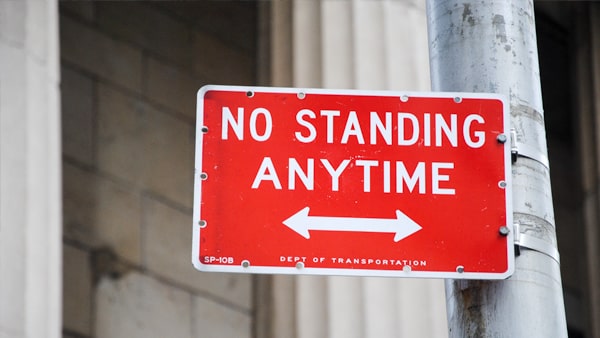
At a location posted NO STANDING, which temporary stop is permitted?

A "no standing sign" at a certain location means:
  1. A Stopping to wait for someone who has not arrived
  2. B Parking while the driver remains behind the wheel
  3. C Stopping briefly to receive or discharge passengers
  4. D Stopping to load or unload merchandise

Correct answer: C – Stopping briefly to receive or discharge passengers

Under Pennsylvania’s statutory definition, a prohibition on standing allows a vehicle to halt momentarily while passengers are actually being received or discharged. It does not allow waiting, parking, or loading merchandise. A NO STANDING sign prohibits standing or parking at that location subject to this passenger exception.

Source: 75 Pa.C.S. § 102 – Definitions, 75 Pa.C.S. § 3353(a)(2)(viii) – Prohibitions in specified places

Question 6

Under Pennsylvania law, when may you pass a vehicle on its right?

  1. A When it is preparing to turn right
  2. B When it is making or preparing to make a left turn
  3. C Whenever the shoulder is wide enough
  4. D Whenever it is traveling below the speed limit

Correct answer: B – When it is making or preparing to make a left turn

A vehicle making or preparing to make a left turn may be passed on the right when the movement can be completed safely. You may not drive off the berm or shoulder to make this pass. Passing on the right is also permitted on a sufficiently wide roadway carrying two or more lawful lines of traffic in the same direction.

Source: 75 Pa.C.S. § 3304 – Overtaking vehicle on the right