Pennsylvania Road Signs Test

4.7 out of 5 (155 votes)
80% Passing score
10 Questions
2 Mistakes allowed
Pennsylvania road sign questions are part of the learner’s permit knowledge test, not a separate road-sign exam with its own private scoring rules. That matters, because a lot of new drivers study signs as if they are just flashcard decorations—red octagons, yellow diamonds, green guide signs, fine, moving on—and then realize too late that PennDOT expects you to understand how those signs, signals, and markings actually work together on the road. The official Pennsylvania knowledge test is based on the Pennsylvania Driver’s Manual and covers traffic signs, Pennsylvania driving laws, and safe-driving practices. You get 18 multiple-choice questions. You need 15 correct answers to pass, which means you can miss up to 3. No separate road-sign-only passing score exists for the standard non-commercial learner’s permit test; sign questions are folded into that same 18-question exam. So, yes, road signs are only one part of the test. But they are the kind of part that can quietly cost you points if you treat them like common sense instead of test material. This Pennsylvania road sign practice test gives you a focused way to work through that material before you sit for the real PennDOT permit test. It is built around the kinds of details drivers are expected to recognize: sign shapes, sign colors, regulatory signs, warning signs, guide signs, traffic signals, pavement markings, and lane markings. Some of it will feel obvious. Some of it will feel weirdly easy to second-guess, especially when two answer choices sound close enough to be irritating. That is exactly why practice helps. The format is multiple choice, like the real Pennsylvania permit practice test, but the value is in the review afterward. When you miss a question, slow down and look at why. Was it the color? The shape? The wording? The difference between a warning and a regulation? Those little distinctions are what turn road sign practice from casual clicking into actual preparation. Use this PA sign test with the Pennsylvania Driver’s Manual, road sign charts, flashcards, or a broader PA permit practice test if you want a fuller study routine. PennDOT allows applicants who fail the knowledge test to retake it the next business day, but the better plan—plainly—is to know the signs well enough that retaking it never becomes part of your schedule.
FREE DMV Practice Test App
Study for your Pennsylvania permit test or driver’s license with the NextDoorDriving app. 700+ DMV questions and answers, 100% free!
Download on the App Store

Sample Pennsylvania Permit Test Questions

Question 1

A black-and-yellow chevron sign pointing sharply to the right warns that:
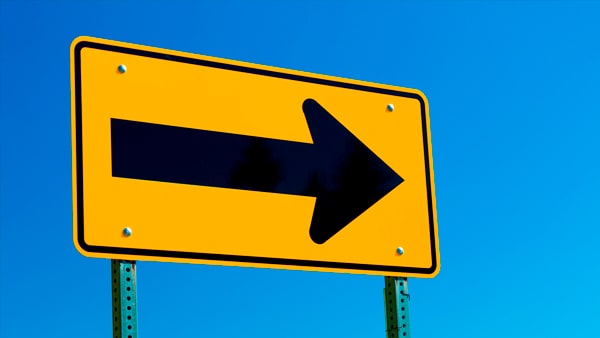
When you see this black and yellow sign, it means:
  1. A The roadway becomes one-way to the right
  2. B Construction traffic must detour to the right
  3. C The roadway changes direction sharply to the right
  4. D A side road enters from the right

Correct answer: C – The roadway changes direction sharply to the right

Pennsylvania uses chevron signs to mark a sharp change in the direction of the roadway, such as a curve to the right or left. The road bends in the direction the chevron points. Slow before entering the curve and follow the indicated change in direction.

Source: Pennsylvania Driver’s Manual — Ch. 2, “Chevron Signs”

Question 2

Which pavement marking helps drivers select the proper lane for a turn?

  1. A Red reflective markers along the centerline
  2. B Yellow lines along the right edge
  3. C White edge lines beside the shoulder
  4. D White directional arrows painted within the lanes

Correct answer: D – White directional arrows painted within the lanes

White pavement arrows indicate the direction of travel permitted or required from a lane. An arrow accompanied by the word “ONLY” identifies a lane reserved for the indicated turn. Drivers should enter the correctly marked lane before reaching the intersection and follow its assigned movement.

Source: Pennsylvania Driver’s Manual — Ch. 2, “Pavement Markings”, Pennsylvania Driver’s Manual — Ch. 3, “Signs and Pavement Markings for Lane Assignment”

Question 3

In Pennsylvania, what does a double solid yellow centerline indicate?

  1. A Either direction may use the opposite lane to pass when clear
  2. B Passing is prohibited for traffic traveling in both directions
  3. C The space between the lines is a shared left-turn lane
  4. D Both lanes carry traffic in the same direction

Correct answer: B – Passing is prohibited for traffic traveling in both directions

A double solid yellow centerline separates opposing directions of travel and prohibits passing by traffic in either direction. It does not identify a shared center turn lane. The driver’s manual states more generally that solid lines should not be crossed except when making a turn, but the double solid marking specifically bars passing.

Source: Pennsylvania Driver’s Manual — Ch. 2, “Pavement Markings”

Question 4

A two-way roadway has a solid yellow line and a broken yellow line, with the broken line next to your lane. When may you pass?

When the road is marked with a solid yellow line and a broken yellow line on your side you may pass:
  1. A Only during an emergency
  2. B Only when traveling on an expressway
  3. C When the passing path is clear and the maneuver can be completed safely
  4. D Only while traveling through an intersection

Correct answer: C – When the passing path is clear and the maneuver can be completed safely

The broken yellow line beside your lane permits passing when safe conditions exist. Before moving left, verify that the roadway is visible and free of oncoming traffic for enough distance to complete the pass without interference. The broken line does not override restrictions on passing near intersections, railroad crossings, obstructed curves, bridges, or tunnels.

Source: 75 Pa.C.S. § 3305 – Limitations on overtaking on the left, 75 Pa.C.S. § 3306(a) – Limitations on driving on left side of roadway, Pennsylvania Driver’s Manual — Ch. 2, “Pavement Markings”

Question 5

What does a steady circular green traffic light allow you to do?

  1. A Proceed without checking whether the intersection is clear
  2. B Stop before entering every intersection
  3. C Proceed through the intersection when clear, yielding as required
  4. D Travel straight only; turns are never permitted

Correct answer: C – Proceed through the intersection when clear, yielding as required

In Pennsylvania, a circular green signal permits you to proceed straight or turn right or left unless a sign prohibits the movement. You must yield to vehicles and pedestrians lawfully within the intersection or an adjacent crosswalk. The driver’s manual also directs motorists to proceed only when the roadway is clear.

Source: 75 Pa.C.S. § 3112(a)(1)(i) – Traffic-control signals, Pennsylvania Driver’s Manual — Ch. 2, “Red, Yellow, and Green Traffic Lights and Arrows”

Question 6

What hazard is indicated by a SHOULDER DROP OFF warning sign?

What should you be most concerned about when you see this sign?
  1. A Your headlights may become misaligned on the uneven roadway
  2. B Your tires will be damaged immediately if they touch the shoulder
  3. C Standing water is always present on the shoulder
  4. D You could lose control if your wheels leave the pavement onto the lower shoulder

Correct answer: D – You could lose control if your wheels leave the pavement onto the lower shoulder

The sign warns of a shoulder that is substantially lower than the roadway. If your wheels drop off the pavement, sudden braking or sharp steering can cause a skid or an abrupt sideways movement. Ease off the accelerator, maintain a firm grip, slow gradually, and return to the roadway gently after checking that the lane is clear.

Source: Pennsylvania Driver’s Manual — Ch. 2, “Shoulder Signs”, Pennsylvania Driver’s Manual — Ch. 3, “If Your Vehicle Drifts Off of the Pavement onto the Shoulder”