Take the real Texas written test online!

Texas DMV Practice Test

4.7 out of 5 (2877 votes)
80% Passing score
20 Questions
4 Mistakes allowed
A Texas DMV practice test is for anyone trying to make the Texas written test feel less like a pile of handbook pages and more like something they can actually handle. Teen drivers working toward a learner license, adults getting licensed for the first time, drivers moving in from another state, and older drivers brushing up before renewal can all use it for the same basic reason: Texas expects you to know the rules, and the test does not care how long it has been since you last studied them. This practice test includes 20 multiple-choice questions drawn from the areas Texas drivers are expected to understand: traffic signs, right-of-way, safe driving habits, distracted driving, alcohol and drug laws, vehicle equipment, and the everyday legal responsibilities that come with having a license. It is not just a quick memory drill, although, sure, memory helps. The better use of a Texas DMV practice test is to notice where the wording slows you down, where two answers seem almost right, and where the handbook rule you thought you knew turns out to be a little more particular than expected. The actual Texas Class C knowledge test is based on the Texas Driver Handbook and is multiple choice. In the practical learner-facing format, it has 30 questions, and you need 21 correct answers to pass, which is 70%. Road signs are included in the main knowledge test, not handled as a separate road-sign-only test for ordinary Class C applicants. So a useful Texas DPS written test practice should not camp out on one topic too long. It needs road signs, rules of the road, safety judgment, and those plain, official-sounding questions that somehow still manage to make people second-guess themselves. The licensing path depends on the applicant, and this is where the details matter. Teens can start driver education at 14, but they cannot receive a learner license until at least 15. Adults ages 18 through 24 need a 6-hour adult driver education course before testing for a first Texas license. Applicants 25 and older are not required to take driver education, though DPS recommends it for first-time drivers. Everyone still has to deal with the usual pieces: documents, fees, vision screening, and any required knowledge or driving tests. Aim for at least 16 correct answers out of 20 on this Texas permit test practice, then slow down and review the misses. That part is the real study session, honestly. Passing is the goal, but understanding why the correct answer is correct is what keeps the real DPS written test from feeling like a coin toss with fluorescent lighting.

Skip the DPS written test. No Joke.

Pass guaranteed — or your money back.

Learn More
Promotion
Learn More

Sample Texas Permit Test Questions

Question 1

An authorized emergency vehicle is approaching with required warning signals, and you are clear of an intersection. What must you do?
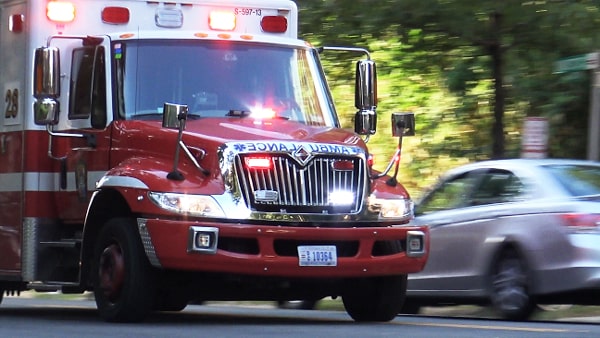
When you hear the siren or see the flashing red light of a closely approaching emergency vehicle, and you are not in the intersection, you should:
  1. A. Continue slowly in the right lane
  2. B. Accelerate to remain ahead of it
  3. C. Move as close as possible to the right edge or curb and stop
  4. D. Choose whichever action causes the least delay

Correct answer: C. – Move as close as possible to the right edge or curb and stop

Unless directed otherwise by a police officer, yield to the approaching emergency vehicle. Immediately move parallel to and as close as possible to the right-hand edge or curb, clear of any intersection. Stop and remain there until the emergency vehicle has passed.

Source: Tex. Transp. Code § 545.156(a)–(a-1) – Vehicle Approached by Authorized Emergency Vehicle
Question 2

At a Texas intersection where both streets carry two-way traffic, what may you do after stopping for a steady red signal?

  1. A. Proceed straight if no traffic is visible
  2. B. Turn left whenever the roadway is clear
  3. C. Turn right after yielding, unless a posted sign prohibits the turn
  4. D. Make any movement if the intersection appears empty

Correct answer: C. – Turn right after yielding, unless a posted sign prohibits the turn

After making the required stop and waiting until the intersection can be entered safely, a driver may turn right after yielding to lawful traffic and people in an adjacent crosswalk. A posted notice may prohibit the turn. A left turn on red is permitted only when both intersecting streets are one-way and the turn is otherwise lawful.

Source: Tex. Transp. Code § 544.007(d), (f) – Traffic-Control Signals in General

Question 3

Which situation calls for reducing speed and increasing your following distance?

You should usually drive slower when:
  1. A. You are passing a large truck on an open freeway
  2. B. You want a better view of a crash scene
  3. C. Traffic is crowded and brake lights appear several vehicles ahead
  4. D. Nearby drivers are traveling faster than you

Correct answer: C. – Traffic is crowded and brake lights appear several vehicles ahead

The Texas Driver Handbook advises slowing down and increasing following distance when the road is crowded. Brake lights several vehicles ahead provide advance warning that traffic may be slowing. Reducing speed early gives you more distance in which to respond without abrupt braking.

Source: Texas Driver Handbook — Ch. 8, “Speed”, Texas Commercial Motor Vehicle Drivers Handbook — § 2.4.1, “Seeing Ahead”

Question 4

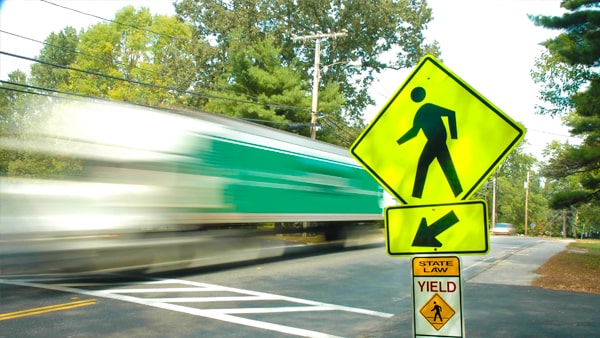
Under Texas law, a pedestrian is crossing your half of the road in an unsignalized marked midblock crosswalk. What must you do?

If a pedestrian is in a crosswalk in the middle of a block:
  1. A. Stop and yield the right-of-way
  2. B. Continue because the crosswalk is not at an intersection
  3. C. Proceed if you sound your horn first
  4. D. Pass any vehicle that has stopped for the pedestrian

Correct answer: A. – Stop and yield the right-of-way

A driver must stop and yield at an unsignalized crosswalk when the pedestrian is on the driver’s half of the roadway or is approaching closely enough to be in danger. A pedestrian may not suddenly enter when a vehicle is too close to stop. Drivers also may not pass a vehicle stopped at the crosswalk for the pedestrian.

Source: Tex. Transp. Code § 552.003(a)–(c) – Pedestrian Right-of-Way at Crosswalk

Question 5

When making a right turn at an intersection, where should your vehicle travel?

  1. A. Toward the left side of the roadway being entered
  2. B. Into the lane farthest from the right curb
  3. C. As close as practicable to the right curb or roadway edge
  4. D. Into whichever lane has the least traffic

Correct answer: C. – As close as practicable to the right curb or roadway edge

Texas law requires both the approach and the right turn to be made as closely as practicable to the right-hand curb or roadway edge. The driver handbook likewise instructs drivers to move into the far-right lane before turning and remain close to the right edge through the turn.

Source: Tex. Transp. Code § 545.101(a) – Turning at Intersection, Texas Driver Handbook — Ch. 6, “How to Make a Right Turn”

Question 6

Why should you maintain open space around your vehicle?

What is the benefit of a "space cushion" around your vehicle?
  1. A. It prevents every other driver from entering your lane
  2. B. It is necessary only when driving outside cities
  3. C. It gives you time and room to respond when something goes wrong
  4. D. It allows surrounding drivers to travel faster

Correct answer: C. – It gives you time and room to respond when something goes wrong

Space management is an important part of defensive driving. When something goes wrong, available space gives a driver time to think and take controlled action. It may provide room to brake or maneuver rather than responding with a sudden, unsafe movement.

Source: Texas Commercial Motor Vehicle Drivers Handbook — § 2.7, “Managing Space”, Texas Driver Handbook — Appendix A, “Glossary of Terms”